
 English
 Italiano
 Español
 Français
 Deutsch
 Português
 Русский
 Български
-1280x854.webp?v=munuc3c5)
-1280x854.webp?v=munuecl1)




-1280x853.webp?v=mv1dw0ut)
-1280x853.webp?v=mv1dw31y)
-1280x720.webp?v=mv1dw5mi)
-1280x720.webp?v=mv1dw86j)
-1280x720.webp?v=mv1dwb0g)
-1280x720.webp?v=mv1dwvpw)

You know the routine. Pencil, little brush, gel, then a squint in the mirror because the left brow has ended up higher than the right. Again. That's the person the question under our heading is aimed at, and if it's you, an eyebrow transplant in Turkey might be worth a proper look.
It won't give you a new face. What it does is put real hair back in the places it used to grow, so the pencil gets used less, or gets thrown out altogether.
Of all the hair work we do, brows are the smallest job by a long way: a few hundred grafts, where a scalp can take thousands. Funnily enough, that's exactly what makes them hard. With so few hairs, every single one is on show.
Why did your brows thin? That comes first
Before anyone talks about grafts, we want to know how the gaps got there.
Very often it's tweezers. Plenty of women plucked their brows to a thin line back in the nineties and early 2000s, and some of those hairs simply never came back. Then there are scars: a fall off a bike at seven, a windscreen, a dog that got a bit too excited. And for some people the brows just get sparser as the years go on.
A few causes are a job for a doctor rather than a surgeon, at least to begin with. When the outer ends of both brows fade away, an underactive thyroid is one of the things worth checking. Neat round bald patches can mean alopecia areata. In women, brows thinning at the same time as the hairline creeps back can belong to a scarring condition that needs treatment of its own. After chemotherapy, brows usually regrow by themselves. In all of these, putting grafts in first would be doing things backwards, and the new hairs might not last.
How many grafts for an eyebrow transplant?
Somewhere between 150 and 350 for both brows at full density. That's our published range. If you're only filling a gap in the arch or thickening a thin tail, you'll sit near the bottom of it, sometimes below. Building a brow back from almost nothing pushes you towards the top.
Nearly every graft is a single hair. Put two hairs together in a brow and you get a tiny tuft, which is the last thing a brow should have.
Where the new eyebrow hairs come from
From the nape of your neck, at the bottom of the scalp at the back. Hair there is the finest you've got, which makes it the nearest match to brow hair. And because a brow needs so few grafts, that area barely notices. If a hair transplant is on your list for later, your brows will hardly dent the supply.
Drawing the brow: arch, tail and the gap between
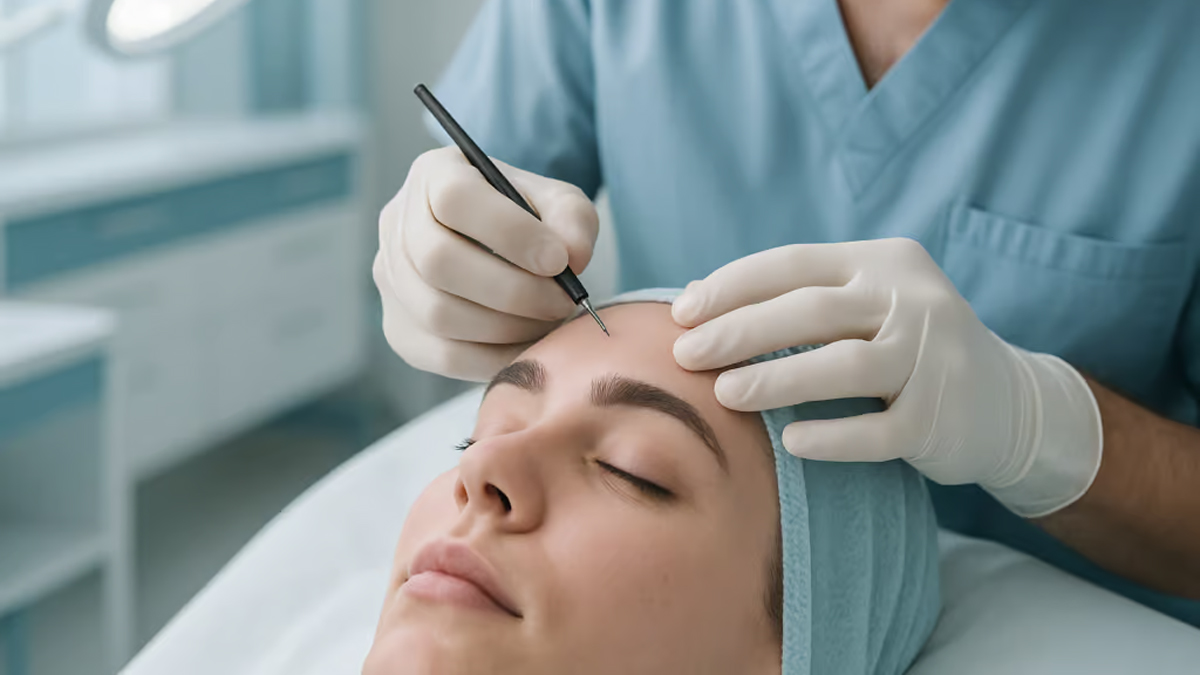
Your brows get drawn on before anything else happens. Nobody here pulls up a photo of a famous face and copies it. Your own features set the rules. A line up from the side of your nose past the inner corner of the eye roughly marks where a brow wants to start, the high point often lands somewhere above the outer part of the iris, and your cheekbone has a big say in where the tail finishes. Then there's the gap in the middle, which people nearly always want narrower than actually suits them.
Don't rush this bit. Look closely, then step back across the room. Frown at it. Raise your eyebrows. Laugh. You'll also notice the two brows aren't drawn as perfect copies of each other, and that's on purpose. Real ones never are, and a pair that mirror each other exactly tends to look painted.
A word on fashion, too, if you're planning an eyebrow transplant in Turkey around a trend. Brows go through phases: thin, thick, straight, sharply arched. Whatever's popular this year, transplanted hair stays where it's put.
Small numbers, nowhere to hide
In a scalp, one graft at an odd angle gets lost among thousands. In a brow, it's the first thing people see. That's why the section above talks about three hundred chances to get it wrong.
So the work is slow. Close to the nose the hairs point upward. Moving along the arch they begin to lean, and by the tail they're sweeping out and a little downward. Each graft goes in lying nearly flat, angled to match whatever would have grown beside it. It can be done with a DHI pen or with fine blades. Honestly, the patience of the person doing it counts for more.
Eyebrow transplant vs microblading
We get asked this all the time. Microblading, and brow tattooing in general, draws hair-like strokes with pigment. Done well it can look lovely. But it's flat, it fades within a year or two, and you keep paying to have it refreshed.
A transplant gives you hair you can touch, brush and shape, and it carries on growing. The downside is that growing part, which we'll come to. Quite a few people end up with both: grafts for shape and texture, a little tint or microblading to deepen the colour. Got an old brow tattoo? Grafts can usually go straight into that skin.
Does an eyebrow transplant hurt?
A bit, at the start. We won't pretend the anaesthetic injections are fun; they're a few sharp little pricks along each brow. Then the area goes numb and you mostly notice pressure, plus the odd tickle near your eyelids, which is the reason we're comfortable calling the procedure painless. Next day? Bruised-feeling, a bit tight across the forehead. A basic painkiller tends to cover it, but check with the team first.
Eyebrow transplant recovery
Picture every graft wearing a scab smaller than a grain of salt. Those dry out over the first two or three days, which is when most of the healing gets done, and by two or three weeks you'd struggle to see where anything happened. In between, think freshly over-plucked: pinkish, a little dotty, nothing dramatic.
Hands off. Seriously. Rub, pick or sleep face-first into a pillow and you risk knocking grafts loose. Brow pencil and tint can come back once we've said the skin's ready. Most office workers go back after a few days, and if you've got a pair of chunky glasses, now's their moment.
Eyebrow transplant results: the shed, then the slow return
About three weeks after an eyebrow transplant in Turkey, a lot of the new hairs drop out. People email us in a panic at this point. No need. The roots underneath are fine. Think of it as them having a lie-in.
Then, somewhere around the fourth month, wispy new hairs poke through, and over the next stretch they thicken up. Expect the full, natural look somewhere between nine and twelve months. Once they've grown in, the hairs generally stay, because they started life in the bit of your scalp that keeps its hair.
Trimming: the habit you're signing up for
Nobody mentions this enough. Those new hairs still think they're on your head, so they keep growing well past normal brow length. Which means trimming, every few weeks, for good.
Small scissors, a brow comb, two minutes in front of the mirror, done. For the first few months a clear brow gel helps train the new hairs to lie down. Ask anyone who's had it done and they'll usually say a quick trim is a better deal than the daily pencil.
Eyebrow transplant side effects
There's usually a little redness and puffiness around the brows for a few days, and sometimes the swelling slides down onto the upper lids. You might get some itching while the crusts come off, or a numb spot or two. All of that fades. Once in a while a hair grows out at an awkward angle; a snip and a bit of gel normally sort it. Infection is unusual, but if anything turns hot, swollen or properly sore, send us a photo that same day.
When the problem isn't the hair
Here's something worth ruling out. Brows can look sparse simply because they've slipped. With age the forehead loosens, the brows sink lower over the eyes and flatten out, and adding hair does nothing for that. If it rings a bell, talk to us about a brow lift before booking an eyebrow transplant in Istanbul.
Eyebrow transplant for men
More men ask about their brows than you'd guess. Usually it's a scar from rugby or boxing, a gap that's been there since school, or brows that have gone thin and patchy in their forties. Men's brows tend to sit lower and straighter, with less of an arch, and the design should keep it that way. Some men are already coming for a beard transplant and fix a brow on the same trip.
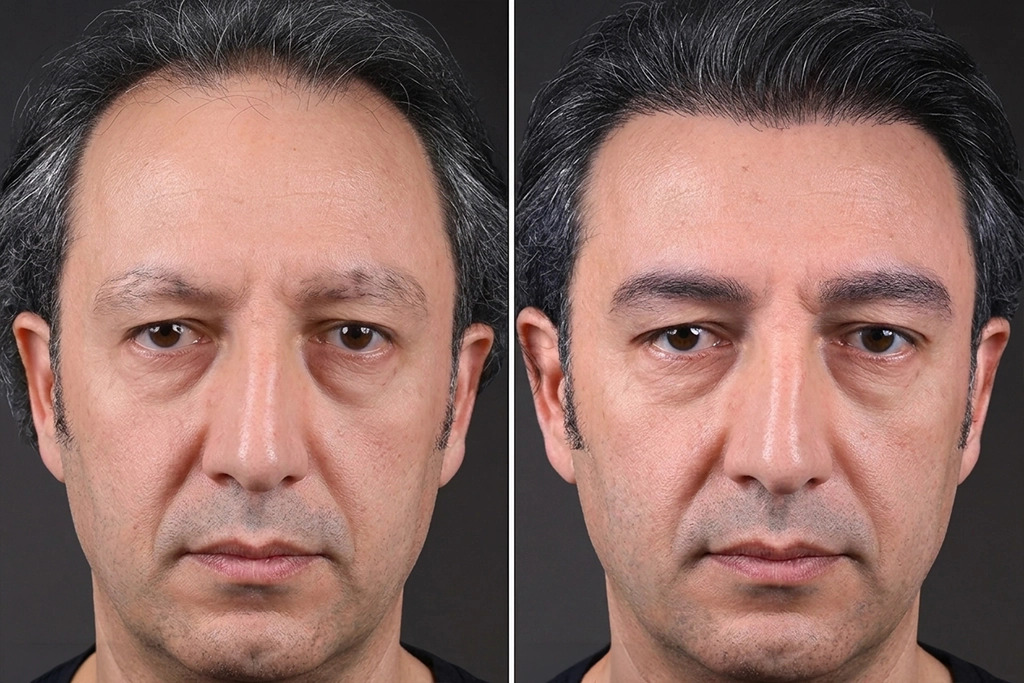
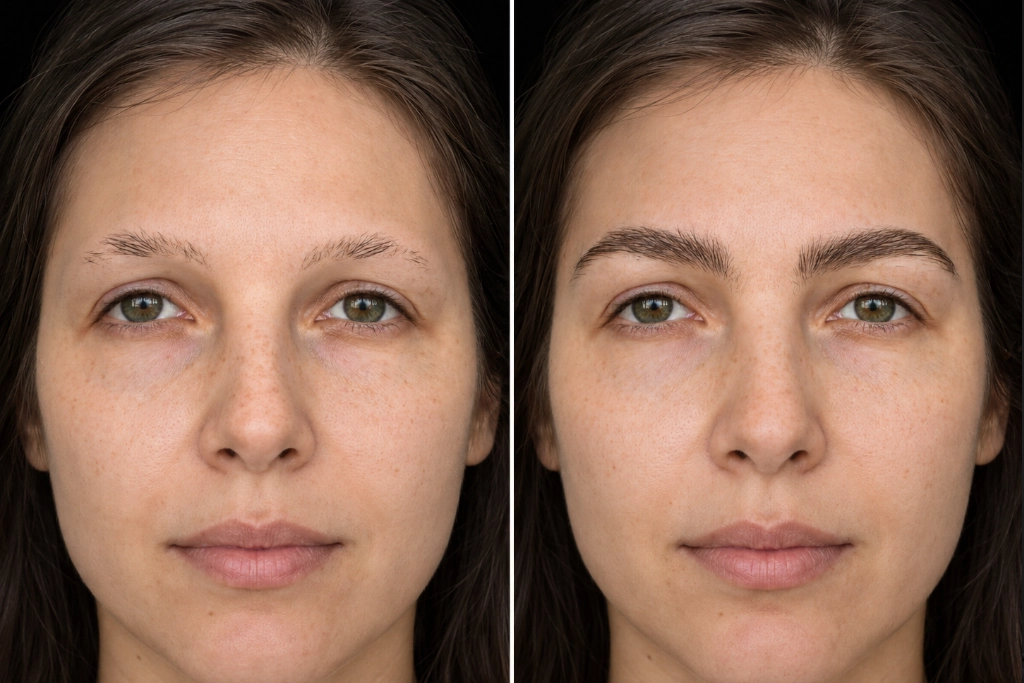
Close-ups, not galleries: eyebrow transplant before and after
Ask to see brows. Close up, and at twelve months. A scalp gallery tells you nothing about brow work, and a fuzzy before and after taken from across the room tells you even less.
When you do get a proper eyebrow transplant before and after, look at which way the hairs run, especially by the nose, where they ought to point up. Look hard at the tail, because that's where shaky work shows. And check whether the brows in the "after" have been trimmed; untrimmed transplanted brows look wild. Reviews from people whose brows started out like yours, like the stories above, are a good second opinion on what the before and after shots show.
What does an eyebrow transplant cost in Turkey? The price explained
Brows aren't on our euro price list, and that's on purpose: 150 grafts and 350 grafts are two very different jobs. Your design sets the eyebrow transplant price in Turkey, and we confirm the figure from your photos before you book flights. Transfers, an interpreter, the local anaesthetic and a year of follow-up are all included.
For a rough idea, typical eyebrow transplant cost elsewhere is €2,340 to €3,500 in the UK, €1,000 to €3,520 in Germany and €1,080 to €1,120 in the US. If you're comparing quotes, look past the price at the top. How many grafts is it for? What does the drawing look like?
Photos for your eyebrow estimate
Daylight, bare brows, no make-up, no filter. One photo straight on with a relaxed face, one with your eyebrows raised, then close-ups of each brow from the front and the side. Add one of the back of your neck, low down where the hair is finest. Let us know what you think caused the thinning, and whether you've had microblading or a tattoo. From that, our Istanbul team can sketch a design, give you a graft figure and tell you what your eyebrow transplant in Turkey would cost.