
 English
 Italiano
 Español
 Français
 Deutsch
 Português
 Русский
 Български
%20(1)-1280x854.webp?v=munxc92f)
%20(1)-1280x854.webp?v=munxd2s7)
%20(1)-1280x854.webp?v=munzp6s9)
-1280x854.webp?v=munxa717)
-1280x854.webp?v=munxao8e)





-1280x853.webp?v=mv1dw0ut)
-1280x853.webp?v=mv1dw31y)
-1280x720.webp?v=mv1dw5mi)
-1280x720.webp?v=mv1dw86j)
-1280x720.webp?v=mv1dwb0g)
-1280x720.webp?v=mv1dwvpw)

The question under the title is a good filter. If you always wear your hair longer at the back, the strip method might be worth a look. If you like a skin fade, it probably isn't. That single detail rules more people in or out of an FUT hair transplant than anything else.
FUT has an image problem. Almost every clinic in Turkey now leads with FUE, and the page above admits it will try to talk you into FUE first. So why does the strip method still exist at all? Because for a handful of people it still does a job nothing else does quite as well. Who those people are, what the scar actually looks like a year on, and how a strip and FUE can end up on the same team: that's what follows.
Is FUT outdated?
Not outdated, just specialised. For most people, FUE is the better choice: no linear scar, easier recovery and the freedom to wear hair short. That's why a strip hair transplant has become the exception rather than the rule.
But FUT's strengths haven't disappeared. When a strip is dissected under magnification, as the section above describes, almost every follicle in it can be used, and very few are damaged. And because the strip comes from a single horizontal band behind you, the donor hair above and below it is left untouched for later. In the right patient, those two advantages matter a great deal, and they're why an FUT hair transplant in Turkey is still offered here at all.
Who is FUT best for?
The FAQ above names the two main groups, and they're worth picturing.
The first is someone with extensive hair loss, perhaps Norwood 6, who needs as many grafts as possible over the course of their life. Taking a strip first yields a large number of grafts in one sitting while leaving the rest of the donor intact. A few years later, FUE can then be used from the areas above and below the scar. Used this way, strip and FUE together can provide more grafts over a lifetime than FUE alone.
The second is someone who has already had one or more FUE procedures, and whose donor area now looks thinner than it used to. Punching more grafts out of that area risks making it look patchy. A strip taken from the remaining density can supply grafts without spreading more small scars across an already-thinned zone.
A third, smaller group simply prefers it: people who always wear their hair long, don't mind a line they'll never see, and want the largest possible yield in one session.
Scalp laxity: how much can be taken
The pathway above mentions scalp laxity, and it decides how useful FUT can be for you. Laxity simply means how much the skin over your donor area can move. The looser it is, the wider the strip that can be removed and closed without tension, and the more grafts it will provide.
A tight scalp limits the strip to a narrower band. Closing a strip under too much tension is one of the main causes of a wide, stretched scar, so a careful surgeon takes only what the skin can comfortably close over. That's why laxity has to be checked in person, by feel, and why a firm quote for FUT comes only after assessment.
The FUT scar: what it really looks like
There's no way around it: FUT leaves a line. In the words of the section above, the line fades and narrows over months, and it doesn't go away.
In most well-healed cases, it's a thin, pale line running from roughly behind one ear towards the other. With the hair a few centimetres long, or longer, it's covered completely. With a very short clipper cut it may be visible, and with a shaved head it will be.
How narrow it heals depends on several things: how wide the strip was, how much tension the closure was under, your own skin and how you heal, and how carefully the wound was stitched. Some people form wider scars regardless of technique, which is worth mentioning if you've had stretched or raised scars elsewhere on your body.
Trichophytic closure
One technique helps a lot here, and it's worth asking about by name. In a trichophytic closure, the surgeon trims a very thin sliver from the edge of one side of the wound before stitching, so that one edge slightly overlaps the other. Hair follicles in that overlapped edge then grow up through the healing scar.
The result is a line with hair growing through it rather than a bare stripe, which makes it much harder to see even when hair is shorter. It doesn't make the scar disappear, but it's one of the most effective ways to make it less noticeable.
FUT without shaving
Here's an advantage of the strip method that often gets overlooked. Because grafts come from a single band, only that narrow strip of hair needs trimming, and the hair above it falls down over the stitches straight away. The rest of the donor area stays at its normal length.
For people who can't be seen with a shaved head, that can make FUT surprisingly discreet in the first weeks, especially if the recipient area can be treated among existing hair too. It won't suit everyone, but it's worth knowing that "no shave" isn't only an FUE option. The unshaven hair transplant page compares the discreet approaches.
FUT scar revision: can the line be improved?
Yes, in several ways. A scar that has stretched can sometimes be cut out and closed again more carefully, ideally with a trichophytic closure, which often leaves a narrower line. FUE grafts can be placed into the scar so hair grows through it. And some people choose scalp micropigmentation, a form of cosmetic tattooing that mimics tiny hair follicles, to blend the line into short hair.
None of these makes the scar vanish entirely. Together, they can make it hard to spot at almost any length.
What happens to the strip
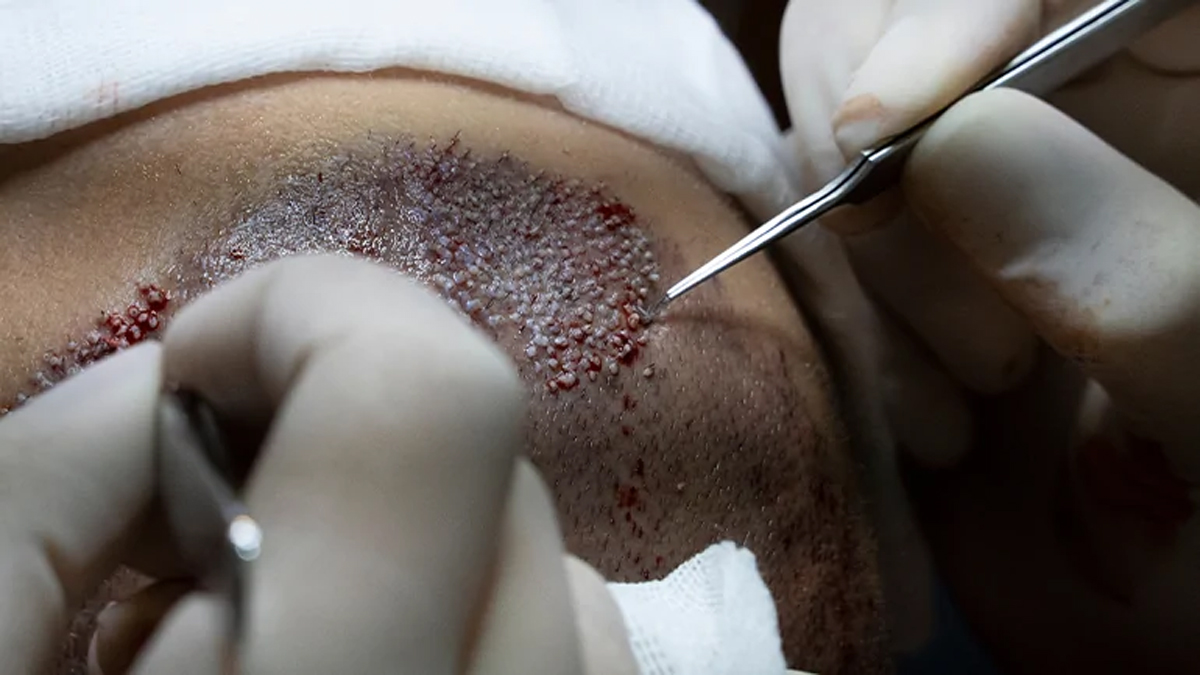
Once the strip is out and the wound is closed, a team works under magnification to divide it into individual follicular units, as the pathway above describes. This is slow, careful work: first into thin slivers, then into single grafts of one, two, three or four hairs, each trimmed and kept in a cool solution.
Because the follicles are cut out under direct vision rather than punched blindly from the surface, fewer of them are damaged along the way. Implantation then happens exactly as in FUE, into channels in the thinning area, which is why FUT results at the front look no different from FUE results. Only the donor area tells them apart.
FUT recovery: stitches, tightness and numbness
The front heals just as it would after any transplant. The back is where FUT feels different.
For the first days, the donor area usually feels tight, and bending your head forward or sleeping on your back can be uncomfortable. The stitches or staples stay in for a period set out in writing in your aftercare notes, as the pathway above mentions, often around ten days to two weeks. They can be removed in Istanbul if you're still here, or by a doctor or nurse at home.
Numbness above the scar is common and, as the section above warns, can last months as the nerves recover. Most people also avoid heavy lifting, intense gym sessions and anything that strains the neck for a few weeks, to protect the healing line from stretching.
FUT vs FUE: an honest comparison
The FAQ above summarises it, and it's worth putting side by side.
FUT gives the largest single-session yield and uses a limited donor very efficiently. It leaves one linear scar, needs stitches, and has a slightly longer, tighter donor recovery. FUE gives scattered dots instead of a line, lets you wear your hair very short, and has an easier donor recovery, but it spreads small scars across a wider area and uses up more of the donor zone to reach a similar total.
Neither is better in general. The FUE hair transplant page explains the extraction side in detail, and the hair transplant overview covers how the technique is chosen for each case.
Combining FUT and FUE
Some of the best long-term plans use both. A strip first provides a large number of grafts from the centre of the donor zone. Later, FUE can harvest from the areas above and below the scar. And FUE grafts can even be placed into the scar itself to camouflage it further.
This isn't something most people need. For someone with advanced hair loss and a long future ahead, though, it can make the donor supply go considerably further.
A second strip
If you've had FUT before, a second strip is often taken so that the old scar is removed within the new one. That way you still end up with a single line rather than two. Whether that's possible depends on how much laxity is left after the first procedure.
FUT hair transplant before and after: ask for the scar
With FUT, the most important before and after photo isn't of the hairline. It's of the donor scar, a year on, with the hair wet or cut fairly short so the line is visible. That's the photo that tells you how well the strip was closed and how it healed. Reviews from long-term FUT patients who talk about wearing their hair short are especially telling.
FUT hair transplant cost: how the price is set
According to the section above, the FUT hair transplant price is quoted per case after your scalp laxity and donor area have been assessed, because the strip width and the number of grafts it yields vary from person to person. The written quote covers transfers, local anaesthesia, an interpreter and a year of follow-up. For a rough benchmark, the comparison table lists what the same kind of surgery tends to cost in Britain, Germany and America.
Choosing a clinic for FUT
The page above makes a sharp point: because almost all transplants in Turkey are now FUE, a clinic that still performs strip well is harder to find. Dissecting a strip and closing the wound neatly are skills that need regular practice.
So ask how many strip procedures the team performs, who does the dissection, what closure technique is used, and whether you can see photos of healed donor scars, not just the hairlines. The section above deliberately includes donor scar photos for exactly that reason.
Photos for an FUT assessment
For FUT, the donor side tells the story. Photograph the rear of your head and each side twice: once at your normal length, once with the hair lifted or parted to expose the skin. Had FUE or FUT before? Then add sharp close-ups of those spots. Mention how short you like to wear your hair. From that, our team in Istanbul can judge whether an FUT hair transplant in Turkey suits your donor, or whether FUE is the better route after all.