
 English
 Italiano
 Español
 Français
 Deutsch
 Português
 Русский
 Български
-1280x854.webp?v=mumjoqm4)
-1280x854.webp?v=mumjkmp7)
-1280x854.webp?v=mumjlp18)











All-on-4 is often sold as the budget full-arch option. That isn't how it started. It goes back to the late 1990s and a Portuguese dentist called Paulo Maló, who was working with Nobel Biocare. His problem was a common one. Patients who'd lost their back teeth years earlier rarely had much bone left back there. Fixed teeth meant a graft, then months of waiting, sometimes more than a year. His answer was to leave the back of the jaw alone and work with the bone at the front, which tends to hang around much longer.
So the technique began as a fix for a particular kind of jaw, and it's still excellent at that. In a jaw without that problem, it's one option among several, and not always the best one.
Built around the bone that stays
Bone loss after extractions is patchy. Up top at the back, the sinus sinks into the gap. Down below at the back, the ridge gets thinner and thinner over the nerve. The front of both jaws usually holds on to its bone for much longer. That's why a long-term denture wearer can have a reasonably solid ridge behind the front teeth and almost nothing to work with behind the canines.
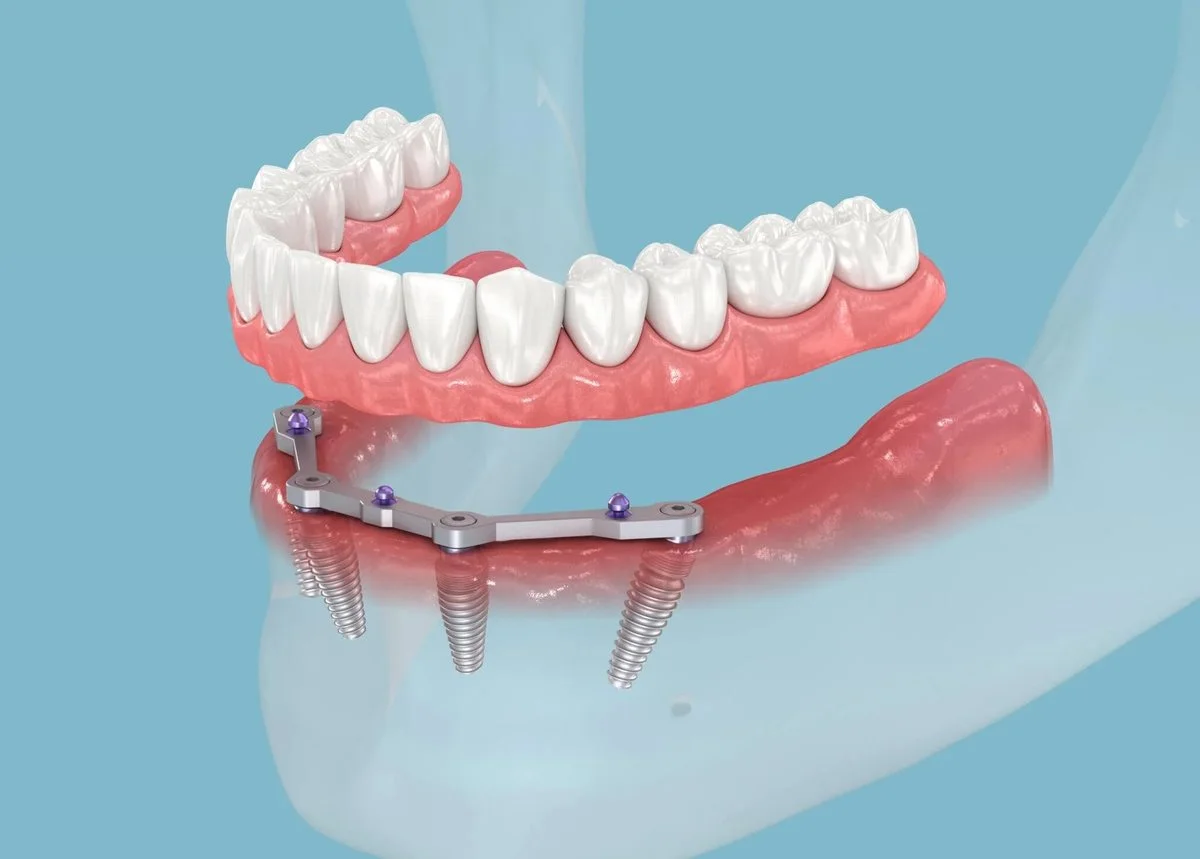
The four implants follow that pattern. The two at the front go in upright. The back pair lean forwards. Their heads come out around the premolars, but the bodies dig into firmer bone nearer the front. The angle itself is covered higher up the page. What it gets you is reach: tilted, the top of each implant ends up further back than a straight one could in the same bone, so the four are spread wider. That spread is what allows one bridge to sit on only four implants.
The overhang at the back
Even tilted, the rearmost implants rarely get past the premolars. A typical arch has ten or twelve teeth on it. Count back and you'll find one, maybe two, at each end with nothing underneath. They extend backwards from the last implant, a bit like a diving board. That unsupported section is called the cantilever.
Some cantilever is normal on this design and perfectly safe when it's kept short. The trouble starts when it's too long. Those end teeth act like a lever. Chew on them and the load lands on the last implant and the screw on top of it. If the lever's too long, screws work loose and bridges crack. It's one of the most common things we're asked to repair.
Good planning keeps that overhang short, even if it costs you a back tooth. Comparing clinics? Ask each one how far the bridge sticks out beyond the last implant, and why.
The line you shouldn't see
This is something few patients think about until it's pointed out. The bridge doesn't just replace teeth. It has a strip of pink gum built in, and somewhere that pink meets your real gum. Let that seam show when you smile and even perfect teeth look fake.
That's why the smile gets checked before the bone does. If you're someone who flashes a lot of gum when you laugh, the seam has to go higher, tucked up behind the lip. The surgeon often trims the top of the ridge a little to make space for the seam and the bulk of the bridge. Yes, that means taking bone away in an operation meant to work around bone loss. People do raise an eyebrow. But shaving off a few millimetres is often what stops the bridge looking chunky.
It's also why the teeth are designed before the implants are positioned, as the pathway above describes. The lip support, tooth length and smile line come first.
What All-on-4 costs in Turkey, and why quotes differ
What moves the price? Mostly the implant brand. The list above runs from a Swiss system up to Straumann, and the same four implants can cost quite different amounts depending on whose name is on them. After that it's one jaw or two, how many teeth need taking out on the day, and the final bridge. The night guard is extra, as you'll have seen.
Plenty of people come to us after a quote at home for several times as much. That gap is real. Still, cheap All-on-4 in Turkey isn't hard to find either, so read any quote closely. Does it name the implant system? Does it include the acrylic provisional and the zirconia arch, or only one of them? Are both trips covered? If the answer to any of that is vague, ask again.
Upper and lower aren't the same operation
On the lower jaw, the landmark that matters most is the nerve that gives feeling to the lip and chin. It comes out of the bone through a small opening on each side, somewhere under the premolars, and the back implants are angled to finish just in front of that point. Lower-jaw bone is usually dense, which tends to help the implants grip firmly on the day.
The upper jaw is softer bone, and the sinus is the obstacle. Here the back implants run forward along the front wall of the sinus. The upper arch also has a cosmetic job the lower one doesn't: it supports the upper lip. Someone who has worn a denture for years has often been relying on its plastic flange to hold the lip out, and the new bridge has to take that role over. It's one reason upper arches take more design work, even when the surgery itself goes smoothly.
Surgery day, teeth within days, and All-on-4 recovery
For many All-on-4 patients, the teeth still in the jaw come out at the same appointment the implants go in. That makes for a long session. It's usually done under local anaesthetic. Not keen on being awake for all of it? Ask about sedation early, ideally before the flights are booked, not on the morning.
When the last implant is in, someone records exactly where each one sits. These days that's often done with a small handheld scanner, sometimes with an old-fashioned impression, and the lab builds your provisional arch from it. Depending on the case, it may be screwed in the same day or a day or two later, which is why the pathway above says "within days" rather than promising hours. In the meantime you won't be left without teeth.
Ask people a week later how it went and you tend to hear the same two things. It hurt less than they'd braced themselves for, and nobody had quite warned them about the swelling. That usually goes down over about a week. By the flight home, most are managing soft food without much trouble.
The first arch you wear
What you leave Istanbul with is the provisional arch, made of acrylic and screwed to the implants. After years of a denture that shifted every time you laughed, a lot of patients say those first days with fixed teeth are the best part of the whole treatment.
It isn't built to last, and it doesn't need to be. For the next few months we'd rather you didn't test it on crusty bread, nuts or toffee, since acrylic is a good deal softer than what comes later. Chips do happen now and then. Annoying, yes. Urgent, no. They're normally fixed quickly.
Keep track of whatever bugs you while you wear it. How your lips sit over it, how you speak, where you bite, what feels too long or too bulky: tell the team, because all of it feeds into the final arch. The months you spend in the provisional are part of the design process, not just a waiting period.
Zirconia, and what it asks of you
The permanent arch comes later, once the implants have taken and the gum has stopped changing shape. It's milled in one piece from zirconia, far tougher than acrylic, and it shrugs off the coffee and red wine stains that acrylic picks up. It stays glossy, too, which acrylic doesn't really manage.
It's also very hard. If your opposite jaw has natural teeth, the bite has to be balanced carefully so those teeth aren't worn down against it. Grinders are the other concern. A bridge this hard doesn't absorb anything, so whatever force you put through it at night goes straight into the implants and screws. A night guard helps with that, which is why you'll see it priced separately in the list above. One more small thing: when zirconia bites on zirconia, some people hear a faint click at first. Most stop noticing within a few weeks.
Judging All-on-4 results: photos and reviews
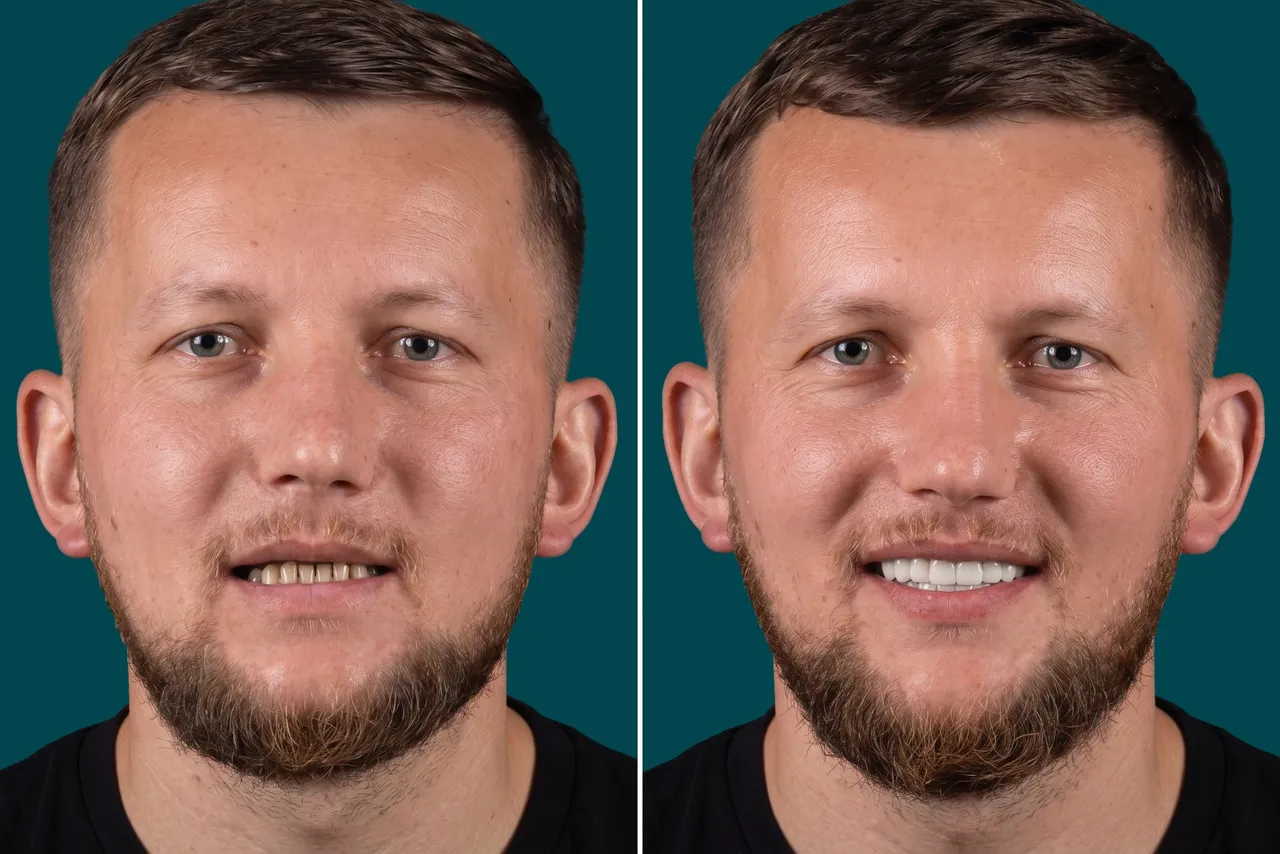
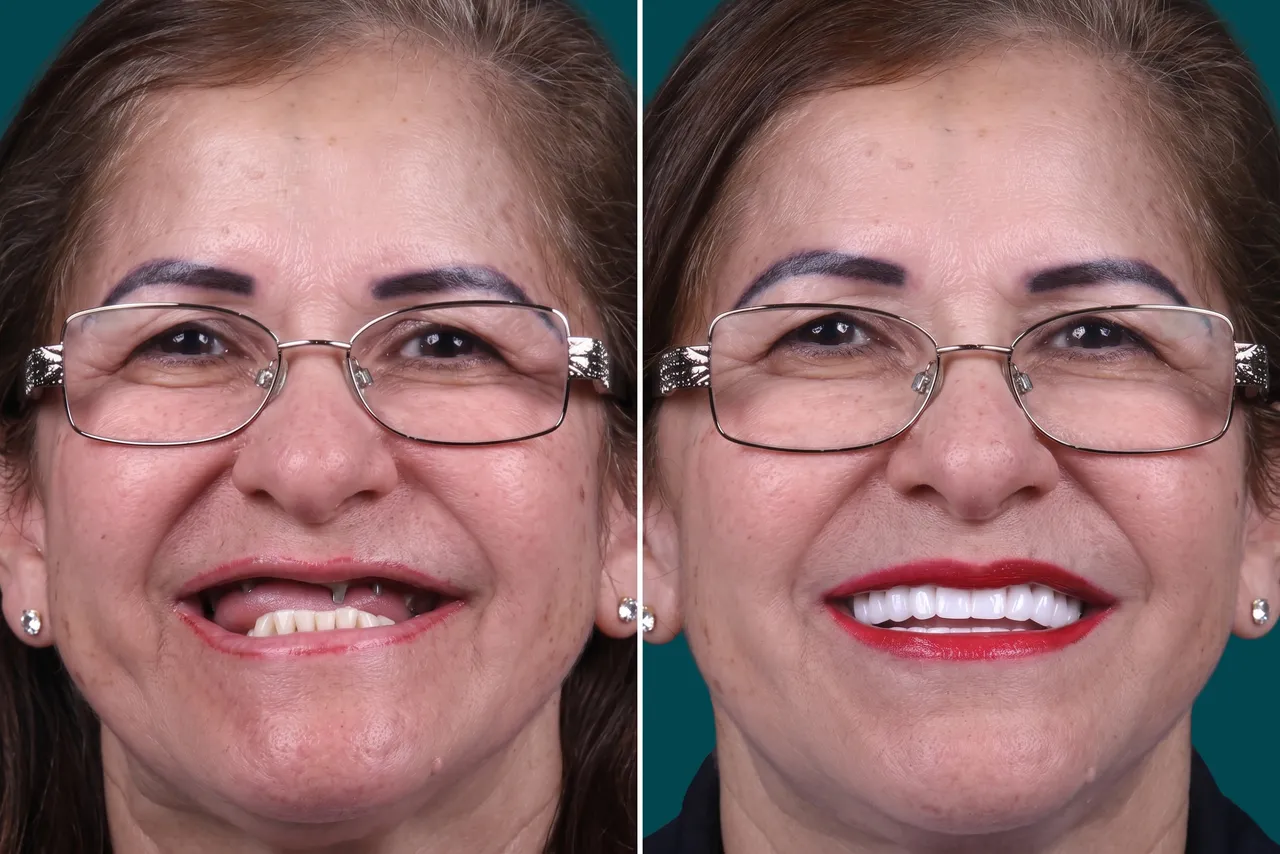
Most All-on-4 before and after photos look impressive. Teeth that were failing, then a full white arch. So look past the teeth. Can you see where the pink meets the real gum when they smile? Is the "after" the zirconia arch or still the provisional? Does the lip look supported or a bit sunken? Reviews help as well, though the useful ones come from people a year or two in, after they've lived with the final bridge for a while.
Having the bridge taken off
Because the arch is screwed in rather than cemented, a dentist can remove it. From time to time, it's worth having that done at a check-up so the implants, the gum underneath and the screws themselves can be looked at and cleaned properly. It's a routine appointment and shouldn't be painful.
If you have your check-ups at home, the dentist there will need to know which implant system and which screws were used before they can take the bridge off safely. Bring that information along rather than leaving them to work it out.
All-on-4 vs All-on-6, and when four isn't enough
All-on-4 earns its place in a jaw where the back bone has gone and grafting would add months, or a year, before teeth could go in. It's also a sensible choice when surgery needs to be kept as short as possible for medical reasons.
It's less convincing in other situations. If your bone would comfortably take more implants at the back, spreading the load over six supports usually gives the arch more margin, and All-on-6 explains when that extra margin is worth having. Very heavy grinders are often better served with more supports too. At the other extreme, if even the front of the upper jaw has resorbed, there may not be enough bone for four implants at all, and zygomatic implants may be the next question. And if some of your own teeth are still sound, they may be worth keeping, which is a conversation for full mouth dental implants rather than here.
So, why four? If your bone is the reason, All-on-4 has a long track record behind it. If the only reason is that it was the lowest figure on the quote, look at your scan with the surgeon first.