
 English
 Italiano
 Español
 Français



Bone Work, Not Only Implants
Genioplasty, chin implants and submental liposuction are all performed in this building, by surgeons who do each of them regularly.
Genioplasty in Istanbul · Quoted After Imaging
Does your chin need to move forward, back, up or sideways?
Genioplasty repositions the chin bone itself, so it can correct length and asymmetry that an implant cannot address. The surgeon plans the movement on X-rays and fixes the bone with small plates. Because the correction differs for every face, your price is confirmed after imaging.
Natural Clinic brings multiple fields of specialised healthcare together under one roof, combining medical expertise, advanced technology and patient-focused care. From hair transplantation and dentistry to facial, body and breast aesthetics, bariatric surgery and reconstructive treatments, every patient journey is managed by experienced medical teams working across disciplines.
1200+ — Advanced treatments across multiple medical specialties
50+ — Experienced specialists working across disciplines
360° — Consultation, treatment, recovery and aftercare coordinated under one roof
150+ — Large-scale medical infrastructure in Istanbul
Genioplasty gets described as a more serious chin implant, which misses what actually separates them. This is bone surgery rather than material placement, and that buys a capability an implant simply does not have — paired with a consequence an implant does not carry.
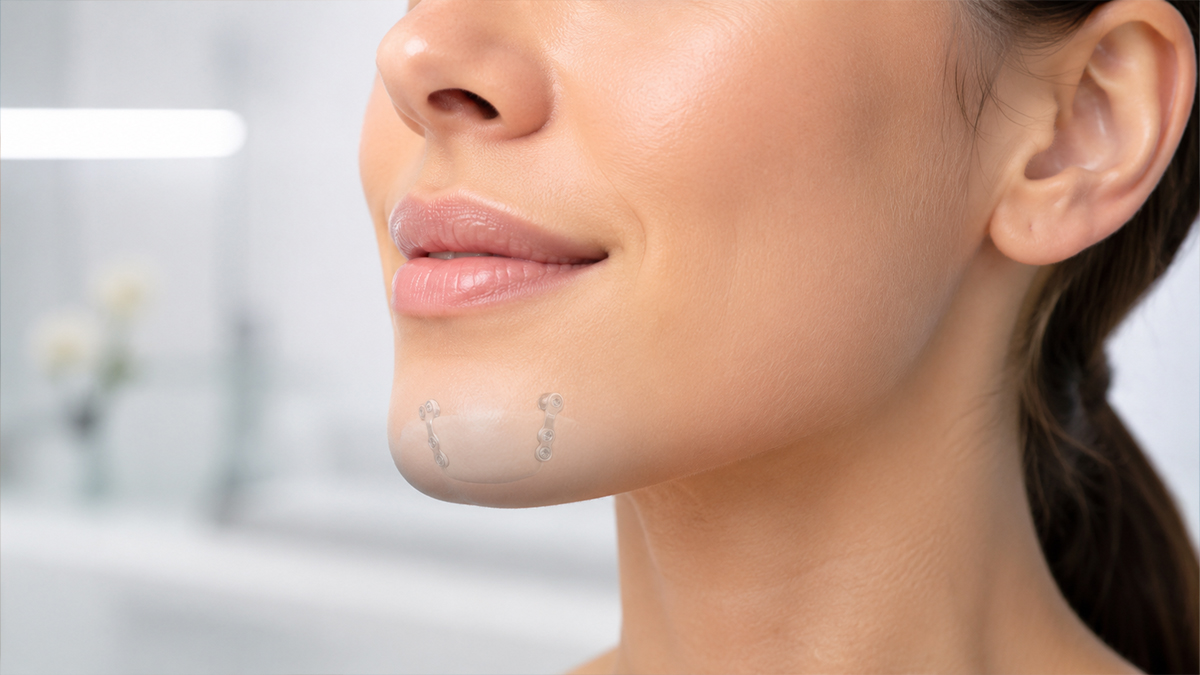
Moves the bone · quoted after CT
A precise horizontal cut frees the lower segment of your chin bone so it can move forward, back, up, down, or sideways, then titanium plates hold it in its new position while the bone heals. Planning happens on imaging before theatre, not by eye.
A chin sitting off your facial midline — a position problem, not a volume one. An implant added over a crooked bone leaves it crooked; only moving the bone corrects it.
Quoted after your CT scan, since cut length, segment movement and plate count are surgical decisions. Osseous union takes six to eight weeks.

Plastic Aesthetic and Reconstructive Surgery
Dr Emre G. qualified in medicine at Uludağ University in 2007 and completed his specialist training in plastic, reconstructive and aesthetic surgery at Bezmialem Vakıf University between 2008 and 2014, with a research post at the University of Wisconsin School of Medicine and Public Health. He has worked in both public hospitals and private practice, and the reconstructive half of that training shows in how he plans an aesthetic case. He practises at Natural Clinic in Istanbul.
Education
Short answer: yes, and what to verify is the planning. Placing an implant is a skill most surgeons have; cutting the jaw and fixing it in a new position is a narrower one. Ask to see the CT, ask which direction the segment is being moved in, and ask whether an implant would have achieved the same thing.
Genioplasty, chin implants and submental liposuction are all performed in this building, by surgeons who do each of them regularly.

The cut line, the millimetres, the direction and the plate positions are decided from your own scan. All of it goes in your written plan.

Lower operating, staffing and facility costs plus the exchange rate produce a real difference against the €7,000–€15,000 genioplasty commands elsewhere.

The longest trip of the chin operations: six to eight days, with a night in hospital and the pre-flight check at about day seven.

An international patient team coordinates every appointment in English, with Dutch-speaking coordination on request.

Ministry of Health licence, the operating surgeon's board registration, logged sterilisation cycles and an independent anaesthesia review.
Genioplasty can move the chin in directions an implant never can. Here is how that movement is planned and healed.
Forward, back, up, down or even sideways — a sliding genioplasty can move bone in any of these.
Your plan shows where the bone segment will be cut and how small titanium plates will hold it.
Access is through the inside of the lower lip, so there's no external scar.
With a wound inside the mouth, a soft diet and rinsing after eating keep the area clean.
Lip and chin numbness usually resolves gradually as the bone knits.
A sliding genioplasty reshapes the chin without an implant. Here is what to expect.
Genioplasty, often called sliding genioplasty, is chin surgery in which the lower part of the chin bone is cut, moved into a new position and fixed with small titanium plates and screws. Because your own bone is repositioned, no implant is needed to change the chin's projection or height.
Genioplasty can move the chin forward to increase projection, backward to reduce a prominent chin, upward or downward to change facial height, and sideways to correct asymmetry. This flexibility is the main advantage over a chin implant, which can only add forward projection.
Genioplasty suits people who need more than simple forward projection, such as those with a long or short chin, an asymmetric chin or a significant deficiency. Candidates should have a stable bite and healthy teeth, and bone quality is assessed with imaging before surgery.
Genioplasty is quoted after your profile and imaging have been assessed, because the amount and direction of bone movement affect the complexity of the operation. The confirmed price, including anaesthesia, hospital care and follow-up, is provided in your written plan before travel.
Genioplasty is generally a more involved operation than placing a chin implant, as it requires cutting and fixing bone. Your plan compares the options that suit your anatomy, so you can see whether the added flexibility of genioplasty is worthwhile for your goals.
Yes. The titanium plates and screws used to hold the repositioned bone are part of the genioplasty procedure and are included in the quoted price. They normally remain in place permanently and do not need to be removed. In rare cases they may be removed later if they cause irritation.
No. Genioplasty is performed through an incision inside the mouth, along the inner surface of the lower lip, so there is no visible scar on the face. The internal incision heals within the lining of the mouth. Dissolvable stitches are typically used, so no external stitch removal is needed.
The mental nerves, which supply sensation to the lower lip and chin, run close to the area where the bone is cut. Temporary numbness or tingling is common after genioplasty and usually improves gradually as the nerves recover over weeks to months.
After the chin bone segment has been moved into its planned position, it is secured with small titanium plates and screws. These hold the bone steady while it heals, much like a carefully planned fracture, and the bone typically fuses in its new position over the following weeks.
Genioplasty is usually completed within a few hours under general anaesthesia, depending on the complexity of the movement required. Your surgeon provides an estimated operating time for your case during planning. Complex movements, such as correcting asymmetry, may take longer than a simple advancement.
Genioplasty patients usually stay in Istanbul for about a week, so the intraoral incision, swelling and bite can be checked before flying. The final review confirms that healing is progressing well and that you are comfortable to travel. Keeping the mouth clean during this week is especially important.
You can usually fly home once your surgeon has confirmed that swelling is manageable, the incision inside the mouth is healing well and there are no signs of infection. This is typically assessed at a review around the end of the first week.
A soft or liquid diet is recommended in the early days after genioplasty to avoid putting pressure on the healing bone and to protect the incision inside the mouth. Rinsing with the prescribed mouthwash after each meal helps keep the area clean.
The repositioned chin bone usually heals over several weeks, although it continues to strengthen for some months. Contact sports and activities that risk impact to the face should be avoided until your surgeon confirms that healing is sufficient. A follow-up review confirms that the bone is healing in the planned position.
Genioplasty changes the position of the chin but not the teeth. Temporary swelling and numbness can make the lower lip feel different while smiling in the first weeks, but lip movement and smile usually return to normal as swelling settles and sensation recovers.
The first link is the cheaper operation this page competes with, and the second is the one for fullness that turns out to be fat rather than bone. The hub page compares all three chin approaches side by side if you are still deciding.
Personalised Care, Just for You
Send a photograph straight on and one in true profile — the profile shows projection, the frontal shows the midline. A facial surgeon reviews your case and replies with a realistic, itemised plan — whether this is a bone case or whether the €4,200 implant would achieve the same thing, which directions the segment would move in, what imaging is needed, what it costs with free transfers and the hotel arranged, and how many nights you'll be in Istanbul. No obligation, no pressure, no cost.
Get My Free Surgical Plan100% Confidential & Secure
Reply Within 24 Hours
Reviewed by Board-Certified Surgeons
Genioplasty is the more invasive and the more expensive of the two chin augmentation operations, and for a large share of the people who arrive asking for it, a chin implant would achieve the same visible result with less surgery. What follows is written to help you tell the two apart.

Look at the question under our heading. Your answer to it decides whether you need genioplasty in Turkey at all. If all your chin needs is a little more forward projection, a chin implant usually does the job with less surgery, and we'll tell you so. Genioplasty in Turkey makes sense when the answer involves another direction: back, up, down, or across to the middle of the face.
That's why plenty of people who enquire about genioplasty go home with an implant instead. The chin surgery overview compares the options. This page is for the cases where bone really does need to move.
Sliding genioplasty is the most common form, and the name describes it fairly well. Working through a cut inside the lower lip, the surgeon makes a horizontal cut through the bottom of the chin bone, below the roots of your lower teeth. That lower piece is then free to slide into its new position, where it's held with two small titanium plates and a handful of screws.
There's no scar on your face, since all of it is done from inside the mouth. Osseous genioplasty and chin bone surgery are other names for the same thing.
Before anything is booked, we look at a CT scan of your jaw. It shows where the tooth roots sit and where the nerve supplying your lower lip exits the bone. The cut line and the exact movement, down to the millimetre, are decided from that scan and written into your plan. You get a copy, so you can see exactly what's proposed before you agree to anything.
A genioplasty planned from photographs alone is guesswork. If another clinic quotes you without imaging, it's fair to ask how they've decided what to move. If you already have a CT from a dentist or another clinic, send it, as it may save you a scan.
Most genioplasties bring the chin forward. For a small change we'd usually suggest an implant instead. Bone is the better choice when the chin is very short, or when its shape has to change as well, and moving it forward tends to tighten the area under the chin too.
Many advancements are combined with a small change in height, because a chin that's both short and set back is common.
Not everyone wants more chin. An implant can't make a chin smaller. Chin reduction surgery pushes the segment back, or takes out a thin wedge of bone to shorten it. Some chins need both.
Much of the reason genioplasty in Turkey gets chosen over an implant comes down to this. Reducing a chin with bone surgery keeps the soft tissue in a natural relationship with the bone, which looks better than shaving the front of the chin away.
Some faces look long in the lower third, others look compressed. Changing the height of the chin can rebalance that. A long chin can be shortened, as above. A short one can sometimes be lengthened by moving the segment down, occasionally with a small bone graft in the gap.
These vertical changes can't be made with an implant at all, so if your concern is about length rather than projection, bone is usually the answer.
This is the case that most clearly needs bone. Put an implant on a crooked chin and you get a larger crooked chin. Moving the bone itself is what centres it. Send a front-on photo for this, taken in daylight with your head level.
Many men want a broader, stronger chin. A lot of the women we see want the reverse, and some come to us as part of facial feminisation surgery, where genioplasty is one of the most useful steps. Either way, the plan comes from your own scan.
The plates hold the two pieces together while the bone knits, which takes six to eight weeks. Afterwards they stay put, and most people never feel them. If one does cause trouble later, it can be taken out.
The wound is inside your lower lip, so for two to three weeks it's soft food, with a rinse after every meal.
Your lower lip will probably feel numb or tingly. The mental nerve sits just above the cut and gets stretched even when it isn't touched; it usually recovers in one to three months, though a few people keep some change. Your smile can feel stiff for a few weeks too, while the lip muscles heal.
It's a well-established operation, and serious problems are uncommon. The main risk is a lasting change in feeling in the lower lip, which affects a small number of people. Infection is rare, and now and then a plate needs taking out later.
Your face has to have finished growing. That's confirmed for each person rather than set by a birthday, but it usually means the late teens at the earliest.
We'll ask smokers to stop for a while before and after, since smoking holds the bone back. A gum or tooth infection has to be cleared first. Braces are worth mentioning too, and if your teeth don't meet properly, jaw surgery might suit you better than a chin operation.
You'll have one night in hospital, then six to eight nights for genioplasty in Istanbul, with a check before you fly at about day seven. Swelling peaks around days two to four, and a scarf covers the bruising under the chin. Around the two-week mark most people feel fine about being seen. You can do light things again at two to three weeks. The bone has knitted by six to eight weeks, and the chin's shape carries on settling for about six months.
Not as much as most people fear. Expect an ache and a tight feeling for a few days, which normal painkillers cover. The numb lip actually blunts some of the soreness. Most of the discomfort comes from swelling, so a couple of extra pillows at night make a difference.
Desk work is usually fine from about two weeks. Talking a lot can be tiring at first, because the lower lip is stiff. You can walk around from the first day or two, while the gym tends to wait until around four weeks. Contact sport has to wait until the bone has fully healed and the surgeon has checked it.
Usually they notice something without being able to name it. Friends often just say you look healthier, or rested. The biggest change is often in photos, so take your own before and after pictures, always from one angle and in one kind of light, to compare later.
Yes. Once the bone has healed in its new position, there's nothing to wear out or replace, unlike an implant. Your chin then ages along with the rest of your face. If you're unhappy with the result, changing it means another operation, so it's worth taking time over the plan, and that is reflected in the price being set only after imaging.
Not in the way an implant can be taken out. The bone can be moved again in a second operation, but that's a bigger undertaking than the first. It's one more reason we plan conservatively and agree every millimetre with you beforehand, using the scan to show you exactly where the chin will end up.
If you already have an implant that has slipped or never looked right, it can often come out in the same operation that reshapes the bone. Let us know what type it is and when it went in, and send any notes.
The chin and nose are judged against each other in profile, so genioplasty is often planned alongside rhinoplasty. Both can be done under one anaesthetic, though you'll need the longer genioplasty stay. If there's also fat under the chin, chin liposuction can be added in the same sitting, and the before and after difference to the jawline is often greater than either would give alone.
Front views are the place to start. The chin point should sit in the middle of the face, and the lower lip shouldn't look pulled. Side-on, the line from lip to neck should be smooth.
Ask to see before and after cases with the same movement as yours. Patient reviews are a good place to find out how long the numbness lasted.
Genioplasty has no fixed list price, since every movement plan is different. Your price is confirmed in writing after the CT has been reviewed. Plates, screws, anaesthesia and the hospital night are all included, and so are transfers, a translator and a year of check-ins.
The table above has prices from other countries. When comparing a genioplasty price elsewhere, find out whether the plates and the scan are included.
With us, a chin implant costs €4,200. Genioplasty is quoted separately and can cost more, since it's more surgery and needs a scan and a hospital night. If an implant would do the same job for you, it's the cheaper choice, and we'll say so.
Whoever you see, ask whether an implant would give the same result in your case, and what on the scan says otherwise. You should also be told how far the bone is moving, and where the cut sits relative to your tooth roots and the nerve. A surgeon planning genioplasty in Turkey or anywhere else can answer all of that from your own imaging, and if they can't, that tells you something too.

© 2026 Natural Clinic. All rights reserved.