
 English
 Italiano
 Español
 Français
 Deutsch
 Português
 Русский
 Български
 العربية
 فارسی
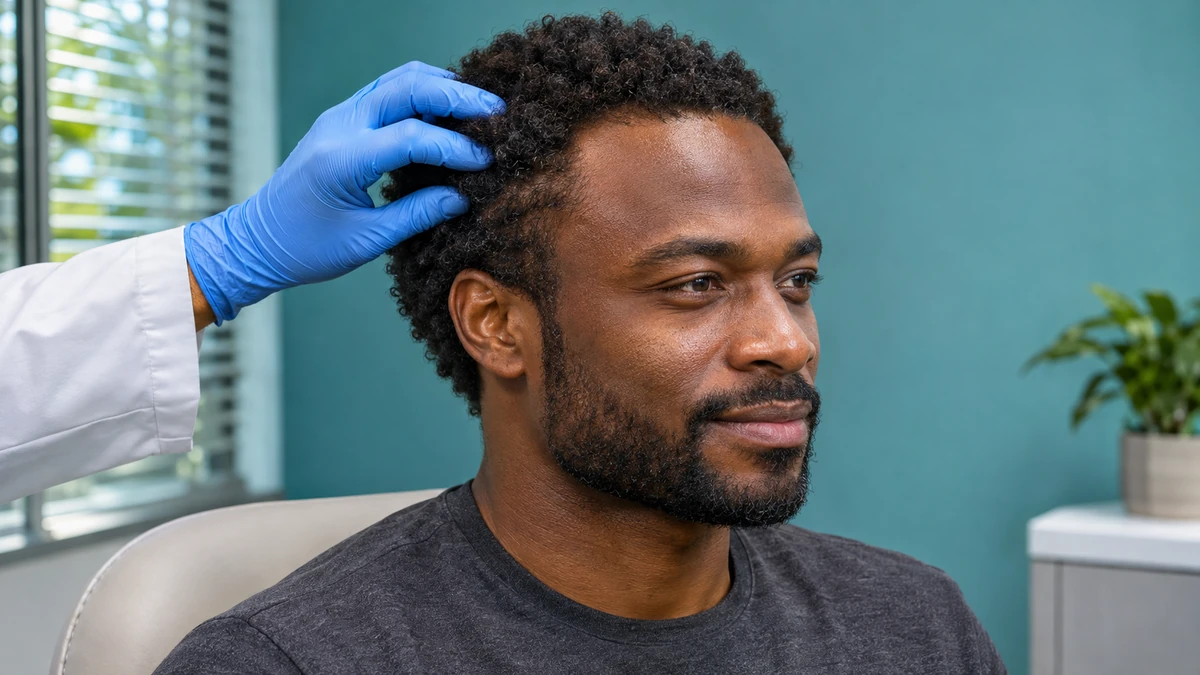
If you've got afro-textured hair and you've started looking into a hair transplant, you've probably noticed something about the before-and-after photos online. Most of them are of straight hair. That's no accident. The bulk of transplants worldwide are done on straight or wavy hair, and plenty of clinics have far less experience with tight curls than their adverts would have you believe.
The good news is that an afro hair transplant works, and in a couple of ways your hair is actually on your side. The procedure isn't quite the same, though, and it's worth knowing where the differences are before you book anything.
It Starts Under the Skin
Straight hair grows from a fairly straight follicle. Look at the angle a hair leaves the scalp and you've got a decent idea of where the root runs underneath. With afro hair, you can't do that. The bend is already there under the skin, in the follicle itself, and sometimes it's a tight one. So the root might run off at an angle you'd never guess from looking at the scalp.
Why should you care? Because of the way FUE is done. The surgeon uses a tiny circular punch to cut around each group of hairs and lift it out. If the punch goes straight down while the root curves away, it can slice right through the follicle. Surgeons call this transection. It happens to some extent in every FUE case, but it's more likely with tightly curled hair, and a graft that's been cut is much less likely to grow.
How Surgeons Adapt the Extraction
A team that's used to curly hair changes a few things:
- A slightly wider punch. Odd, when clinics usually boast about going smaller. But a bit more room makes it easier to capture the whole curved root.
- Gentler, shallower scoring. Often the punch is only pushed in partway. After that, the graft is coaxed out slowly instead of being pulled.
- A test extraction. Before the main session, lots of surgeons remove just a few grafts, look at them under a microscope and tweak the depth or angle if the roots look clipped.
- More time. Expect a long day, typically six to eight hours under local anaesthetic, and with afro hair there's even less room to rush.
So the surgeon's experience with curly hair counts for more than the name of the technique in the brochure. FUE and DHI can both work well. What makes the real difference is who's holding the tools.
Your Curls Can Work in Your Favour
Here's the upside. Coiled, coarse hair takes up more room. One strand of it hides more scalp than one fine, straight hair does, so a transplant of the same size tends to look a good deal thicker on you.
Studies do suggest afro scalps carry a few fewer hairs per square centimetre on average. You'd never know it to look at, because the curl fills the gaps. It may also stretch your donor area a little further. Whether it does depends on your own density, and only a surgeon looking at good photos (or at you) can tell you that.
Keloids: The Question You Should Be Asked
A keloid is a scar that doesn't know when to stop. It keeps growing, thick and raised, past the edges of the original cut. Darker skin is more prone to them, which is why a careful clinic asks how you scar before it asks almost anything else.
Think back. Did an ear piercing, a cut or an old operation ever heal into a hard, raised lump? Tell your surgeon early. That's not an automatic no, but it can change what happens next. A surgeon might treat a small test patch and wait to see how it heals. Sometimes they'll tell you surgery isn't worth the risk. And if nobody at the clinic asks you about keloids at all, that tells you something too.
One smaller point: on darker skin, FUE can leave tiny pale dots in the donor area. Most of the time your hair covers them. Keep the back in a very tight skin fade, though, and they might show.
Traction Alopecia, CCCA and Why the Cause Matters
Plenty of hair loss in people with afro hair has nothing to do with genetics. Traction alopecia is a big one. Years of tight braids, weaves, locs or ponytails tugging at the roots slowly wear the hair away, and it usually shows first at the hairline and temples.
Where those follicles have died off completely, a transplant is a reasonable fix. The pulling has to stop first, though. Keep wearing the same styles and they'll strain the new grafts, and the hair around them, exactly as before. Your surgeon will also want to work out whether the follicles in that patch are really gone, or just weakened and still able to recover.
Then there's central centrifugal cicatricial alopecia, or CCCA. The name's a mouthful, but it's worth remembering. This kind of hair loss scars the scalp and normally begins at the crown. Grafts placed where it's still active may simply not survive, so a dermatologist needs to diagnose it and get it under control first. Only then does surgery come into the conversation.
Getting the Hairline Right
No two hairlines are quite the same, and a shape designed around straight hair might not suit yours at all. Afro hairlines are usually flatter across the front and gentler at the temples, without the sharp corners. Use a one-size-fits-all template and something can look wrong, even when every graft takes.
Angle matters as well. Set a curly hair in at a poor angle and it can grow back round into the skin, which leads to ingrowns and bumps. Good surgeons think about which way the hair should point in each area of the scalp. The front line is only part of the job.
Recovery: What the First Year Looks Like
In most ways, healing is the same as for any transplant. Small scabs clear within the first week or two. Somewhere around weeks two to four, most of the transplanted hairs fall out. That's normal, and our piece on the shedding phase explains why it happens. New growth tends to show from about the third or fourth month, and the full result takes roughly a year.
You might spot one difference. The coils make new growth look full earlier than it would on straight hair. The catch is that a curly hair coming through can now and then get stuck under the skin. Itchy little bumps? Leave them alone and bring them up at your follow-up.
What to Ask a Clinic First
Take these to any clinic you're considering:
- Roughly how many afro hair transplants does your team do each year?
- Can I see before and after photos of people with hair like mine?
- Will you do a test extraction before committing to the full session?
- What punch size do you use on curly hair, and why?
- If I've had keloids in the past, what would you do differently?
- Who draws my hairline, and have they done many on hair like mine?
Afro Hair Transplant FAQs
Is an afro hair transplant more complicated?
From the surgeon's side, yes. Curved roots slow the extraction down and make damaged grafts more likely, which is why you want someone who does these regularly. In the right hands, results are good.
FUE or DHI: which is better for afro hair?
Both can work. On afro hair, the surgeon's experience with curly follicles usually matters more than the method. Our DHI vs FUE comparison goes through the general differences.
Can women with afro hair have a transplant?
Yes, as long as the cause of the hair loss is suitable and stable. Traction alopecia where the tension has stopped is a common example.
Will I need fewer grafts?
Often, since coiled hair covers more scalp per graft. Your exact number depends on your donor area and how much ground there is to cover.
Does it hurt?
It's done under local anaesthetic, so once the area is numb you should only feel pressure. Most people find the first few injections are the worst part.
Before You Choose a Clinic
Afro hair isn't a barrier to a good result. It just asks more of the person doing the work. Go in knowing about the curved follicles, the keloid question and what's really behind your hair loss, and you'll find it much easier to tell whether a clinic is up to the job. You can read more about how we approach it on our afro hair transplant page.
Want a surgeon's view on your own hair? Send photos of the front, top, crown and back of your head and we'll take a look as part of a free consultation.