
 English
 Italiano
 Español
 Français
 Deutsch
 Português
 Русский
 Български
 العربية
 فارسی
Ask ten people who've had a hair transplant in Istanbul which method they went for, and two names will come up more than any others: DHI and Sapphire FUE. Ask them which one is better and, well, that's where things get loud.
We hear this question at the clinic almost daily. Usually it comes from someone who's watched a few YouTube videos, scrolled through a Reddit thread or two and ended up more confused than when they started. Fair enough. A lot of what's online is written to sell one method rather than explain both.
The short version? Both techniques take hair out of your donor area in exactly the same way. What changes is how that hair gets put back in. That one step ends up deciding quite a lot: how big an area can be covered in a day, whether you'll be shaving your head, how thick the hairline can look.
We'll go through both properly below, and by the end you should have a decent idea of which camp you fall into. (If you don't, that's fine. Most people only really know once someone has looked at their scalp.)
What DHI and Sapphire FUE Have in Common
Let's clear up the biggest misunderstanding first. DHI and Sapphire FUE aren't two completely separate operations. Both are built on FUE (follicular unit extraction), and the first half of the day looks the same whichever you pick.
You're given a local anaesthetic, then the surgeon starts removing tiny clusters of hair, usually one to four hairs each, from the back and sides of your head. The punch they use is less than a millimetre across, so every extraction leaves a mark roughly the size of a pinprick. Once your hair grows back over them, you'd struggle to find them.
Why the back and sides? Hair in that horseshoe-shaped zone doesn't react to DHT, the hormone behind most male pattern baldness. It keeps that quality after it's moved, which is why a well-done transplant tends to last.
Up to this point, no difference at all. The split comes after.
How Sapphire FUE Works
With Sapphire FUE, implanting happens in two separate stages. First the surgeon makes hundreds (sometimes thousands) of tiny openings in the thinning area, which we call channels. Then, once they're all ready, the team places the grafts into them one by one with very fine forceps.
The name comes from the blade used for that first stage. Classic FUE relied on steel. A sapphire blade has a crystal tip instead, and because sapphire is so hard it stays razor sharp and cuts a clean, narrow V shape. In practice that means less trauma to the skin, a bit less swelling on top, and an area that usually settles down faster.
It's tempting to see channel-making as the boring bit. Honestly, it's where a lot of the artistry lives. The angle and direction of each channel decide how the new hair grows out. Get that wrong and the hairline looks pasted on. Get it right and nobody can tell.
When Sapphire FUE makes the most sense
Because the whole area is mapped out and opened in one go, Sapphire FUE copes really well with big areas. If you're thin on top and at the crown, this is usually where we'd start the conversation. Depending on how strong your donor area is, a single session can often move somewhere in the region of 3,000 to 4,500 grafts.
The trade-offs with Sapphire FUE
For most people the big one is shaving. In nearly every case the whole head is shaved, so the first couple of weeks are harder to keep private. Grafts also sit outside the body a little longer between coming out and going back in. They're kept in a holding solution made for exactly this, so it isn't a real worry, but it's still a difference. And if you've got a fair amount of hair left in the area, placing new grafts between existing ones takes extra care.
How DHI Works
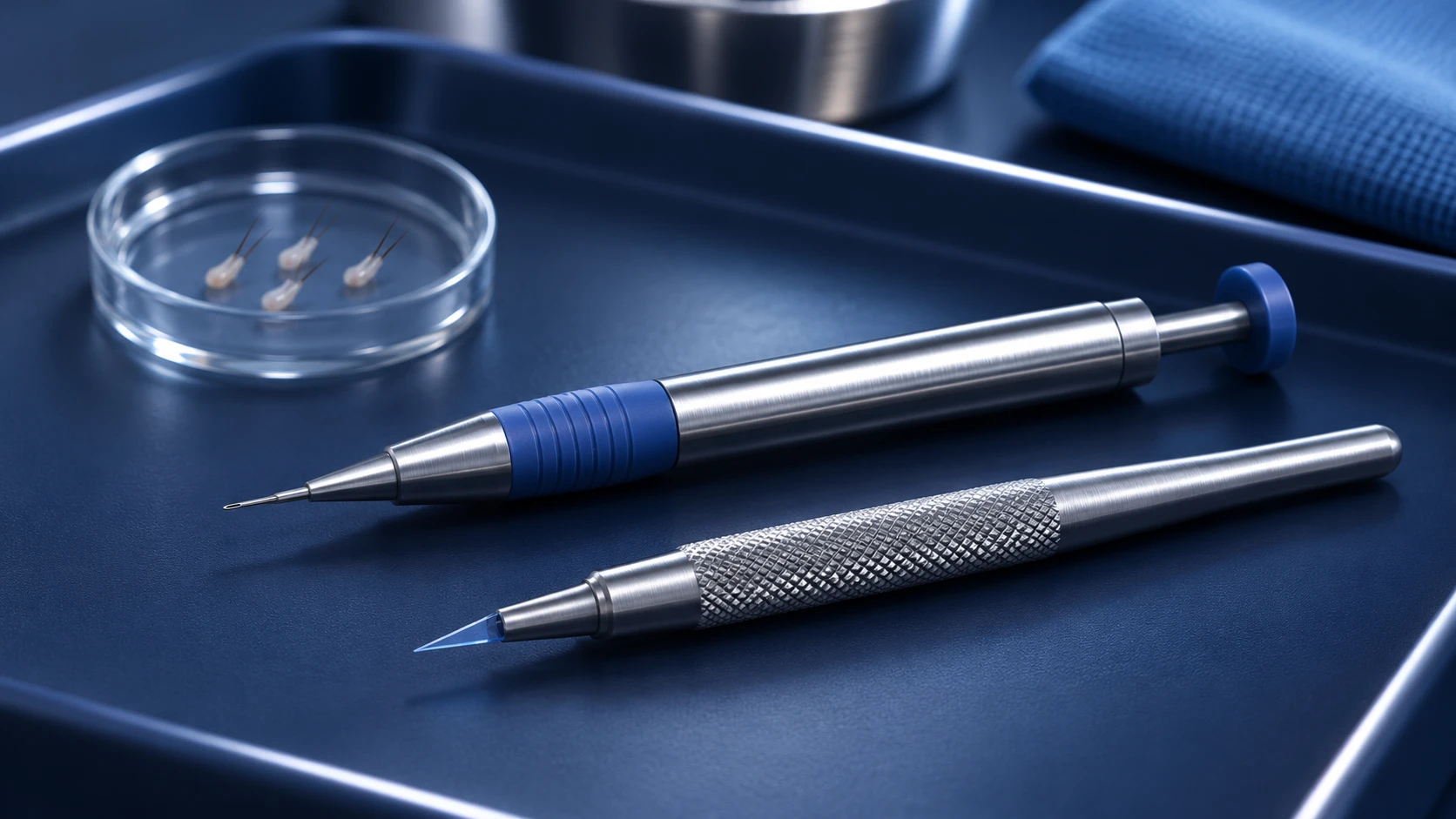
DHI means direct hair implantation, and "direct" really is the key word. There's no channel stage at all. Instead, the surgeon works with a small pen-like instrument called a Choi implanter.
Picture a hollow needle with a plunger behind it. A graft is loaded into the needle, the pen goes into the scalp, and in that one movement the opening is made and the hair is set in place. Depth, angle and direction are controlled hair by hair. It's slow, patient work, a bit like embroidery.
Doing it this way has a couple of side effects. Grafts go back in soon after they come out, so they spend less time outside the body. And because nothing is cut in advance, the hair you already have is barely disturbed.
When DHI makes the most sense
The number one reason people ask for DHI? They don't want to shave. With this method the top can usually be left alone, which is why it's the go-to for an unshaven hair transplant. The donor area at the back is often still trimmed, though normally in a section longer hair can hide. DHI is also very good at packing grafts tightly. So if you're after real thickness along the hairline or temples, or you're filling in hair that's thinning rather than gone, the pen gives the surgeon a lot of control.
The downsides of DHI
It takes longer, simple as that. Every graft is loaded and implanted on its own, so a typical session lands closer to 2,000 to 3,000 grafts. The team has to be experienced, and several pens are kept in rotation through the day. For a large bald area, DHI by itself might mean coming back for a second session.
DHI vs Sapphire FUE: Side-by-Side Comparison
Short on time? The table below sums it up. Treat the graft numbers as rough guides, because in the end your donor area has the final say.
Feature | Sapphire FUE | DHI |
|---|---|---|
Graft extraction | Standard FUE | Standard FUE |
Implantation | Channels opened first with sapphire blades, grafts placed with forceps | Choi pen opens and places each graft in one step |
Typical grafts per session | Around 3,000 to 4,500 | Around 2,000 to 3,000 |
Shaving | Usually full shave | Top can usually stay unshaven |
Best suited to | Large areas, advanced hair loss | Hairlines, smaller areas, adding density |
Density in a small area | Good | Very high |
Time per graft | Faster | Slower |
Cost | Same package range | Same package range |
Recovery | Similar | Similar |
One thing worth pointing out: recovery is pretty much the same with both. So if someone tells you to choose a method because it "heals faster", take that with a pinch of salt.
Which Hair Transplant Technique Is Right for You?
Forget the technique names for a second and think about your own hair. Where are you losing it, how much of it, and how do you feel about shaving? Those three answers do most of the deciding.
Sapphire FUE could be the better fit if...
...the thinning has spread across the top or the crown and you want to cover as much as possible in one trip. It suits people who don't mind a shaved head and can take a week or so out of the public eye.
DHI could be the better fit if...
...your hair loss is still fairly early, or it's mostly at the front and temples. Maybe you've got decent hair left and just want more of it. Maybe shaving simply isn't happening because of your job. DHI is a common pick for women as well, since female hair loss tends to be spread out rather than one bald patch. Our female hair transplant page goes into this in more detail.
What about using both?
Plenty of patients end up with a mix, and it's often the smartest option. In a hybrid hair transplant, the surgeon uses DHI for the hairline, where every single hair is on show, and Sapphire FUE further back where coverage counts for more than pinpoint placement.
Things that matter more than the method
We'll be blunt. The technique gets most of the attention, but it's rarely what makes or breaks a result. Your donor area is a limited supply, and how it's used now shapes what you can do in ten years. Hairline design matters enormously, because a line that looks great at 28 can look odd at 50. Your surgeon's experience with hair like yours counts for more than whichever tool is in their hand. And a good clinic will be straight with you about what's realistic, even when it isn't quite what you were hoping to hear.
Recovery and Results: What to Expect After Either Method
Good news here. Whichever method you go for, healing looks about the same. Everyone's body is a little different, so don't panic if you're a few days ahead or behind, but this is roughly how it goes.
For the first few days your scalp feels tight and a bit sore, and some swelling can drift down towards your forehead. It tends to look worse than it feels. The first wash is usually done for you at the clinic, around day two or three.
By day seven to ten, the small scabs around each graft soften and come away. If you work at a desk, you're probably back at it by now.
Then comes the part nobody enjoys. Somewhere between week two and week eight, a lot of the transplanted hair falls out. It's called shock loss and it's completely expected. The follicles are still there, just resting.
Around month three or four, new hairs start to show. They're often thin and patchy at first, so try not to judge anything yet. By six months most people can see a real difference in the mirror, and the full result usually arrives at twelve to eighteen months. The crown is normally the last to catch up.
Some patients add treatments like PRP along the way to support the new growth. Whether that's worth it for you is a good question for your doctor.
Frequently Asked Questions About DHI and Sapphire FUE
Is DHI better than Sapphire FUE?
Not really, no. They're good at different things. DHI wins on precision in small areas and lets you keep your hair long on top, while Sapphire FUE wins when there's a big area to cover. Which one is "better" comes down to your hair loss.
Which technique gives more density?
In a small zone like the hairline, DHI can usually place grafts closer together. Over the whole head it's a different story. Sapphire FUE can move more grafts in one session, and more grafts often means a fuller look overall.
Is DHI or Sapphire FUE more painful?
Neither should hurt during the procedure itself, since you're under local anaesthetic for both. The injections at the start sting for a minute or two, and that's the bit most patients remember. Afterwards, expect a few days of mild soreness. There's no real difference between the two here.
Can I have a hair transplant without shaving my head?
Often, yes, if you go with DHI. The top can stay unshaven, and the donor area is usually trimmed in a strip that longer hair covers. It gets trickier when you need a lot of grafts, so bring it up at your consultation.
Does DHI cost more?
Not at Natural Clinic: DHI and Sapphire FUE are offered within the same package range, so the choice comes down to your hair, not the price.
How many grafts will I need?
Honestly, nobody can tell you that from a blog post. It depends on how big the area is, how dense you want it to look and how much your donor area can give. Send a few photos to a doctor and you'll get a far more reliable estimate.
Are the results permanent?
The transplanted hair should be, because it comes from an area that's resistant to DHT. The catch is your original hair around it. That can keep thinning over the years, so some patients are advised to use medication or have follow-up treatments to hold on to what they've got.
Still Not Sure? Let a Specialist Look at Your Scalp
At some point the reading has to stop. The only way to really know whether you're a DHI person, a Sapphire FUE person or somewhere in between is to have an experienced doctor look at your hair.
That's exactly what our free consultation is for. Send us clear photos of the front, top, crown and back of your head, and our hair team will tell you what they see, what's realistic and roughly how many grafts you'd need. No pressure, and nothing to commit to.