 English
 Italiano
 Español
 Français
 Deutsch
 Português
 Русский
 Български
 العربية
 فارسی
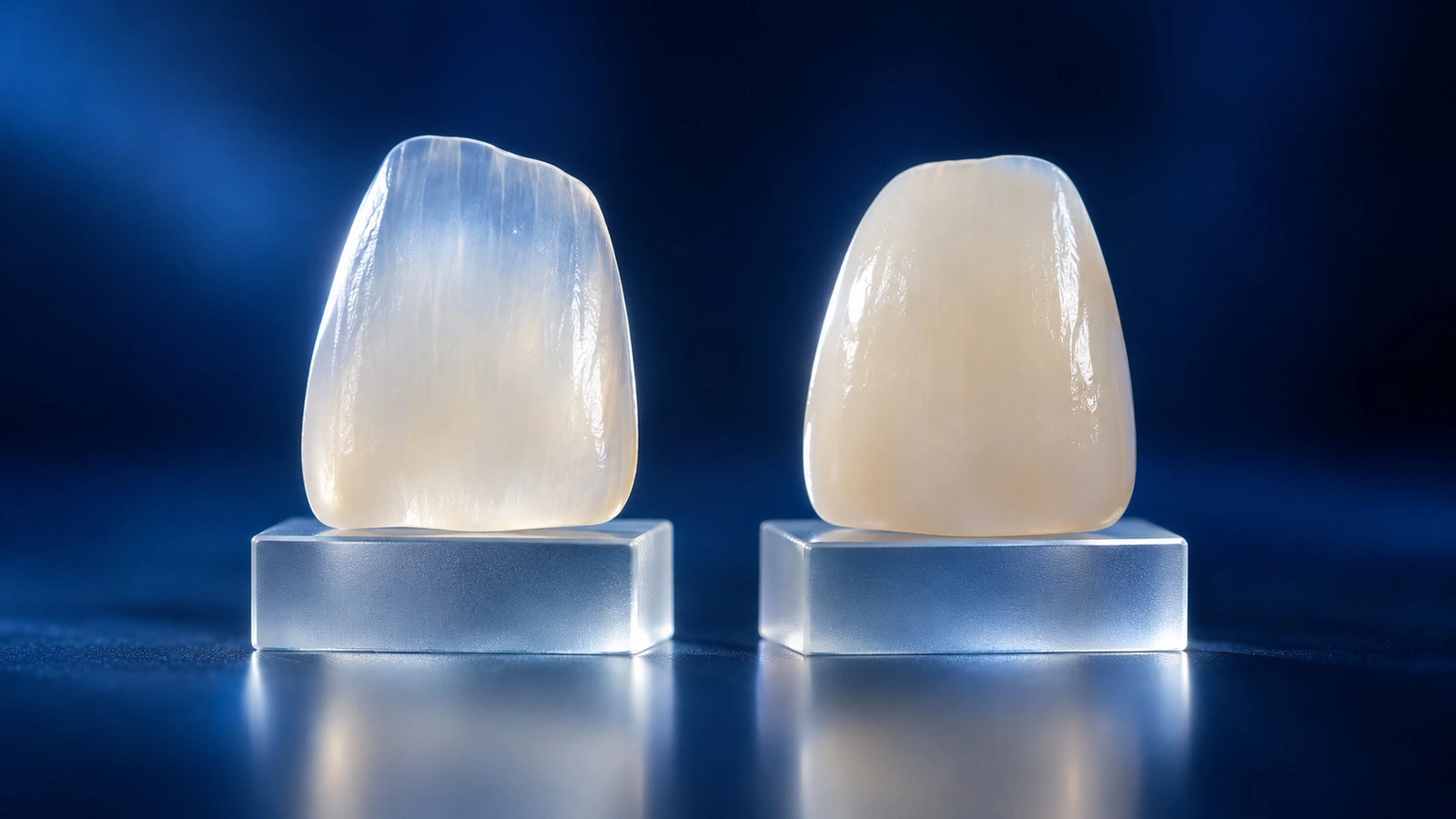
Shopping around for veneers usually goes something like this. Clinic one recommends E-max. Clinic two swears by zirconium. Clinic three offers both and asks which you'd prefer, as if you're supposed to know.
You'll hear that E-max is "the natural-looking one" and zirconium is "the strong one". Fair enough, as far as it goes. But it skips the stuff that actually matters for you: how dark your teeth are right now, whether you clench at night, which teeth we're talking about, and what a clinic really means by "zirconium veneer" (more on that below, because it isn't always what you'd think).
Here's the fuller picture.
What Are E-max Veneers?
E-max veneers are made from lithium disilicate. That's a glass ceramic, pressed or milled into shells that can be as thin as 0.3 mm and rarely thicker than 0.8 mm, then bonded onto the front of each tooth.
Why do dentists love it for front teeth? Light. Real enamel is slightly see-through, and E-max is too, so light sinks in a little rather than bouncing off a flat white surface. That's the difference between teeth that look like teeth in a flash photo and teeth that look like a row of bathroom tiles.
The thinness helps your teeth as well. Less enamel has to be filed away to make room, and E-max grips enamel very well once it's bonded.
Where it gives ground is toughness. It's far stronger than old-fashioned porcelain, but it's not the strongest option going, and people with a heavy bite or a grinding habit can chip the edges.
What Are Zirconium Veneers?
Zirconium veneers are made from zirconium dioxide, which most dentists just call zirconia. It's seriously tough stuff, two to three times stronger than E-max, and that's why it's also used for back-tooth crowns and on top of implants.
Early zirconia had a reputation for looking chalky on front teeth. Fair criticism at the time. The newer high-translucency versions are a lot better, and in skilled hands they can look very convincing. Most dentists would still say E-max has a touch more depth when you're up close.
Zirconia's slightly opaque nature is actually handy in one situation: covering things up. If a tooth has gone grey after a root canal, or has deep stains that bleaching won't touch, zirconia is very good at hiding it.
One more thing worth knowing before you line up quotes. "Zirconium veneer" doesn't always mean the same thing. Sometimes it's a thin shell on the front. Sometimes it's a full zirconia crown wrapped round the whole tooth, which means filing down a lot more. Always ask which one you're actually being offered.
E-max vs Zirconium Veneers Side by Side
Below is the quick comparison most people ask us for. Take the numbers as typical rather than guaranteed.
Feature | E-max veneers | Zirconium veneers |
|---|---|---|
Material | Lithium disilicate glass ceramic | Zirconium dioxide (zirconia) |
Look | Very natural, translucent like enamel | Natural with modern types, slightly more opaque |
Strength | Strong | Very strong |
Hides dark or stained teeth | Moderately | Very well |
Tooth preparation | Usually minimal | Often a little more |
Best for | Front teeth, healthy enamel | Discoloured teeth, heavy bites, back teeth |
Typical lifespan | 10 to 15 years or more | 15 years or more |
Put very simply, E-max is the looker and zirconia is the tough one. Your own teeth decide which of those counts for more.
Which Veneer Material Looks More Like Real Teeth?
On a healthy front tooth, E-max usually wins the beauty contest. Real front teeth aren't solid white all the way through; the bottom edge lets a little light pass. E-max copies that, which stops the smile looking like one solid block of white. Close-up selfies are where it really shows.
Discoloured teeth are another matter. Teeth that turned grey after root canal work are tricky for E-max, since a little of that grey can show through such a thin layer. Zirconia covers it fully. In the hands of a good lab technician, the finish can still look convincingly natural.
Then there's the shade. Too bright for your complexion and even the best ceramic looks fake. If you're hoping to lighten your remaining teeth, get teeth whitening out of the way first so the lab has the right colour to match.
Strength and Lifespan: E-max vs Zirconia
Zirconia is clearly the stronger material. It takes the kind of pressure that would crack many other ceramics, so it's the usual recommendation for people who grind or clench, and for teeth doing heavy chewing work.
For everyday eating and talking, E-max on front teeth is absolutely fine. It's constant heavy force that it doesn't love, which is why grinders get told to wear a night guard whatever the material.
On lifespan, a decent set of E-max veneers will usually see you through 10 to 15 years, frequently longer. Zirconia regularly makes it past 15. Our dentists will tell you the same thing: your daily routine has more effect than the material. That means flossing, regular check-ups, keeping your teeth for food rather than packaging, and a night guard for grinders. Most issues begin at the gumline or in the tooth itself; the ceramic is rarely the weak point.
Matching the Material to Your Teeth
We tend to recommend E-max when the teeth underneath are healthy and the changes are cosmetic: a lighter colour, a neater shape, a closed gap. It's at its best on the teeth visible in your smile, usually six to ten of them, and needs only a very thin layer of enamel removed.
Zirconia earns its place with teeth that are darkened, stained, heavily filled or root-treated, and with patients who grind or clench. It's also the usual pick further back in the mouth, where strength counts for more than translucency.
Or mix the two. Quite a few Hollywood smile cases put E-max on the front teeth and zirconia behind them, colour-matched so the switch can't be seen.
Working to a smaller budget, or keen on something reversible? Composite veneers are an option too. Just bear in mind they won't last as long as either ceramic.
Looking After E-max and Zirconium Veneers
There's nothing special to learn here. If you look after your own teeth well, you already know how to look after veneers.
A soft brush, a gentle toothpaste, flossing along the gumline every day, and the dentist and hygienist at regular intervals. That covers it.
The usual causes of chips are small things people do without thinking, such as chewing ice or pen tops, cracking hard sweets and opening bottles. Drop those habits and you've taken away most of the danger. Grinders should wear a night guard. It's cheap protection for an expensive smile.
You don't need to give up coffee or red wine. Ceramic absorbs very little colour, so the veneers themselves stay bright. At most, a faint line may appear at the edges after a few years, and a professional polish normally removes it.
Questions About E-max and Zirconium Veneers
Should I choose E-max or zirconium veneers?
There's no universal winner. For healthy front teeth, E-max tends to look more natural. For dark teeth or a heavy bite, zirconia is usually the safer bet. A dentist looking at your teeth can tell you which applies.
Do zirconium veneers look fake?
The old opaque type sometimes did. Modern translucent zirconia from a good lab can look really natural, although E-max usually has a little more depth up close.
How fragile are E-max veneers?
Stronger than they look. A chip is possible after biting something very hard, or after years of grinding without a night guard, but with normal use they're very durable.
How long do E-max veneers usually last?
Plan on at least a decade. Fifteen years or more is common when they're looked after.
Zirconium veneer or zirconium crown: what's the difference?
A veneer is a thin facing on the front of the tooth. A crown is a cap that covers the tooth completely and needs more filing down. Since the word "veneer" is sometimes used for both, ask your clinic exactly which one is in your plan.
Is it possible to use both materials together?
Yes, and lots of patients do. In a full smile makeover it's common to have E-max on the front teeth and zirconia behind them.
Not Sure Yet? Ask Us
To recommend a material, a dentist needs to see your teeth, even if only in photos, and check their colour, your bite and how much enamel you have. With that information, the decision is usually simple.
Just send us three smile photos, front and both sides, plus any recent X-ray you have. We'll tell you what we'd go for, E-max, zirconia or a mix, and why.
Book your free consultation and get a plan made for your smile.