
 English
 Italiano
 Español
 Français
 Deutsch
 Português
 Русский
 Български
 العربية
 فارسی
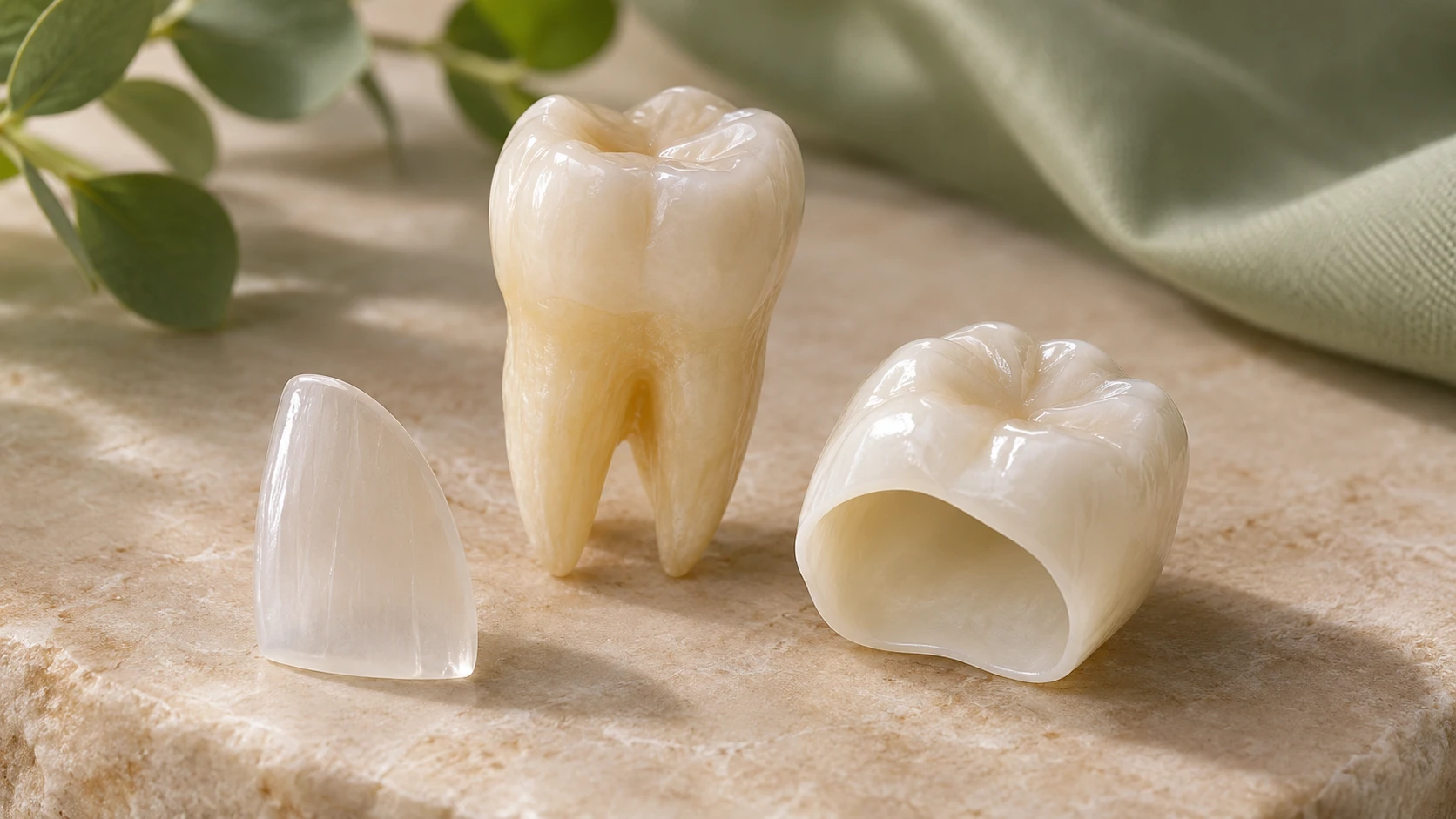
Perhaps you've caught yourself smiling with your mouth shut in pictures because of a few front teeth. One's a bit yellow, one has a chipped corner, and another has a big old filling that's started to go grey around the edge. You start reading up, and within ten minutes two words are bouncing around your head. Veneers. Crowns. Which is it?
Mixing them up is completely understandable. Each one gets made by a dental technician from a mould or a 3D scan of your mouth, they're nearly always ceramic, and from a metre away even a dentist might struggle to say which tooth has which.
What they do underneath is a different matter. And that, more than looks or price, is what decides which one you end up with.
What a Veneer Actually Is (and Isn't)
A veneer is a thin facing, usually ceramic and occasionally resin, glued onto the front surface of one tooth. Porcelain ones tend to be around half a millimetre thick, thin enough that light comes through them a little.
Before it goes on, the dentist polishes away a sliver of enamel from the front so the veneer won't stick out. The back of the tooth, the sides and most of the biting edge stay untouched.
What they're for is looks, nothing else. With one, a dark tooth turns lighter, a pointed canine gets softened, a front tooth worn down over the years gets its length back, and that chip you've been hiding since secondary school disappears. They handle all of that well. Ask one to hold together a tooth that's cracked down the middle, though, and it'll let you down. There just isn't enough material there to take the strain.
Dental Crowns: When the Whole Tooth Gets Covered
A dental crown goes over everything you can see of the tooth, right down to the gumline. Front, back, both sides and the top. Plenty of people still call it a cap, and frankly that's not a bad way to picture it.
All that coverage comes at a cost. For it to fit, your dentist has to file the tooth down all the way round, somewhere between one and two millimetres off each surface. Compare that with the half millimetre or so a veneer takes and it's obvious why crowning a healthy tooth purely for colour would be a bad trade.
Where crowns earn their keep is with teeth that are already in trouble. A molar where the filling is bigger than what's left of the tooth. A front tooth with a crack in it. A tooth that's had root canal treatment and gone brittle, which happens a lot once the nerve is gone. If you're getting an implant, the visible tooth fixed onto it at the end is a crown as well.
Veneers vs Crowns Compared, Row by Row
The table underneath lays out the main points side by side. The millimetres and years in it are averages, and your own dentist could quite reasonably give you slightly different figures.
Feature | Veneers | Crowns |
|---|---|---|
What it covers | Front surface only | The whole tooth |
Typical thickness | About 0.3 to 0.7 mm | About 1 to 2 mm |
Tooth removed | Small amount of enamel | Shaped down on all sides |
Main purpose | Appearance | Strength and protection |
Best for | Stains, chips, gaps, uneven edges | Cracks, large fillings, root-canal teeth, implants |
Usual location | Front teeth | Any tooth, front or back |
Typical lifespan | 10 to 15 years (porcelain) | 10 to 15 years or more |
Cost per tooth | Depends mostly on the material | Depends mostly on the material |
Of all those rows, purpose is the one dentists actually decide on. A sound tooth that just looks wrong tends to get a veneer, whereas one that's broken or weakened tends to get a crown, and the other rows mostly follow on from that one.
Veneer or Crown? How a Dentist Actually Decides
You get a say, of course. Realistically, though, it's the state of the tooth that decides. Before shades even come up, expect your dentist to ask about old fillings, previous root canals, any clicking in your jaw and whether you clench or grind in your sleep.
When veneers usually make sense
If your teeth are healthy and it's purely how they look that you dislike, you're in good company, and you're probably looking at veneers. Think of stains that bleaching hasn't touched (grey tetracycline staining from childhood antibiotics is a common one), front teeth worn short from years of use, small gaps, a chipped corner or teeth that sit slightly out of line. Only a thin layer of enamel is removed, so most of your own tooth stays put, and over the next twenty or thirty years that really does count.
When a crown is the safer bet
Big fillings, cracks, root canals, a tooth that's lost a good chunk of itself. Bonding a thin veneer onto any of that is asking for trouble. A crown wraps the whole thing and keeps it in one piece. Back teeth nearly always go this way anyway, since molars do the heavy chewing and hardly show when you smile.
Plenty of people end up with both
In a full Hollywood smile or smile makeover it's actually pretty normal. Plenty of smile makeovers end up as a mixture, often veneers across the six upper front teeth and a crown or two on damaged teeth beside them. The technician makes the whole lot at the same time, which is how the colour and translucency end up matching.
Grinding deserves its own warning. Plenty of people clench in their sleep and only find out when a partner complains about the noise. Ceramic doesn't love that kind of pressure, so if it sounds like you, say so, and you'll likely go home with a night guard.
E-max, Zirconia, Porcelain or Composite: Choosing a Material
Most of the gap in price between two quotes comes down to this choice. It also changes how your teeth look under bright light, which people rarely think about until they see their holiday photos.
E-max is a glass ceramic and a very popular pick for front teeth. Light passes into it slightly, the way it does with real enamel, so it doesn't look flat or fake. It's used for E-max veneers and for crowns as well.
Zirconia is incredibly strong, which is why you see it so much on molars and implants. Early versions had a chalky, opaque look. The layered zirconia used now is a lot more natural, and our zirconia crowns page has more on that.
Porcelain has been around the longest. Good colour, a nice natural shine, still a perfectly sensible choice.
Composite is the odd one out because it isn't made in a lab. The dentist builds resin up on your tooth, often in one sitting. Composite veneers are cheaper and usually need little or no enamel taken off. They do pick up stains more easily, though, and you'll be replacing them sooner.
What the Treatment Process Looks Like
Getting either one done involves pretty much the same appointments; the only real difference is how much filing happens on day one.
Your first visit is mostly talking and checking. X-rays, a look at your gums, then a chat about how long, how white and how rounded you'd like your teeth to be. If the clinic uses digital smile design, you'll see a rough preview on a monitor. Once everyone's happy, the teeth are prepared and scanned, and temporary ones go on for the next few days.
While the technician works on the final pieces, your time is your own, and many people use those days to see a bit of Istanbul. At the fitting, everything is tried on before it's fixed. Expect to bite down on a strip of thin coloured paper a few times while the dentist checks where your teeth meet, with a look in the mirror in between. Anything that hits early or rubs against your tongue is worth pointing out straight away, since a couple of seconds of polishing in the chair beats trying to fix it once you're back home.
How many days should you plan in Turkey?
There isn't one answer for everybody. A handful of veneers is a quicker job than a full mouth of crowns, and anything that has to be sorted first, a root canal or inflamed gums for instance, adds time. Ceramic is made in a lab rather than in the chair, so a few days always pass between preparing the teeth and fitting the final ones. A dentist who has seen your X-rays can work out a realistic timetable for you, and with bigger treatment plans it isn't unusual to split the work over two trips.
Ten Years? Twenty? How Long Veneers and Crowns Really Last
With sensible care, porcelain and E-max veneers tend to keep going for somewhere between ten and fifteen years, and it's not rare for them to go well past that. Crowns are roughly the same, although zirconia, being so hard, often comes out on top. Composite won't match them; after five to seven years it typically needs a polish, a repair or replacing.
Nothing exotic shortens their life. What cuts their life short is the same stuff that wrecks natural teeth: decay working its way in under the edge, heavy clenching, and tearing open packets or prising off bottle tops with your teeth.
There's no special routine to learn. Keep brushing twice a day with a mild toothpaste, clean between your teeth with floss or interdental brushes, and see a dentist and hygienist about every six months. If you were given a night guard, actually wear it. Crunching ice cubes is best avoided too.
A lot of people only discover this afterwards, but bleaching works on natural enamel and does nothing at all to ceramic. Whatever shade your veneers and crowns are made in is the shade they'll stay, so anyone hoping for teeth whitening too should book that first and have the new teeth matched to the brighter result.
Quick Answers on Veneers and Crowns
Which is better, a veneer or a crown?
Depends what's wrong. If the tooth is healthy, a veneer is the kinder option because it leaves more of it intact. If it's cracked, heavily filled or has had a root canal, a crown is the better bet simply because it protects the whole thing.
Do veneers work on back teeth?
Hardly ever. Your molars do the crushing when you eat and nobody sees them when you smile, so there's little reason to veneer them. A crown is what you'd normally get.
Will veneers damage my real teeth?
Not in the sense of harming them, but there is a catch with porcelain veneers. The thin layer of enamel taken off to fit them never grows back. So once you've had them, those teeth will always need some kind of covering. That's a decision worth sleeping on for a while.
Does it hurt to get a crown or veneer?
Usually not. After the anaesthetic injection, which is the only bit most people notice, it's mostly a feeling of pressure and some buzzing from the instruments. Cold drinks might make the teeth twinge for a few days afterwards; that tends to settle without any treatment.
Can you have a crown on a front tooth?
Yes. Front teeth get crowned regularly when they're cracked, broken or have had root canal treatment, because a veneer wouldn't be strong enough there, and today's ceramics can be shaded to sit naturally next to the neighbouring teeth.
Will veneers straighten crooked teeth?
Only minor issues. Veneers are good at hiding a tooth that's turned slightly or an edge that's a bit uneven, but real crowding or a bite that's off is better dealt with by braces or aligners. Veneers can always come later if you still fancy them.
What should I do if a veneer or crown falls off?
Put it somewhere safe (a little pot or a sealed bag works), don't try sticking it back with anything from the kitchen drawer, and phone your dentist. If it's still in one piece it can often just be re-cemented.
Not Sure Which One Your Teeth Need?
For a dentist who can see your teeth, this is usually a five-minute call. From articles alone (this one included) it's a lot harder.
Want a second pair of eyes on your own teeth? Three phone photos are enough to start with: a full smile from the front and one from each side. Send them to us and a member of our dental team will come back to you with a suggestion and the reasoning behind it, before you've decided anything.