
 English
 Italiano
 Español
 Français
.webp?v=mu6u3ybe)
.webp?v=mu6u4qvj)
%20(1).webp?v=munrsoke)
.webp?v=munru28i)


.webp?v=mth1gwjb)













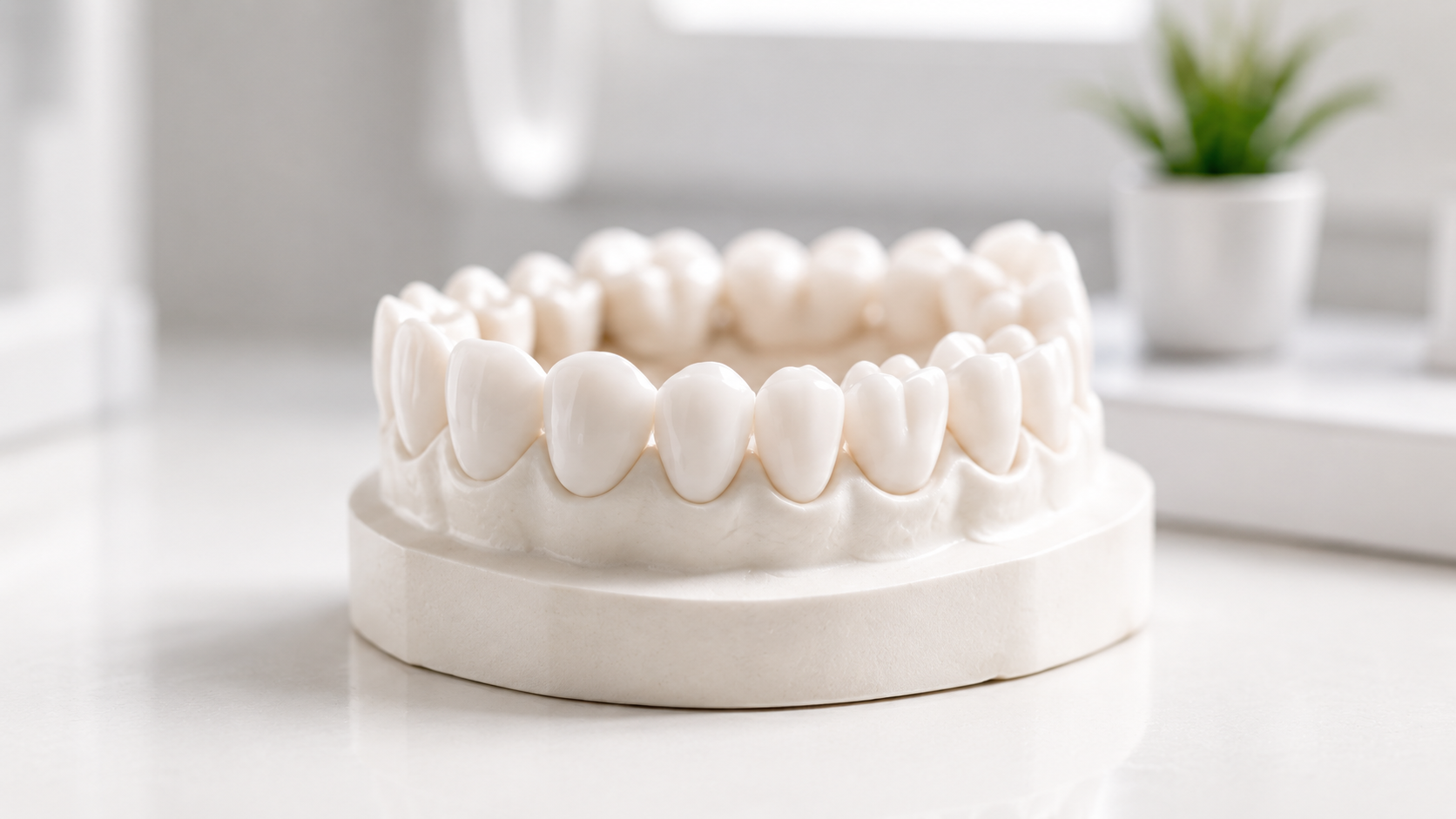


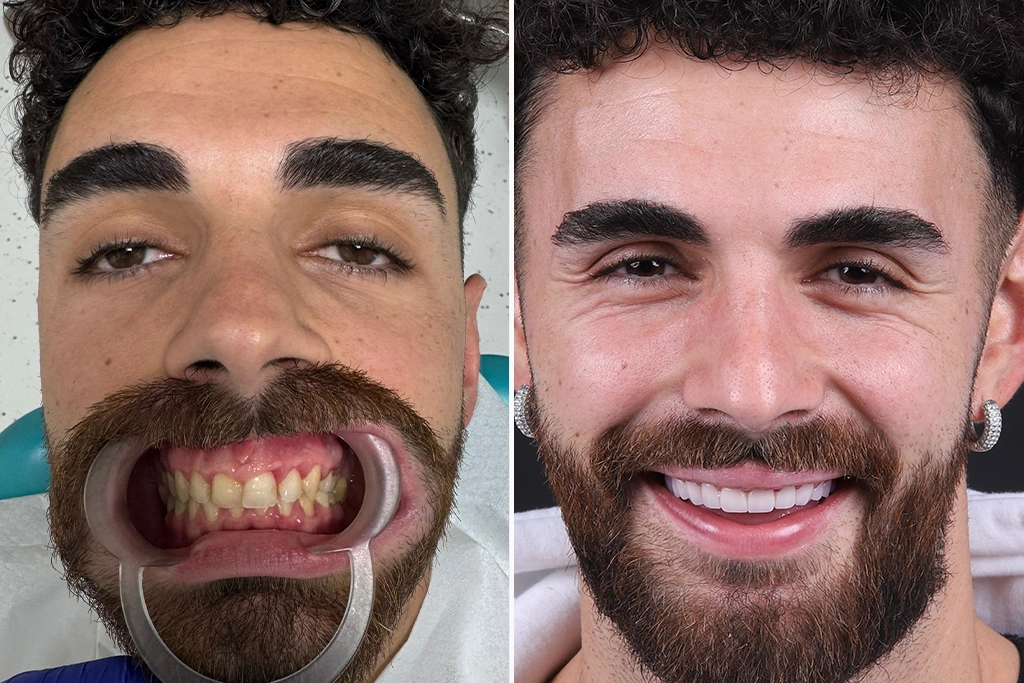
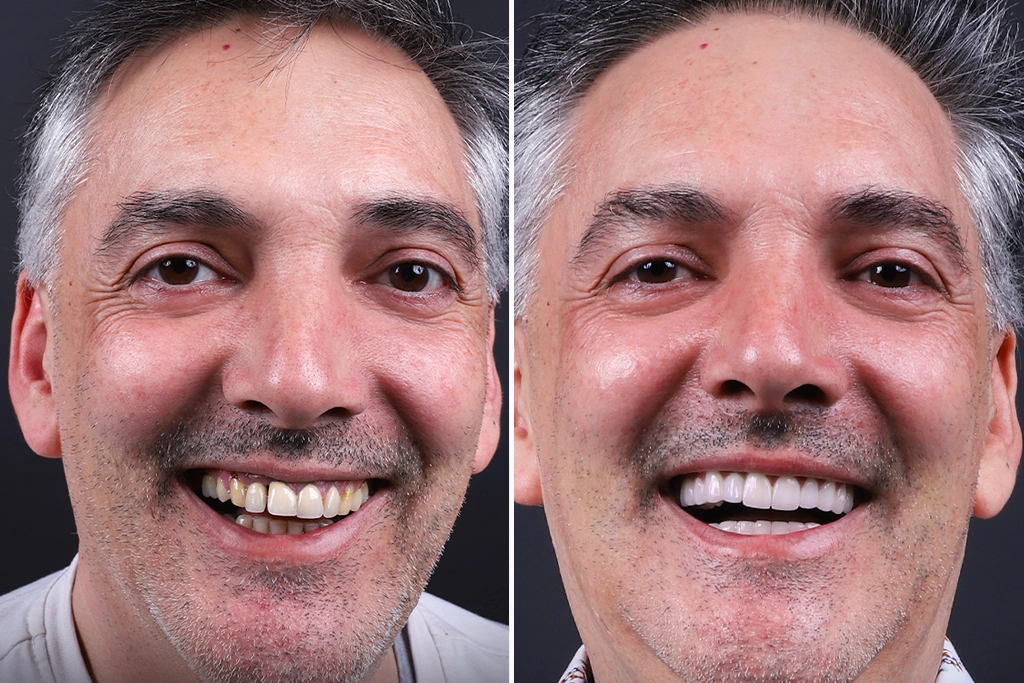
Plenty of people find this page because of the question under the title. Somewhere in their mouth is a crown that's been there for ten, maybe twenty years. Then, one morning, there's a thin dark line along the gum. Bathroom lights make it worse. So do photos. After that, it's all you see.
That line nearly always tells you how the crown was made. It's behind a lot of the enquiries we get about porcelain crowns in Turkey. And it leads to the single most useful thing to know: "porcelain" can describe two quite different crowns.
PFM or all-ceramic: two very different crowns
Type one hides a metal shell under its porcelain. Porcelain gets baked onto that shell in layers. On paperwork it often appears as PFM (porcelain fused to metal). Metal for strength, porcelain for colour. They've been around for decades, and a huge number of the crowns in people's mouths right now are this kind.
The second type has no metal anywhere. The whole thing is ceramic, so light goes into it the way it goes into a tooth instead of hitting a metal wall. It looks far more natural, especially at the front.
On a quote, both can just say "porcelain". Hence the note in the card above about deciding metal-backed or metal-free for each tooth. Comparing prices? First thing to find out is whether metal is involved. Everything else follows from it: the look, the amount of drilling, the way it ages.
Where the dark line comes from
In a metal-backed crown, the metal cap has to stop somewhere, and that's usually right at the edge, by the gum. When the crown's new, the gum hides that edge.
Over the years most people's gums creep back a little. Scrubbing too hard makes it happen faster, and so does gum disease. Once enough gum has gone, the edge of the metal peeps out. That's the line. Sometimes there's no line at all, just gum that looks faintly grey because the metal is showing through thin tissue.
Neither means the crown has failed. It may be sealing the tooth just as well as the day it went in. It's a looks problem. On a back molar, you might shrug. On a front tooth you see every morning, maybe not.
The "too white, too solid" look
Some old metal-backed crowns never show a line and still look a bit wrong next to real teeth. Hard to put your finger on at first. The answer's inside.
Light can't get through metal. To hide it, the lab puts down a layer of opaque material first, and the natural-looking porcelain goes on top of that. Light reaching the crown therefore stops almost at the surface. You'd never spot that on a back tooth. Beside real front teeth, though, the crown can come across as slightly too white and too dense, and cameras exaggerate it.
Do old porcelain crowns need replacing?
Often they don't. We'd rather tell you that straight than sell you a crown.
Say there's a molar right at the back, crowned in metal and porcelain fifteen years ago. It fits, it's clean underneath, it doesn't hurt, and only your dentist has ever seen it. We'd usually say leave it. Taking off an old crown nearly always costs a sliver more tooth, and you only get so many slivers.
Front teeth are a different matter. When that grey edge is the first thing you see in the mirror, a metal-free replacement can change how you feel about your smile. Decay at the margin, a crown that doesn't fit well or chipped porcelain are reasons to replace too, wherever the tooth is.
Look at each crown on its own. Ask a dentist to go through them with you. Some will be worth changing. Others will be fine where they are.
Replacing one crown among several old ones
Here's one people don't expect. Four old PFM crowns along the front, a grey edge on one. Put a metal-free crown in its place, and suddenly the other three look tired beside it, because the newcomer catches the light so differently.
That isn't a reason to do all four. But it's a decision for the group, looking at the whole smile, not one tooth. Sometimes the answer is to do them together. Sometimes it's to wait until more of them need work. Whichever it is, get that conversation done before anything is removed.
When metal inside still makes sense
Metal-backed crowns have gone out of fashion. That doesn't make them useless.
A molar right at the back, one you'd need a torch and a mirror to see, is well protected by a properly made metal-backed crown. On very short teeth, a thin metal cap gives good strength in a tight space. Some longer bridges benefit from a metal frame too. And if budget is what decides whether a tooth gets treated at all, a sound metal-backed crown now beats a fancier one that never happens.
Where they make less sense is on front teeth where looks matter, on people whose gums are already shrinking back, and on teeth with lots of healthy structure left, for the reason below.
How much tooth each version needs
Every layer needs room. A metal-backed crown needs space for the metal, then the opaque layer, then the porcelain. That usually means taking off a bit more tooth than a metal-free crown, around 1.5 to 2 mm against the 1 to 1.5 mm on the main crowns page.
On a tooth that's already mostly filling or root-treated, that difference may not matter much. On a tooth with plenty of healthy structure, it's a real loss. Taking off more tooth to save a little money is rarely a good deal on a tooth you want to keep for decades.
Why the surface can chip
Metal or no metal, the outside of a porcelain crown is built up in layers, and the outermost one gives it its natural look. It's also where the weakness is. A porcelain crown almost never breaks in two; what happens is a flake comes off a corner or a cusp.
Chips usually start where the bite is heaviest. One high spot, hit every time you close, takes a beating. So the bite gets checked carefully on fitting day, and people who grind tend to be steered to zirconia crowns.
Little chips can often be polished out, or filled in with white filling material. It won't be invisible, but on a back tooth that may be all it needs. A bigger chip, especially one showing metal, usually means a new crown.
Metal sensitivities
A small number of people react to certain metals, nickel being the commonest. Many metal-backed crowns use alloys that contain it, though precious-metal alloys exist too.
If you know you're sensitive to nickel, or cheap jewellery or watch straps have given you a rash, say so before the plan is made. Metal-free crowns take the question off the table. Much easier to decide at the start than find out after fitting.
Porcelain vs E.max crowns for front teeth
For front teeth sitting next to natural ones, most dentists now go metal-free. Without metal, light passes into the crown much as it does into enamel, and there's nothing dark to show at the gum later.
Then it's usually metal-free porcelain against an E.max crown, another metal-free option with its own page. Hand-layered porcelain, as the FAQ above mentions, can recreate a lot of depth, and a good technician makes it look superb. The right pick for each tooth comes down to its colour underneath, how you bite, and what the teeth either side look like.
A mixed mouth
One of the before and after cases above shows porcelain on the back teeth and E.max at the front. That's a common, sensible pattern. The cheaper material goes where looks matter least, and the most lifelike one where they matter most.
The skill is making it all match. Crowns in different materials need to hit the same target shade, so you can't see where one stops and the other starts when you smile or laugh.
Porcelain crown cost in Turkey, and reading the quote
Porcelain crowns are usually the most affordable crown on our price list, with metal-backed ones at the lower end. Set against what most UK or German clinics charge, even a whole mouth of them is cheaper here. Exact figures, though, usually wait until after the examination (the page above explains why): one porcelain crown can be a very different thing from the next.
Go down the quote tooth by tooth and check: metal, or none? If there is, which metal? And why that choice for that tooth?
One thing to be a bit wary of: a plan with the exact same crown on every tooth, front to back. Your front teeth and back teeth work very differently. A plan that reflects that has had some thought put into it.
Treatment, recovery and how long porcelain crowns last
You can usually have porcelain crowns done in a single trip to Istanbul. There's a temporary phase of a few days while the lab makes them, and once fit and colour are approved the final crowns are cemented. Cold drinks may sting for several days. A crown that hits first when you bite needs adjusting before you fly. With decent care, a lifespan of 10 to 15 years is typical, and plenty go on well past that. Reviews from people several years in tell you more than ones written on fitting day.
What to photograph for a porcelain crown assessment
Writing to our Istanbul team about old crowns? The photo we'd most like is one hardly anyone sends. Stand near daylight, hold your top lip up out of the way, and get a sharp close-up of each crown's edge at the gum. Add how many years the crowns have been in, and say if any have chipped, come loose or started to hurt. That tells a dentist far more about what's going on, and what's worth changing, than a smile photo ever will. For a wider look at how all the crown materials compare, our dental crowns page brings them together.