
 English
 Italiano
 Español
 Français
.webp?v=mumd5dzg)



















Hardly anyone writes to us asking for a "full mouth restoration", or a "full mouth reconstruction" as Americans tend to say. They tell us what they've noticed. Their teeth seem shorter than they were. Steak and crusty bread have become hard work. Fillings keep breaking. Someone has said they look older lately, and they can't put their finger on why. Behind most of those stories sits years of wear, a few repairs that didn't last, and a bite that has slowly sunk.
That's the real job of full mouth restoration in Turkey, or anywhere. It isn't just a bigger version of a cosmetic smile makeover. As the section above says, function comes first and looks follow. Here we explain what that means for a mouth that's been worn down rather than knocked out, and why the plan starts from the bite and works upwards.
How teeth wear down
We'll use an example to keep this concrete. Think of a man in his late fifties, a lifelong night grinder with a weakness for cola and a bit of heartburn he's never bothered his GP about. His mouth shows all three of the usual kinds of wear at once.
From the grinding, his front teeth have lost their edges and gone square, and the cusps on his molars have been polished almost flat. From the acid, mostly the reflux he's ignored, there are shallow saucer-shaped dips in his back teeth and the edges of his upper front teeth have gone thin enough to look slightly see-through. He also brushes hard, the way you'd tackle a burnt saucepan, and that's carved tiny grooves into the teeth just above where his gums have shrunk.
That combination is typical. The reason it's worth untangling is that grinding, acid and over-brushing each call for a different fix.
Fix the cause first
Give him a brand-new set of crowns without changing anything else, and they'd get the same treatment his own teeth did. Yes, acid barely touches ceramic. But wherever it meets his own teeth there's still a seam that acid can attack, and a determined grinder can crack or loosen almost anything.
So he'd be sent to his own doctor about the reflux, which is worth treating for its own sake anyway. He'd get a hard night splint as part of the plan, not as an add-on, which is what the pathway above describes. And we'd have a frank chat about the cola.
When one tooth at a time stops working
His dental history probably reads like many we see. A filling around 2008, a crown next door in 2013, a bridge in 2017 that had to be remade five years later. None of those were bad decisions. Put together, though, they've left a mouth full of patches that no longer line up into a sensible bite.
There comes a point where fixing whichever tooth breaks next doesn't get anyone anywhere. His problem is the bite as a whole. That's the moment to plan everything together.
Rebuilding bite height
Here's the part most people have never heard of. With his teeth worn down, his jaw now closes further than it once did. Dentists call the lost distance vertical dimension, and in his case it's probably several millimetres.
You'd see it in his face before you saw it in his teeth, though not in the mirror, because it crept up over a decade. Compare a photo from fifteen years ago and the lower part of his face is shorter now, his lips sit thinner, the corners of his mouth have dropped, and his chin has moved up towards his nose. His lower front teeth have started to crowd, too, with less support from behind.
Getting some of that height back is among the first calls in his plan. With more room, the new teeth can be properly long and properly shaped, and sore jaw muscles often get some relief. Go too far and everything feels too full, so the amount is worked out with care.
Testing the new bite before it's permanent
Rather than going straight to ceramic, he'd first wear provisional crowns made to the new height, as described in the pathway above. He'd eat with them, talk with them and sleep with them for a spell.
Plenty of people get used to them in days. He, on the other hand, might notice a faint whistle on his s's, a stiff jaw in the mornings, or the left side touching before the right. Those are exactly the things we want reported. Each one gets fixed, and we carry on until his bite feels like nothing in particular.
The permanent crowns are then copied from those adjusted temporaries. Skipping the trial would mean committing to a bite nobody had tested.
Every tooth gets its own decision
As the section above explains, each tooth is put into one of three groups: keep and restore, replace, or leave alone. In a worn mouth, that middle option can mean a lot of different things.
Take a molar whose top has been ground flat but whose sides are sound. An onlay may be enough, covering the chewing surface only. One that's crumbling or has had a root canal will usually want a full crown. His thin front teeth, still healthy underneath, could be lengthened with veneers. Any that can't be saved get replaced, usually with implants.
We'd always rather keep a tooth than pull it. As the checklist above says, a tooth that can be saved gets crowned, not extracted for convenience. Our dental crowns page goes into how that call is made.
Why the front teeth matter for the back ones
Try sliding your lower jaw forward, then to one side. Notice how your front teeth, and especially your canines, take over and your back teeth separate. That's deliberate design. It keeps the molars out of the way of sideways grinding they were never built for.
His canines no longer do that job, so his back teeth rub in every direction. Restoring that guidance is one of the main reasons front teeth in a rebuild get designed around how the jaw moves, not just how they look. We use digital smile design to check the movement and the appearance before any drilling.
Clicking jaws and tired muscles
People with this kind of wear often mention a jaw that clicks, stiffness first thing, or aching at the sides of the face. So the joints and chewing muscles get examined along with the teeth.
A better jaw position sometimes settles those symptoms, and the temporary phase is where you find out. We wouldn't promise it, though. Real pain, or a jaw that locks, should be assessed properly before anyone changes the bite.
Full mouth restoration or full mouth implants?
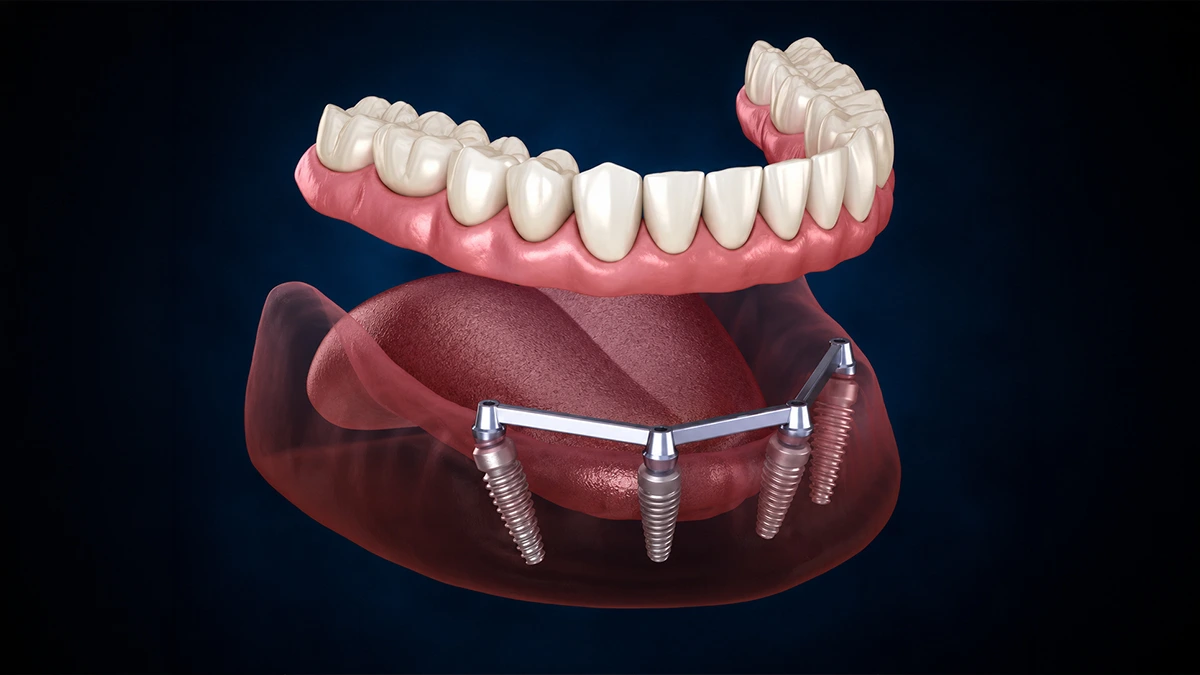
The FAQ above covers this. A restoration saves and repairs as many natural teeth as it can and adds implants only where there's no choice. Full mouth dental implants replace a jaw's teeth with a fixed bridge on implants.
People who've assumed they'll need implants throughout often find more can be kept than they'd thought. Others, sadly, find very little can. Only a proper assessment will tell.
How much does full mouth restoration cost in Turkey?
It depends on the mix, as the page above explains. To give you the building blocks: a root canal is €100, a zirconia crown €150 and an E.max crown €200. Implants start at €230, or €380 including the crown. Our example prices put one arch of crowns at €2,100 and both at €4,200.
The final number depends on how many teeth need what, plus anything extra like extractions, bone grafts or a sinus lift, which we price separately. Any quote for full mouth restoration in Istanbul worth trusting will go through your mouth tooth by tooth.
How long does full mouth restoration take in Istanbul?
Roughly two routes, as shown above. If it's mainly crowns on your own teeth, expect around a week in Istanbul on a single trip. If implants are involved, you'll come twice, with a few months in between while the bone grows around them. That bit can't be hurried.
Testing the new bite can stretch things a little. If yours needs a few weeks rather than a few days in temporaries, you should know that when the plan is drawn up, not halfway through.
Full mouth reconstruction before and after photos
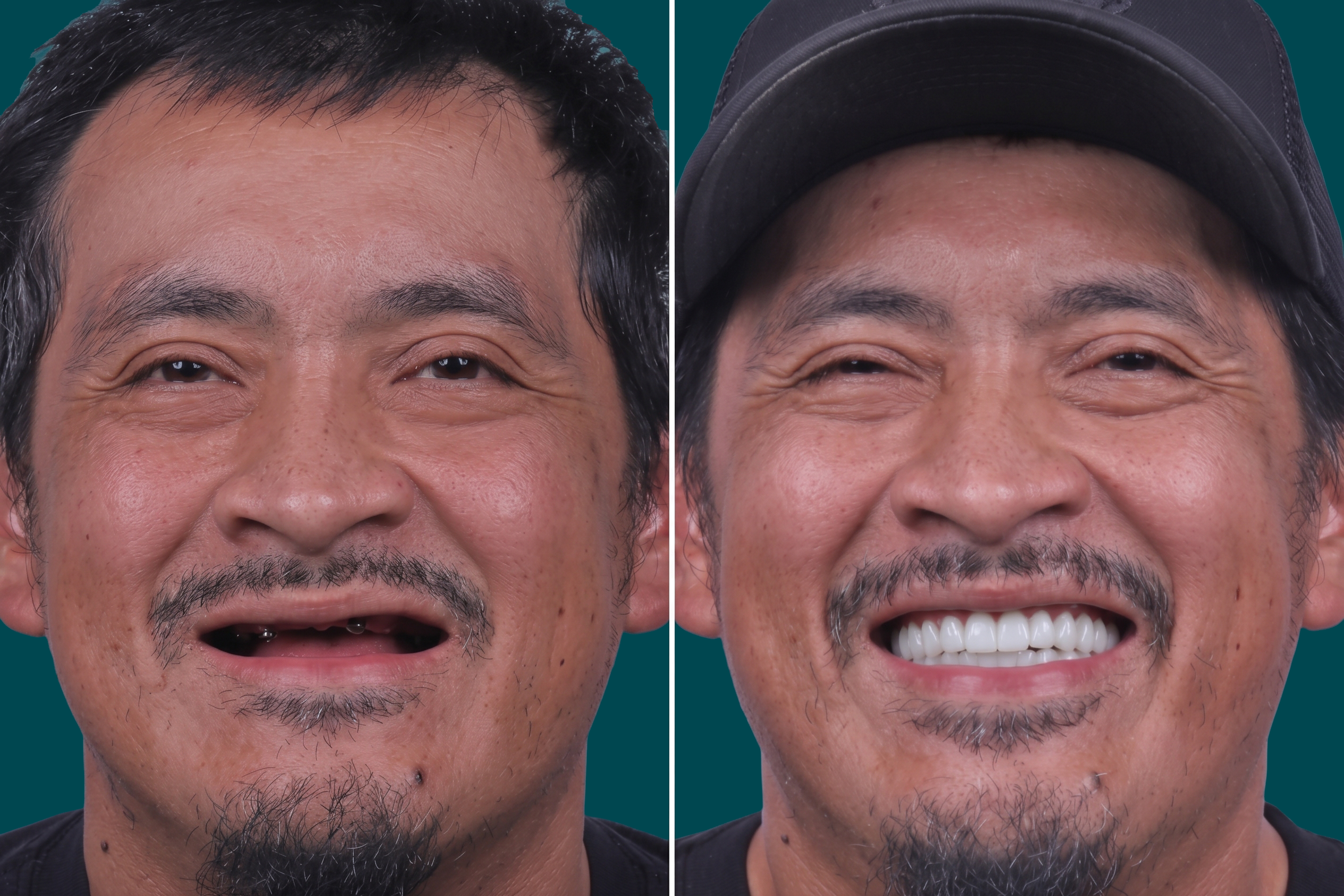
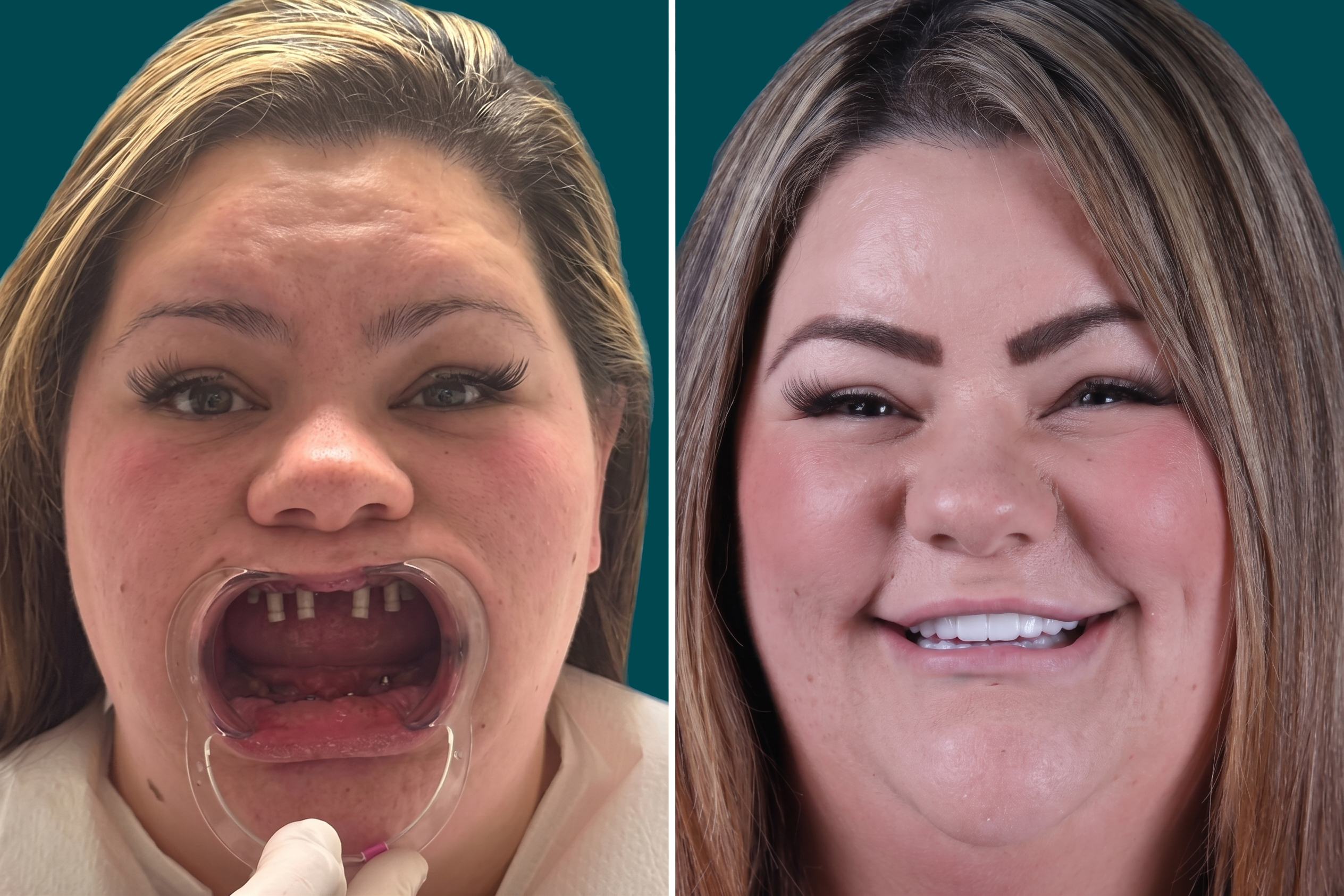
Before and after photos of full mouth reconstruction can be striking, but look past the white teeth. Look at the whole lower face. Has some length come back? Are the lips better supported? And do the new teeth have a little natural variety, or do they look like one white strip? Reviews from people who've lived with their new bite for a year or two will tell you more than any photo taken on the day.
Aftercare following full mouth reconstruction
The pathway above ends with a hard night splint and a check-up every six months. You might skip those after one crown. After a whole mouth, you can't.
At home, a little extra attention goes a long way. Brush slowly along the line where crown and gum meet. Drink fizzy or acidic things with food rather than nursing them through the afternoon. If your bite starts to feel off, tell us then, not at your next review.
What to send before your first visit
Smile photos are a good start. A few close-ups of the worn areas help, and the chewing surfaces of your back teeth too, if you can get the phone in. Ask your own dentist for copies of any X-rays or CBCT scans; they're very valuable to us. Finally, a short note: when the wear first caught your eye, whether you grind, whether you get heartburn, and what bigger dental work you've had and when. More often than not, those few lines tell our Istanbul dentists more than the pictures do.