
 English
 Italiano
 Español
 Français
Hair Transplant Before & After | Natural 6-Month Result









.png?v=mtn37ore)
.png?v=mtn382cn)
.png?v=mtn38kn8)
.png?v=mtn3922l)
.png?v=mtn39jxs)
.png?v=mtn39vgz)

More hair in the plughole than there used to be, a parting that seems a bit wider in photos, and no real wish to book surgery. That's who the question beneath the heading is aimed at, and it's where a lot of people first hear the word exosomes. Usually from an advert. Often with a promise attached.
We offer exosome hair therapy in Turkey, at our clinic in Istanbul, and we'd still rather you came to it carefully. It's a new treatment, it's the most expensive non-surgical option we have, and it isn't made from you. None of that rules it out. Ask us awkward questions. We'd honestly prefer it.
What are exosomes, in plain English?
Your cells gossip. All day long they fling tiny parcels at their neighbours, each one far smaller than anything you'd spot under a school microscope, carrying proteins and fragments of genetic code. Biologists named the parcels exosomes.
So the theory behind exosome therapy for hair loss goes like this. Put enough of those parcels next to a tired follicle and maybe it gets the message to try harder. Maybe. Whether real scalps agree is still an open question, which we'll come to.
Where the exosomes in your vial come from
This is the part most adverts skip. Not one exosome in the vial came from you. A lab grew the cells, usually stem cells out of donated umbilical cord or fat (now and then plant cells instead), collected what they released, cleaned it up, concentrated it and bottled it. Then it travelled in a cold box to a clinic somewhere.
So you're not just choosing a treatment. You're choosing a product, made by a particular company, from a particular source, to a particular standard. Two vials both labelled "exosomes" can contain quite different things.
Exosomes vs PRP for hair loss
People compare these two all the time, and the difference is bigger than it looks. With PRP hair treatment, a nurse takes some of your blood, spins it down and injects your own plasma back within the hour. Nothing comes from anyone else.
Exosomes arrive from outside. That raises questions about donor screening, manufacturing, sterility and storage that simply don't exist when the material is your own. PRP also has a longer track record in hair loss. Exosomes may yet prove their worth, but right now they're the newer, costlier and less proven of the two.
Is exosome hair therapy FDA approved?
No. At the time of writing, the US Food and Drug Administration hasn't approved any exosome product for treating hair loss, and rules differ from one country to the next. The product may be legally available in Istanbul and not where you live, or the other way round. That matters if you were hoping to keep treatment going after you get home, so check the position in your own country before you start.
Does exosome therapy work for hair loss?
Honest answer: it's too early to say with confidence. There's a good deal of laboratory research, plus some small studies and case reports in people with thinning hair, and some of them look encouraging. What's missing are the large, well-controlled trials that medication for hair loss has behind it.
There's a catch on top of that. No two manufacturers make exosomes for hair loss the same way, so a paper showing good results with Brand A says next to nothing about Brand B. Next time a website tells you "studies show" exosomes work, ask the obvious follow-up: which product did they test, and is that what's in my vial?
Exosome hair treatment for women
Women with diffuse thinning sometimes ask about exosome hair treatment because it doesn't involve surgery or shaving. The same rules apply, perhaps more so: female hair loss has many possible causes, and hormones, iron and thyroid need checking before anything is injected. The female hair transplant page explains that investigation in more detail. If the cause turns out to be pattern loss with plenty of living follicles left, exosomes can be discussed as one option among several.
Who might it suit, and who it won't help
Exosome hair therapy is aimed at early to moderate pattern thinning, where the follicles are weaker but still alive. It's also sometimes used to support the native hair around a transplanted area.
It can't do anything for a patch that's been bald for years. No follicle, nothing to talk to. We'd also say no, at least for now, if you're pregnant or breastfeeding, if there's infection or inflammation on your scalp, if your immune system is suppressed, if you're being treated for cancer, or if you've reacted to any of the ingredients before.
Try the established options first
Has anyone actually looked into why you're losing hair? If not, that's step one. A sluggish thyroid, low iron, a nasty virus last spring: any of them can make hair fall, and sorting them out sometimes sorts the hair out too. And if it does turn out to be pattern loss, what a doctor can prescribe has far more evidence behind it than any injection, at a fraction of the price. Hair mesotherapy and PRP are cheaper, too.
We'll often suggest one of those before exosomes, and the page above says the same. If you've already been through them, or you're using medication and want to add something, then it's a reasonable conversation to have.
The file you should see before any needle
Before anything goes near your scalp, get these answers on paper. Human donor tissue or plant? If human, what screening did the donors go through? Which company made it, where, and under what standard? Then the batch, the expiry, the storage conditions, and whatever else shares the vial with the exosomes.
You'll get all of that with our quote. On treatment day, someone holds the vial up against that paperwork in front of you before the seal is broken. A clinic that goes vague when you ask? That's your answer.
A stopping rule, agreed on day one
Here's something you won't find in many brochures. Before the first session, we write down what would make us stop. Your scalp is photographed under the same fixed lights it'll be photographed under later, a review date goes in the diary, and we note the improvement we'd need to see to carry on. On review day the pictures make the call. Not optimism, not a sales target. Your wallet will thank you, whichever way it goes.
What an exosome session is like
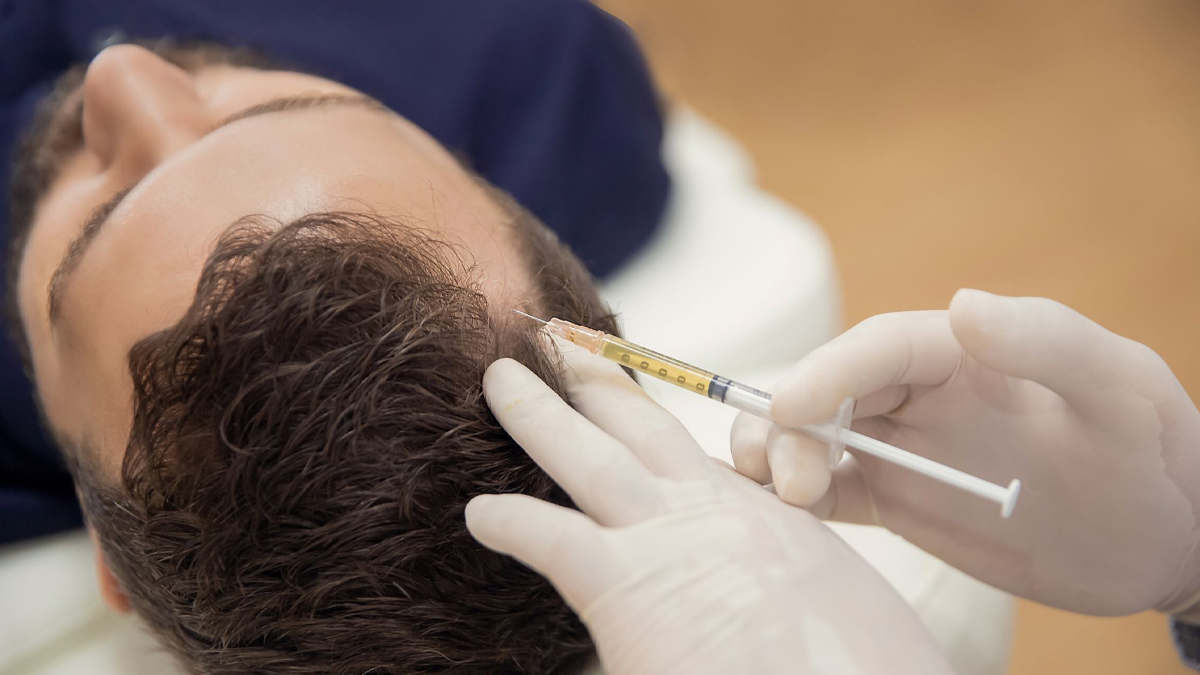
A session of exosome hair therapy in Turkey is quick. The vial is checked, prepared and injected across the thinning area in small amounts, close to the follicles. Numbing cream can be used if you'd like it. There's a brief sting, no wound and no dressing, and most people are back to normal straight afterwards. You'll be told how long to wait before washing your hair; after that there are no special restrictions.
Exosome hair therapy side effects
Expect a tender scalp for a few hours, some redness, maybe a tiny bruise or two and occasionally a mild headache. This one comes from someone else's cells, so our threshold for checking is lower than for anything made from your own blood. Redness creeping outwards, puffiness, a temperature, or pain that feels too much for a few small injections: message us that day. Don't save it for the next visit.
Exosomes don't trigger a shed, by the way. Hair still falling mid-course? That's the underlying problem showing itself, and our response is to look at the diagnosis again, not to sell you another vial.
How many sessions, and how long do results last?
How many vials? That depends on how much ground needs covering, and the gap between sessions comes from your plan. You'll see both on paper before day one, with the full cost next to them.
And don't expect it to last for ever. Exosomes won't grow new follicles, and they won't switch off the hair loss behind your thinning. Stop the treatment and whatever you gained tends to drift away again. It's maintenance, really, more than a cure.
Exosomes after a hair transplant
Thinking of pairing exosomes with a hair transplant in Istanbul? That's possible, mainly to support your own hair around the new grafts. Be wary of anyone who says it'll boost graft survival or let you get away with fewer grafts; there's no solid evidence for either claim. And if you do both, the surgical team sets the timing beforehand, not on the day.
Exosome hair therapy before and after: judging the photos
Don't expect dramatic before and after shots from exosome hair therapy. Changes, when they come, tend to be small and slow. Patients in the reviews above say much the same: things shift gradually over months, not weeks. A wet head, a brighter light or a slightly different parting can create a "difference" that isn't really there.
That's why your own before and after comparison is done against baseline photos taken in the same fixed lighting, from the same angles, at the review date we agree at the start. Compare the parting and crown like for like. If you're looking at someone else's before and after, check whether the conditions match, and whether they were also using medication at the time.
Exosome hair therapy price in Turkey
Exosome therapy is priced per vial and sits outside the hair transplant packages, so you won't find it on the fixed euro list. The number of vials depends on the area, and your quote for exosome hair therapy in Turkey lists the vial count, interval, total price and the product's source documentation together.
For comparison, the page above shows typical per-vial prices of €175 to €584 in the UK, €279 to €650 in Germany and €1,250 to €3,500 in the US. Per-vial price alone tells you very little, though. "Exosomes" on one invoice and "exosomes" on another may not be the same product at all.
What to send us first
Photos of the front, top and crown in daylight, with your hair parted as you usually wear it. A few lines on what's already been checked, such as bloods or thyroid, and what you've tried so far, whether that's medication, PRP or anything else. From that, the Istanbul team can judge whether exosome hair therapy in Turkey has a sensible role in your case, which product we'd use and where it comes from, and what it would cost. Quite often the honest answer will be that a cheaper treatment with better evidence should come first.