
 English
 Italiano
 Español
 Français
-1.webp?v=munwy6zh)
%20(1).webp?v=munwz98y)
.webp?v=munzr8yw)
.webp?v=munxl9jd)
.webp?v=munxm4m4)


.png?v=mtn37ore)
.png?v=mtn382cn)
.png?v=mtn38kn8)
.png?v=mtn3922l)
.png?v=mtn39jxs)
.png?v=mtn39vgz)

The line under the title describes DHI better than any brochure: the site opens and the follicle lands in the same motion. Hold on to that sentence. The upsides of DHI come from it, and so do the downsides.
So let's follow one graft. It starts behind your ear and ends up somewhere along your new hairline, and its trip explains why people booking a DHI hair transplant in Turkey tend to be hairline cases or people who'd rather not shave. It also shows why DHI isn't the right call for every head.
Step one: taken out like any FUE graft
A DHI graft starts life exactly as it would in FUE. As the section above describes, a fine micro-punch lifts it free of the donor skin, 0.7 mm across in this case, and the donor heals as small scattered dots. That stage is explained in full under FUE hair transplant in Turkey.
Once it's out, someone looks at it under magnification and counts its hairs: one, two, three. Single-hair grafts are set aside for the very front. Grafts with two or three hairs go further back.
Step two: loaded into the pen
This is where DHI parts company with every other technique. Instead of waiting for a channel to be opened, the graft is gently loaded into the hollow needle of a Choi implanter pen.
Picture a slim fountain pen. Swap the nib for a hollow needle and put a small plunger on the back end, and you've got a Choi pen. Needles come in a few widths: a skinny one for a single hair, a bit wider for a three-hair graft. On the day you'll see several pens on the tray. A technician loads them, the implanter uses them, and the pens go back and forth like a relay baton, so nobody's graft sits waiting.
Step three: in and placed in one movement
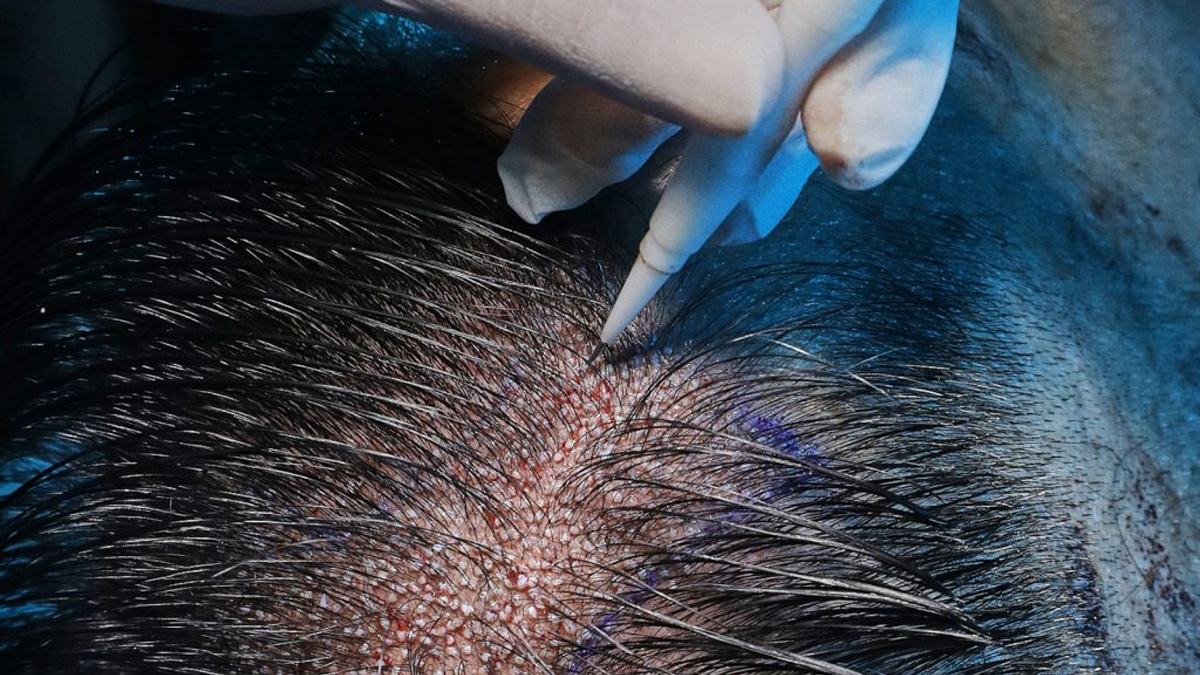
The implanter holds the pen at the exact angle and direction the hair should grow, pushes the needle into the scalp to the right depth, and presses the plunger. As the needle withdraws, the graft is left behind in the opening the needle has just made.
That's the "same motion" the title refers to. Angle, depth and direction are all decided at the moment of placement, graft by graft. No surprise, then, that the pathway above singles DHI out for hairlines. It also means the graft spends a little less time outside the body, because it doesn't have to wait for a whole field of channels to be cut before it goes in.
What is a Choi pen actually good at?
Two things stand out.
The first is control at the very front. A hairline needs single hairs placed at a low, forward angle, slightly irregular, with subtle changes of direction at the temples. Setting each of those by hand, one at a time, is exactly what the pen does best.
The second is working among existing hair. Because nothing is cut in advance, the implanter can slip grafts between native hairs with less risk of damaging them. That's why DHI is often chosen for thinning that still has hair in it, for refining a hairline that's only slightly receded, and for patients who want to keep their length.
DHI without shaving
The FAQ above confirms that DHI is commonly done without shaving the recipient area, and it's the reason many people arrive on this page. The donor area may still need to be trimmed in some cases, often in strips that longer hair can cover, and whether a fully unshaven procedure is possible depends on your donor density and the size of the area.
If keeping your hair is the main priority, the unshaven hair transplant page goes into the day-to-day side: returning to work, how visible things are, and what the trade-offs are.
How many grafts can DHI do in a day?
This is where DHI's strength becomes its limit. Placing grafts one at a time with a pen is slower than opening a field of channels and filling them. The page above doesn't hide it: DHI is slower per graft, the number of DHI grafts per session tends to run lower, and very large plans may be split rather than rushed.
In practice, that means DHI is at its best for small and medium areas, especially the front third of the scalp. For someone who needs thousands of grafts across the hairline, mid-scalp and crown, it often makes more sense to combine methods. The hybrid hair transplant page explains how DHI at the front and sapphire FUE behind it are planned in a single session.
DHI vs FUE: which is better?
Neither, in general. It's one of the most searched questions, and the honest answer is that they're good at different things.
Both take grafts out the same way. The difference is in how they go in. Classic FUE and sapphire FUE open all the channels first and then place grafts into them, which is quick and well suited to large, mostly bald areas. DHI opens and places in one step, which is slower but gives fine control at the hairline and among existing hair, and usually doesn't need shaving.
So "is DHI better than FUE?" usually becomes "which parts of my scalp need which approach?" Many plans end up using both.
Who is DHI best for?
DHI tends to suit people with an early or moderately receding hairline, thinning at the temples, a hairline that just needs refining, or diffuse thinning where plenty of native hair remains. It's also a common choice for anyone whose job or family life makes a shaved head difficult.
It's less well suited to extensive baldness across the whole top of the head, where the number of grafts needed would stretch a DHI session too far, or where there's little existing hair to protect.
DHI for women
The section above mentions that DHI is often the choice for female patients, and it's easy to see why. Women's hair loss usually shows as thinning along the parting or across the top, with plenty of hair still present. Shaving is rarely acceptable. DHI's ability to place grafts between existing hairs without shaving makes it a natural fit. The female hair transplant page covers when surgery is appropriate for women and when it isn't.
Less time outside the body: what it really means
DHI is often sold on the idea that grafts spend less time out of the body, and the page above mentions it too. It's true that there's no wait for a whole field of channels to be cut. It's also true that loading each graft into a needle is an extra step of handling, and grafts are delicate.
In the hands of an experienced, well-organised team, both factors are managed well, and growth is good. The real protection for your grafts isn't the name of the technique. It's how gently and how quickly the team handles them, whichever tool is used.
Can DHI treat the crown?
It can, but it's rarely the most efficient way. The crown is often a wide area, sometimes largely bald, and it needs many grafts spread along a spiral. Placing them one by one with a pen is possible, just slow, and it eats into the number of grafts that can be placed at the front in the same day.
That's why, in larger plans, the hairline and temples often get DHI, where its precision shows most, while the crown gets sapphire FUE channels. For someone who only has a small, thinning crown with hair still in it, DHI alone can work well.
The skill behind the pen
According to the section above, doing DHI properly takes long specialist training, and it recommends asking who holds the pen before asking what it costs.
That's because the pen doesn't make decisions. Every angle, every depth and every direction comes from the hand holding it, over and over through the day. A good implanter adjusts constantly: flatter at the hairline, steeper behind it, following the swirl at the crown and the changing direction at the temples. The same pen in less experienced hands can produce hair that sits too upright or grows in slightly the wrong direction.
DHI hair transplant recovery
Recovery in the recipient area is broadly similar to other FUE-based methods: small crusts that settle over the first week or two, and the usual timeline of shedding and regrowth described on the main hair transplant page.
The difference with DHI is often the hair around the grafts. If you kept your length, washing needs a little more care, because you're cleaning around healing grafts without pulling on long hair. The pathway above points out that the first wash at the clinic is where you're shown how to do it. Many people find that longer hair also helps disguise the treated area during the first couple of weeks. DHI results then arrive on the same curve as any other method, with the hairline filling in between months four and twelve.
DHI hair transplant before and after: zoom in on the hairline
DHI is a hairline technique, so the hairline is where you should judge any DHI before and after. Zoom in. The very front should be made of single hairs, slightly irregular, lying forward at a low angle, with no visible row or "plugged" look. A photo with the hair swept back tells you far more than one where a fringe hides the edge. When reading reviews, look for people whose hairline started out similar to yours.
DHI hair transplant price in Turkey
For a DHI hair transplant in Istanbul, the Choi pen doesn't change the price at all. Per the price section above, DHI costs the same as FUE: €1,600 for the session, €1,800 with three hotel nights, or €2,100 with fibroblast therapy. Elsewhere, DHI is sometimes priced as a premium technique, which is why the UK, German and US figures shown above are worth comparing.
Questions to ask before DHI
Who will hold the pen, and how long have they been doing DHI? How many grafts can realistically be placed in one day for your case, and will the plan be split if more are needed? Will the donor area be trimmed, and if so, how much? And is the whole recipient area being treated with DHI, or will part of it be done another way?
Clear answers to those are a good sign that "DHI" on your quote means the real technique, not just a label.
Photos for a DHI plan
For DHI, the hairline and temples matter most. Take a straight-on photo with your hair pulled back from your forehead, and a close-up of each temple from the side. Then add the top, crown and back, once as you normally style it and once flattened so the skin is visible. With that set, our Istanbul team can judge whether DHI alone, DHI without shaving, or a combination with other techniques is the right route for your DHI hair transplant in Turkey.