
 English
 Italiano
 Español
 Français
Hairline Lowering - New Hairline Design









.png?v=mtn37ore)
.png?v=mtn382cn)
.png?v=mtn38kn8)
.png?v=mtn3922l)
.png?v=mtn39jxs)
.png?v=mtn39vgz)

Pull your hair straight back and look in the mirror. We'll ask for that photo anyway, and it's the view most people searching for hairline lowering in Turkey have been studying for years. For some, the forehead has always been tall, often a family trait. For others the line used to sit lower and has slowly crept up. Those two stories usually end in different operating plans.
The section above lays out the two routes. This part covers what sits around them: whether your forehead really is "high", how forehead reduction surgery and a transplant compare once you're living with them, recovery, the scar, how to read hairline lowering before and after photos, and what decides the price.
Is my forehead actually too high?
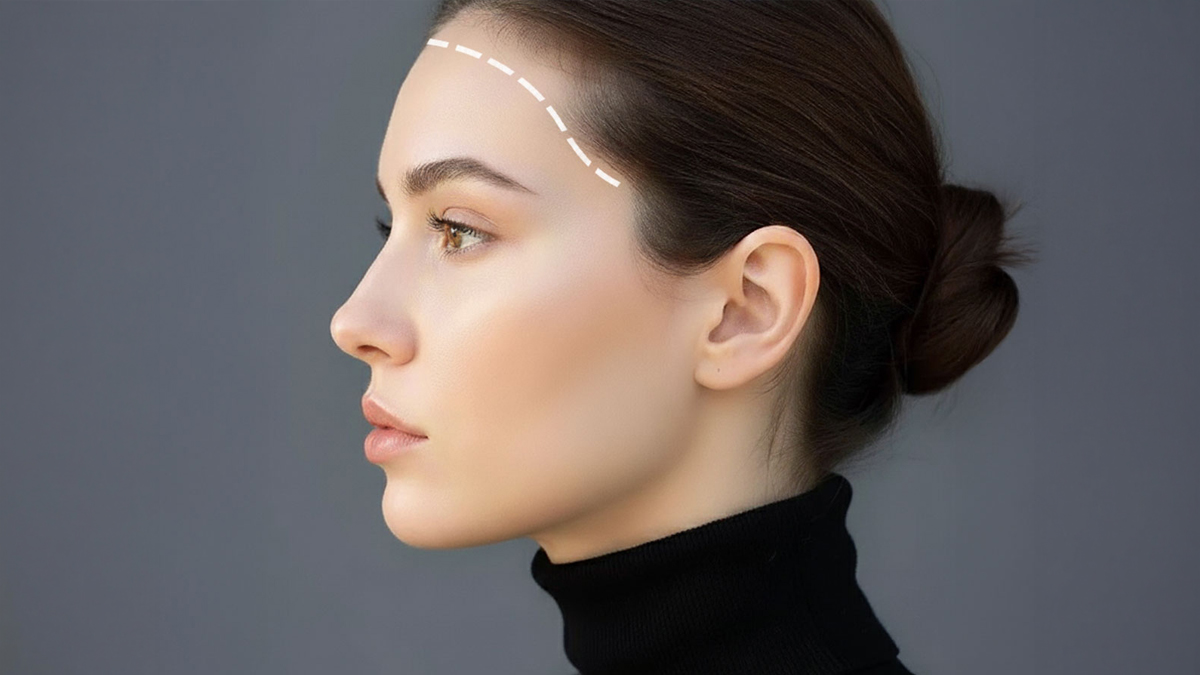
Usually the person asking already knows. But a selfie held at arm's length flattens everything, so it's a poor judge. There's an old trick from portrait drawing. Divide the face into thirds: top of the forehead down to the brows, then on to the bottom of the nose, then to the chin. If that first third is obviously the biggest, you'll see it straight away, and it's the forehead people notice first in photos. That imbalance is what hairline lowering surgery is built to correct.
Sometimes the forehead is fine and something else is making it look bigger. Brows sink a little with age. Temples thin out. Even a centre parting with the hair lying flat can add what looks like an extra centimetre. Each has its own fix. Brows sitting low and heavy over the eyes may point towards a brow lift as well, or first. If it's mostly the corners that have gone, that's a temple question, and grafts answer it almost every time.
Female hairline lowering
Most people who have the surgical version are women, as noted above. Biology explains it better than demand does. Women are more likely to have the combination surgery depends on: a hairline set high since the teenage years that has stayed exactly where it is, and a scalp with some give in it.
A few practical things come up early. Plenty of women have worn a fringe for a decade to cover the forehead, and want to know whether they'll ever be able to drop it. Often, yes. Longer hair helps in the first weeks too, because it can be styled over the healing line. And if thinning runs in the women of your family, mention it. Forehead reduction moves the line you have today. It does nothing for diffuse thinning further back, which is where a female hair transplant or medical treatment comes in.
Hairline lowering for men
Men often arrive expecting the opposite answer. Their hairline has moved back, and one afternoon in theatre sounds a lot better than a year of watching grafts grow. Here's the catch. Receding hairlines tend to keep going, even after a quiet few years. Pull the scalp forward over one and the hair behind the new scar may carry on thinning. You'd end up with a hairline that can't move and a thin patch growing behind it.
That's why, for most men we see, lowering the hairline ends up meaning grafts at the front. We draw that line on the cautious side. Picture it on you at fifty, and keep the temples soft. Surgery isn't off the table for every man, mind. If your forehead has always been tall, nothing has receded, and your dad looks just the same in his old photos, you might qualify. That's a smaller group, and we'd want evidence of stability before agreeing.
Hairline lowering vs hair transplant: living with each one
Most comparisons stop at scar or no scar. Day to day, other things matter more.
After forehead reduction surgery in Turkey or anywhere else, the change shows as soon as the swelling goes down. You'll have stitches, a line along the front that starts pink and fades over the first year, and an area of numbness behind it that can last weeks or months. It can't be undone, because the skin that came out isn't going back. On the plus side, every donor hair stays where it is for later.
A hair transplant for the hairline looks like very little at first, just tiny crusts. The waiting is the hard bit. Hairs shed, the first growth comes in patchy, and it's nine to twelve months before the line looks finished. You use donor hair you may one day want for the crown. The upside? If the shape needs a tweak, a second session can sort it, and you'll never have an incision line to hide.
There's no universal winner here. It depends on your scalp, on whether your hair is still moving, and honestly on which downsides bother you less.
How much can a hairline be lowered?
Surgically, it depends on how much your scalp moves. For most people that's a couple of centimetres. We can't make a tight scalp looser, however the operation is done. When someone wants more than one operation can deliver, grafts in front of the healed line are the usual top-up.
With grafts, the limits are donor supply and how the line will age. Every extra millimetre down means more grafts spread over a bigger area that has to look full from the side as well as the front. We'd rather set a line slightly higher that still convinces in ten years than chase the lowest possible point. For a hairline, many surgeons prefer DHI because each hair's angle can be set as it goes in.
Before your hairline lowering in Istanbul
We start planning while you're still at home. Your blood results need to be in before we confirm a date. We'll also ask what you take every day, so put everything on that list, even the daily aspirin or the hair-loss tablets you've stopped thinking of as medicine. Had a scalp operation before? Tell us what was done. And if a scar has ever healed thick or raised on you, say so now. For surgery, it matters a lot.
On the morning itself, the new line is drawn while you're sitting up, because that's the angle everyone else sees you from. You'll look at it in a mirror and agree to it first. Think it's too low? Speak up. We plan around hair you might lose later and around how your face will age, so on day one the line can sit a little higher than you'd hoped. That's on purpose.
Hairline lowering recovery
The two routes heal very differently.
If you've had surgery, your forehead will swell for the first few days, and some of that swelling tends to slide down around your eyes. It goes. The stitches come out when the team says so. After that, the big thing is keeping strain off the wound. No heavy lifting for a while, no straining, nothing that tugs at the front of your scalp. How much pull a wound is under has a lot to do with how wide the scar heals, and that part is in your hands.
With grafts, we do your first wash at the clinic before you go. You'll get written instructions for the first ten days: how to wash, and please don't scratch. From week two, skip the gym and anything that makes you sweat. Same goes for drinking, smoking and sunbathing. Healing is quick. Two or three days does most of it, the crusts are gone soon after, and by two to three weeks your scalp looks normal again. People usually go back to office work within a few days.
The hairline lowering scar
If you go the surgical route, it's worth thinking about the scar on its own. It runs along the hairline. The closure is done so hair can grow up through it, which helps it blend in, though you'll still be able to find it if you look. Early on it's at its worst, red and a little raised. Give it time. Month by month it flattens, and the colour slowly drains out of it.
Don't decide what you think of it at six weeks. A year in is when it's fair to judge, and that's also the photo to ask for in any clinic's before and after gallery. Wet your hair and comb it straight back. If the line looks fine like that, it'll look fine anywhere. If parts of it still catch the light, grafts placed into the closure are a common second stage, planned from the start and not a sign anything went wrong.
Hairline lowering results
Results arrive on very different clocks. After hairline lowering surgery you can see the difference within days, as soon as the swelling goes down. The scar takes longer. It's still fading a year on. Grafts follow a slower calendar. The transplanted hairs usually fall out around week three. Some people see another shed at about two months. Both are expected. New growth starts showing around month four, and you're looking at nine to twelve months for the final result.
Once they've taken, transplanted hairs hold up against pattern loss, so they stay. The hair around and behind them doesn't share that protection. If loss is still active, it carries on behind the new line, which is why we never use up the whole donor area in one go and why some people come back years later.
Hairline lowering before and after: what to look for
Whichever clinic you're considering for hairline lowering in Turkey, the trick with its before and after photos is that a fringe or a side parting can hide almost anything. Ignore pictures with hair styled forward. Good photos match: same light, same angle, hair pulled right back. Ask for a side view too, because the temples are where a lot of hairline work falls apart. With surgery, the photo that matters is a close-up of the scar a year on. With graft results, zoom in on the very front. Real hairlines start with single hairs dotted about unevenly. A neat row gives the game away.
Patient videos and hairline lowering reviews are useful for something photos can't show: how the choice of route was made, and how people feel about it months later.
Hairline lowering cost and price in Turkey
Neither route has a fixed starting figure. The surgical price is worked out case by case, and the graft price follows the number of grafts your line actually needs, counted from your photos. That's why the hairline lowering price in Turkey shows as "on request" above, next to typical figures abroad. Our quote also covers your hotel and transfers.
Comparing clinics? Get each quote in writing and check what it actually says. Is it for surgery or grafts? How far will the line move, or how many grafts are planned? For surgery, how will the wound be closed? And who's doing the operation? Two very different procedures go by the same name, so one clinic's hairline lowering cost and another's cheaper figure might be prices for two different things.
What to send for a hairline lowering quote
Front and side photos with your hair pulled back, as above, and a few extras that save time. If you've got an old photo of yourself at eighteen or twenty-five, send that too. Nothing shows faster whether your hairline has moved. Mention any hair-loss medication as well, and anything that's happened to your scalp before. Our Istanbul team will look at the lot and come back with a route. You'll also get a rough idea of how far down the line could go and what your hairline lowering in Turkey would cost.