
 English
 Italiano
 Español
 Français
%20(1).webp?v=mumqr7dy)
.webp?v=mumqsa98)
.webp?v=mumqqfe8)

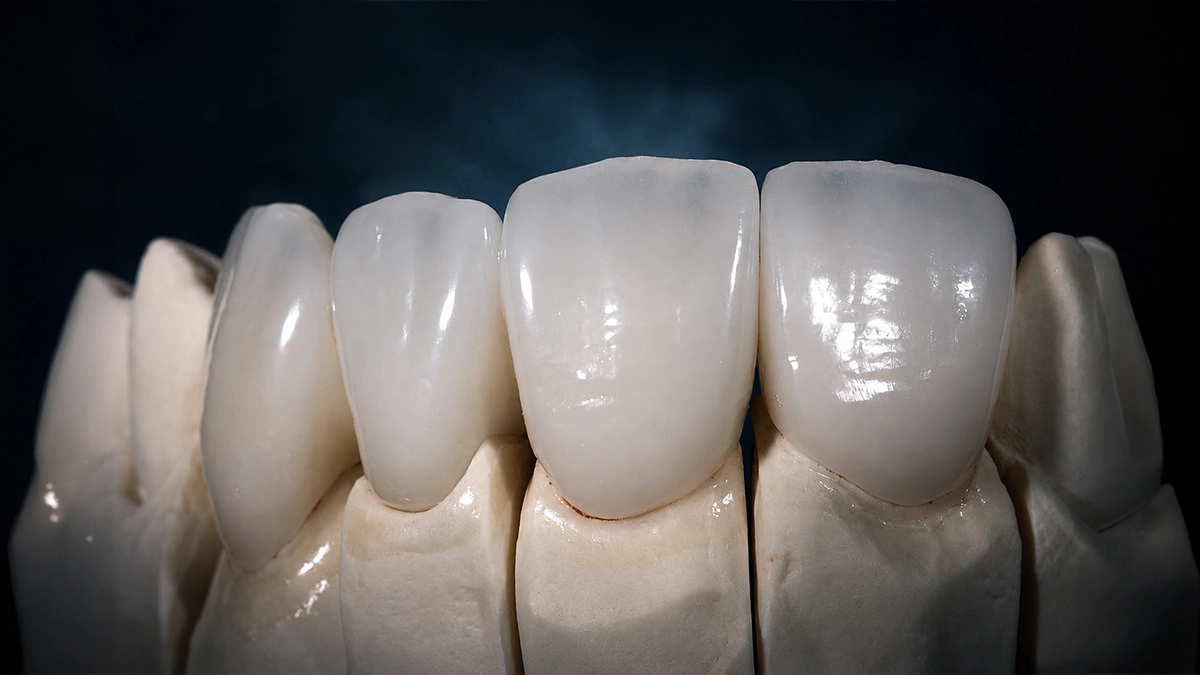















The hardest crown to get right isn't a whole arch. It's one front tooth sitting between natural ones, in plain view. If the colour, outline, texture or gum is even slightly off, the real tooth next to it makes the difference obvious, and eyes go straight there.
That's the job E.max crowns get picked for more than any other, and it's why so many people searching for E.max crowns in Turkey are really asking about a single tooth. Why the material fits the job is covered above. Light behaves in it roughly as it does in a real tooth. But material is only part of it. A handful of other things decide whether that one crown passes unnoticed, and they matter just as much on a row of them.
What's underneath can show through
A see-through crown has one catch. Light gets into it, so whatever lies beneath gets some say in the final colour. Over a healthy, normally coloured tooth, that's a bonus: the crown picks up a natural warmth.
The problem comes when the tooth underneath isn't normal-coloured. Front teeth that end up needing crowns were often root-treated years earlier, and root-filled teeth tend to go darker with time. Some have a metal post inside, or an old dark core. Put a very translucent crown over a grey stump and the grey shows, however carefully it was shaded.
There are ways round it. Bleaching the stump from inside sometimes helps. A less translucent E.max block is another route, as is a light-coloured lining inside the crown to mask what's underneath. If the stump is very dark or the post shows badly, we'd usually switch to a zirconia crown with an opaque core instead. It always starts with an X-ray and a look at the stump colour, which is why the dentist photographs the tooth after it's prepared, not just before.
Taking the shade first
This one catches people out. A tooth that's been dried out looks paler than it really is. Keep it dry under cotton and suction for half an hour and it can lighten by a shade, and take some time to come back.
That's why we pick the shade for a single crown first thing, while your teeth are still damp, and by the window if we can. The pathway mentions daylight shade photos; for this kind of case they have to capture the teeth either side in detail. A clearer tip, a tiny white mark, a slightly warmer band near the gum: the technician needs to see all of it. They can only copy what's in the photos.
The gum line matters as much as the crown
People judge a single front crown by its colour. Often it's the gum that gives it away first. If the gum sits higher or lower on the crowned tooth than on its partner, or looks red and puffy at the edge, the crown will look wrong however good the ceramic is.
Old crowns are often to blame. Years under one can leave the gum a little swollen, or shrunk back. After the swap it takes a while to adapt to the new outline, and your temporary crown helps steer it. If one front tooth's gum is obviously higher than the other's, we might suggest evening it up with a small gum trim.
During the try-in, don't just stare at the tooth. Smile as you normally would and check the gum line runs evenly across.
How an E.max crown is fixed
How glass-ceramic is etched and bonded is covered on our E.max veneers page. With crowns there's an extra question: is bonding even the right method?
Enamel is what bonding likes, and teeth needing crowns are often short of it. Where the crown's edge ends on healthy enamel above the gum line, a bonded E.max crown holds superbly. Where it ends deep below the gum, or on filling instead of tooth, keeping things dry enough is hard and the bond may suffer. In that case the crown can be made a little thicker and cemented the traditional way, or we might go for zirconia.
Where will the crown's edge sit, and what will hold it? Put that to the dentist early on. Don't be surprised if the honest answer is "we'll know once the old work is off".
Making the try-in count
As the page above says, each crown is tried in before it's fixed, while changes are still free. For one front crown, give that moment a few minutes.
Take it over to the window. Relax your lips, then say a few words with "f" in them, and compare its length with the tooth on the other side. Glance at the tiny notches between the biting edges; real teeth usually have them, and a crown without them looks squarer. Then the surface. Your natural front teeth probably have soft ridges you've never noticed, and a perfectly glassy crown will reflect light in a different way.
Then the contacts. Try flossing either side. There should be a little snap as it goes through. Too loose and food will pack in; too tight and the floss shreds. Speak up about anything you're unsure of. Shape and texture can still be altered at this stage, and sometimes the colour.
E.max vs zirconia crowns for premolars
E.max isn't just for front teeth. The upper premolars, just behind the canines, show in most smiles, especially when people laugh. When one needs a crown, often after a root canal, there's a choice front teeth rarely face.
Premolars do a fair bit of chewing, though nothing like a molar. E.max usually handles them well and means your smile looks natural further back. For heavy grinders, or bites that put a lot of force through those teeth, zirconia may be safer even though it shows a little. The FAQ above touches on this. It's decided tooth by tooth, from your bite, not by a rule.
Mixing E.max crowns and veneers
We often see one front tooth broken badly enough to need a crown, with the teeth beside it intact but discoloured. Those neighbours only need veneers.
We'd generally go along with that. It saves the healthy teeth from being cut down for crowns. Getting them to match is the hard part, because a crown covers the whole tooth and is thicker, while a veneer is a thin front layer over real enamel. Using the same ceramic for both helps hugely, which is a big reason E.max gets chosen. Our dental veneers section covers the veneer side.
Front implants and short bridges
When a missing front tooth is replaced with an implant, the visible part is still a crown, often E.max. What's underneath is different: a connector screwed into the implant, called an abutment. A metal one can give the crown a faint grey tint through thin gum, so at the front a tooth-coloured abutment, or a crown designed to block the metal, is usually preferred. Our single dental implant page covers the whole process.
E.max can also make small bridges, but the manufacturer only approves short spans, at the front or around the premolars. A long bridge, or one at the back where forces are high, needs something stronger. If a quote shows a long E.max bridge across the back teeth, ask why. Our dental bridge page explains how bridges are planned.
E.max crowns cost in Turkey, and when a full row makes sense
E.max crowns in Turkey are €200 per tooth on our price list, with six and ten units shown as examples. Compared with UK prices, even a single front crown usually costs a fraction, and the gap grows with every tooth. The quote should name the material. If it just says "ceramic", ask.
Sometimes a whole row really is the answer. Acid erosion or decades of grinding can leave the front teeth short and thin. Big old fillings, or a run of crowns that are all failing at once, are other good reasons. Healthy teeth are another matter. Crowning them just for colour or shape means grinding away a full layer of tooth on every side, and that's permanent. Veneers can usually give the same result with much less loss. If someone suggests crowns on sound front teeth, they owe you an explanation.
Judging E.max crown results: photos and reviews
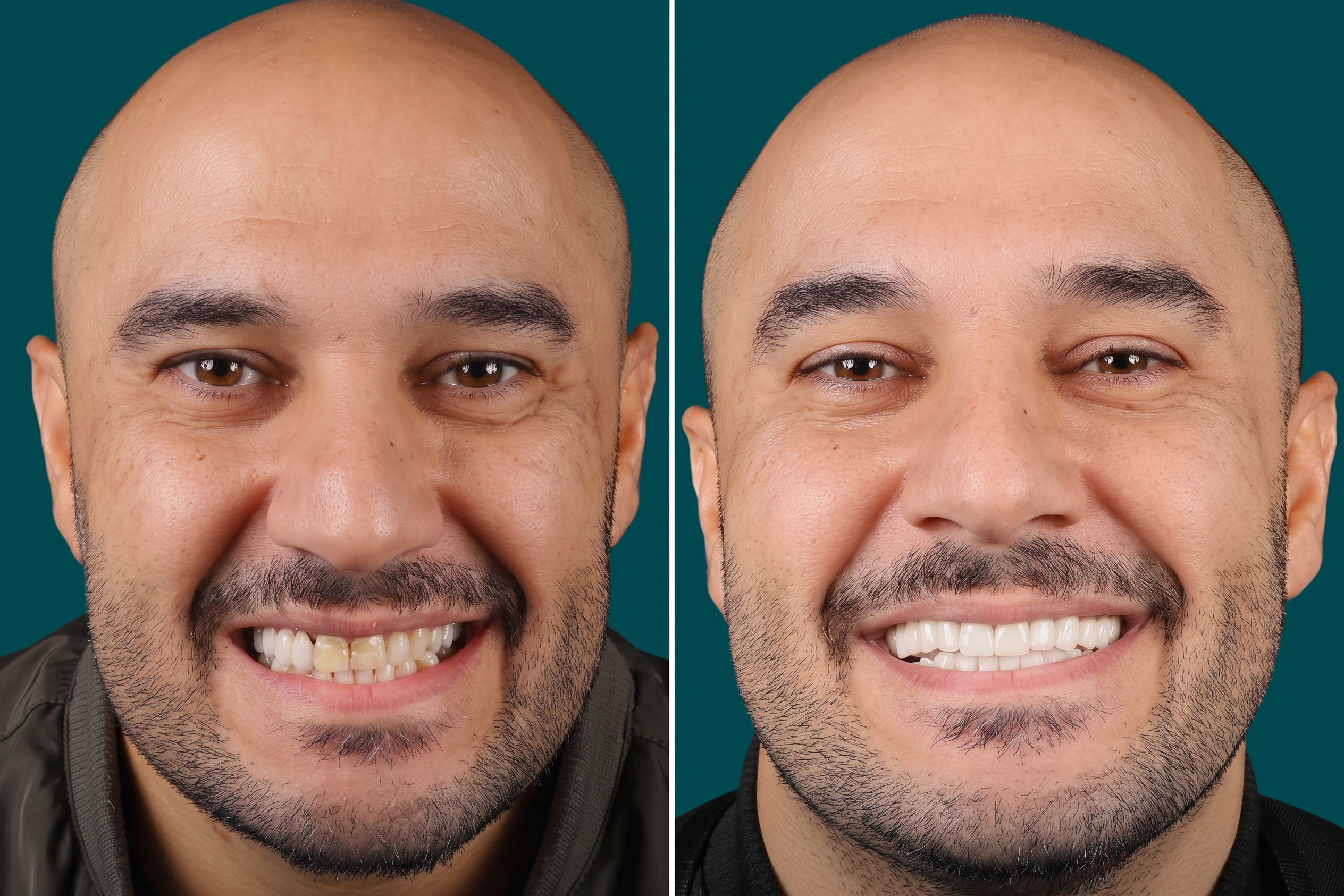
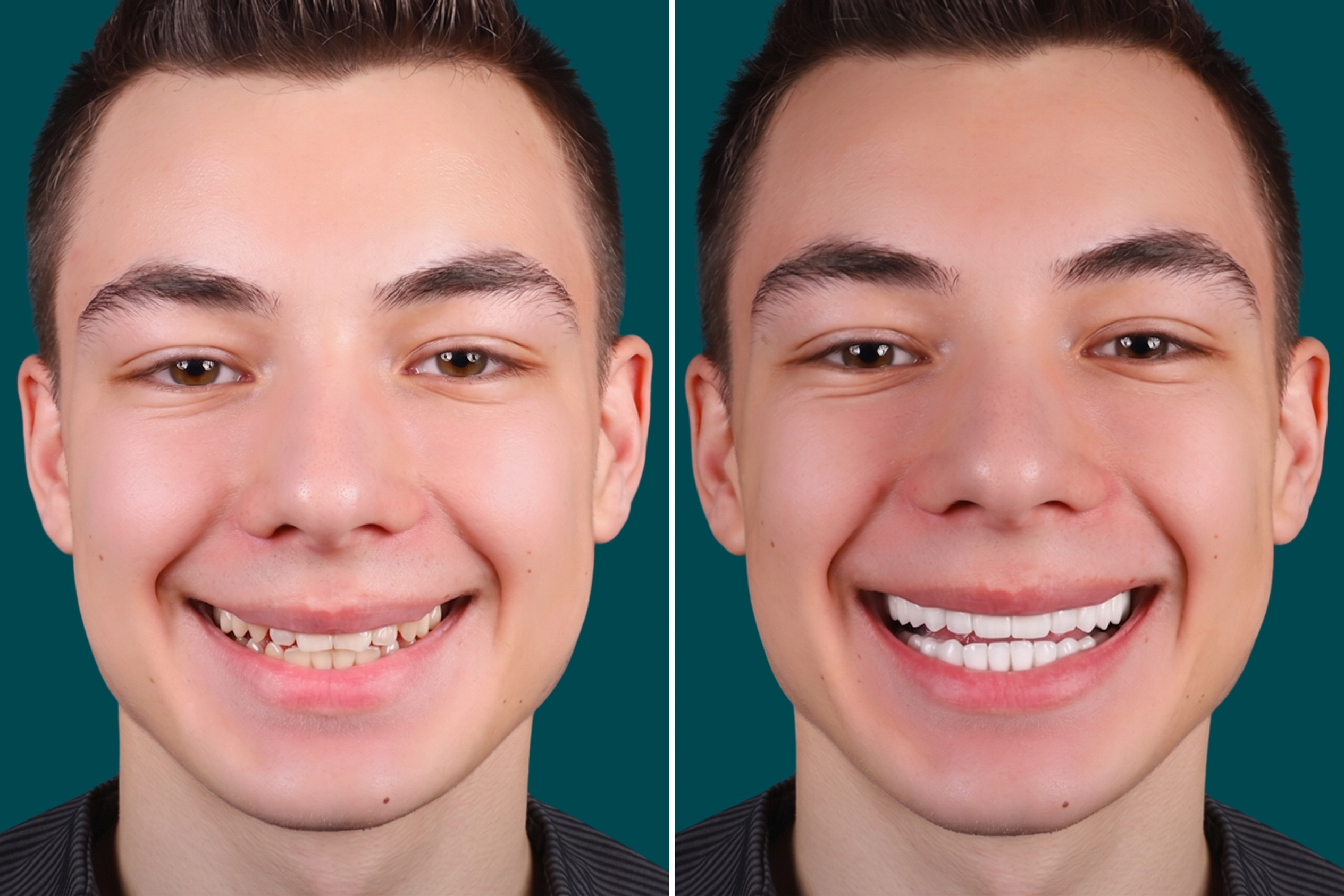
Here's a test for single-crown before and after pictures: can you spot which tooth it is? If not, that's a good sign. Favour photos taken in natural light over ring-lit close-ups, and look at the gum on both sides of the crown. Reviews posted years later show whether the match held up.
Living with E.max crowns, and how long they last
Looked after, a well-fitted E.max crown should give you many years; crowns in general tend to last ten to twenty. Glazed E.max doesn't stain the way enamel does. Good news for the crown, with one side effect people don't expect. Your real teeth, meanwhile, pick up colour from tea, coffee and simply getting older. So a crown that was a perfect match on day one may stand out as slightly brighter a decade later. Bleach your other teeth before the crown is made, then do a top-up every so often, and the two stay closer.
Day to day, just look after it like your other teeth. Packets and thread need scissors, not incisors. Grinders need the night guard. Pay attention to the join at the gum when you brush, because most problems start there. And a tiny chip is easiest to deal with early, often with nothing more than a polish.
Planning a single E.max crown in Istanbul
For a single E.max crown done here in Istanbul, the most useful photos are the simplest. A natural, full smile in daylight, showing the tooth and the ones either side, plus a close-up if possible. Any X-ray you have helps. Mention any root canal, post or earlier crown on that tooth, because that history affects the result more than shade does. For how E.max compares with the other options, see our dental crowns page.