
 English
 Italiano
 Español
 Français
.webp?v=mumlt570)
.webp?v=mumlucqk)
.webp?v=mumls97a)
.webp?v=mth4mn70)















Most people don't mind if all their teeth are a shade or two yellow. What bothers them is the odd one out. One grey front tooth in a row of normal ones pulls every eye in a photo, and it's often the thing that sends someone looking at veneers in the first place.
That's the job zirconium veneers are built for. Every other veneer is chosen for how it looks. Zirconium is chosen for what it covers up. It's brilliant at that, and the wrong pick for most other things.
Why has the tooth gone dark?
Find that out first. It changes the plan.
Usually it's an old injury. The tooth got knocked, maybe a decade ago, the nerve died off quietly, and the tooth went grey from the inside. It may have had a root canal since, or not. Either way the colour is inside the tooth, not on top of it.
There are other reasons too. Tetracycline is one. It was handed out a lot for childhood infections once, and in some people it left grey or brown stripes inside the teeth that were still forming. Fluorosis is another, from too much fluoride as a child, and it shows as patchy white and brown blotches. And occasionally the tooth's fine and the dark colour is coming from behind it. An old metal post in a root-filled tooth, or a dark filling at the back, can glow through like a shape behind a bathroom window.
So the first step on the pathway above is an X-ray. We want to know if the root filling is sound, whether there's infection at the root tip, and whether there's metal inside. Put a veneer over a problem nobody has dealt with and you've only hidden it for a bit.
Try the gentler fixes first
No veneer in our range takes off more tooth than zirconium. That's a good reason to try other things first.
Got one dark, root-filled tooth? Internal bleaching is usually where we start. The whitening gel goes into the tooth from behind, through a tiny opening, instead of onto the surface. Some teeth lighten so much that they then need only a thin veneer, or nothing. It doesn't work every time, and the colour can creep back over the years, but nothing extra is drilled off the front, so it's worth asking about.
If the tooth is only a bit dark, a more opaque glass-ceramic may cope. Our E.max veneers page explains that E.max comes in different levels of see-through. A cloudier one, made a touch thicker, can hide a fair bit of colour and still bond as strongly as glass-ceramic does.
Zirconium is for when those won't cut it. Very dark teeth. Heavy tetracycline stripes. Metal that a thin shell just can't hide.
What opacity actually does
All the other veneer materials let some light through. Light gets into them, scatters, and comes back out, which is how enamel works too, and it's why they look natural. The flip side is that on a dark tooth, the light picks up the grey on its way through and brings it with it.
Zirconia doesn't let light through. The figures on the page above make the point: 0.4 mm of glass-ceramic still shows the colour beneath, an opaque zirconia core hides it.
There's a price for that. Something light can't get into tends to look flat, a bit like a tile. So the core gets milled, then the front is built up with porcelain. That porcelain gives the tooth some depth again. Skip it and the veneer stands out as artificial.
What it costs in tooth structure
The page above says zirconium veneers need 0.5 to 0.8 mm of space, more than glass-ceramics. Two reasons.
First, room. The opaque core has to be a certain thickness to block colour, and the porcelain on top needs its own space.
Second, the way it's fixed on. Glass-ceramic is etched with acid and bonded so firmly that shell and tooth act as one piece. Zirconia doesn't etch like that. Its inside is roughened with a fine sandblast, coated with a primer, and cemented on. It works well, and it's been used on zirconia crowns for years, but it leans more on the shape of the prepared tooth to stay put. That usually means shaping a little more.
On a dark tooth that really needs hiding, that's a fair trade. Do the same on a perfectly good tooth and you've lost enamel for no reason.
One opaque tooth among translucent ones
A common plan, described above, is zirconium on the grey tooth and glass-ceramic on its neighbours, all tinted to the same target shade. It makes sense. Labs find it hard, though.
Opaque and see-through ceramics don't react to light in the same way. Indoors they can look identical. Use a flash and the translucent ones may brighten at the edges while the zirconium looks denser. Club lighting is the extreme case: real teeth fluoresce a pale blue under UV, some ceramics less so, and untreated zirconia can look darker than everything round it. Labs have porcelains and stains that fluoresce like teeth. Say if it bothers you.
This is the reason for the try-in mentioned above, before any cement goes on. Stand by a window. Take a quick flash photo if you can. A small mismatch is easy to fix at that point and much harder afterwards.
When the whole smile is dark
Sometimes it's every tooth. Heavy tetracycline staining puts the same grey or brown bands across the whole front, and whitening hardly touches it.
That's a different job from one dark tooth. There's no natural tooth to copy, so the lab is effectively inventing a new set, and the risk of a flat, too-white, all-the-same look goes up. The porcelain layer on each shell matters even more, and so does the trial smile. Count how far back your smile goes, as well. Stained teeth that show when you laugh have to be included, or you'll see a line where the new teeth end.
Zirconium usually earns its keep in smiles like these. But it's the design that decides whether anyone can tell.
The grey line at the gum
One thing zirconium can't always fix. Better you hear it now.
If a tooth has gone dark from the inside, the root may be dark too. Where the gum is thin, that colour can show through as a greyish shadow just above the veneer's edge. The veneer covers the tooth. It can't do anything about the root under the gum.
Metal-based crowns do something similar. Gums recede with age, a grey edge appears, and replacing the crown with a metal-free one usually sorts it. A dark root is harder, but internal bleaching sometimes lightens it, and a well-placed veneer edge can disguise a little more. Even so, very thin gum over a very dark root may still leave a faint shadow. A good dentist will tell you that up front.
Zirconium vs E.max: when it's sold for the wrong reason
Zirconia is incredibly strong, around 1,200 MPa according to the page above, way ahead of any other veneer material. You can see why "the strongest veneer" makes an easy sales line.
Up front, though, sheer strength isn't what makes a veneer last. Once a decent ceramic is bonded properly, it and the tooth share the load. Veneers usually fail for duller reasons. Too much enamel taken off. A rushed bond. A bite that hammers one tooth harder than the others.
So if your teeth are healthy and a normal colour and you're told zirconium is best for all of them because it's strongest, ask why. You'd be losing extra tooth for strength you don't need, in the material that's hardest to make look natural. Most people are better off with E.max, porcelain or even laminate veneers. Our overview of all five materials shows what each one is for.
Zirconium veneers cost in Turkey
Zirconium is near the top of our veneer price list, mostly because of the porcelain layering and extra lab work. But few people need it on more than one or two teeth. The rest usually get glass-ceramic, so you're rarely paying for ten zirconium shells. Compared with UK prices for the same thing, zirconium veneers in Turkey tend to cost a fraction. Whatever quote you get, it should say which teeth are zirconium and the reason for each.
Photos, reviews and how long they last
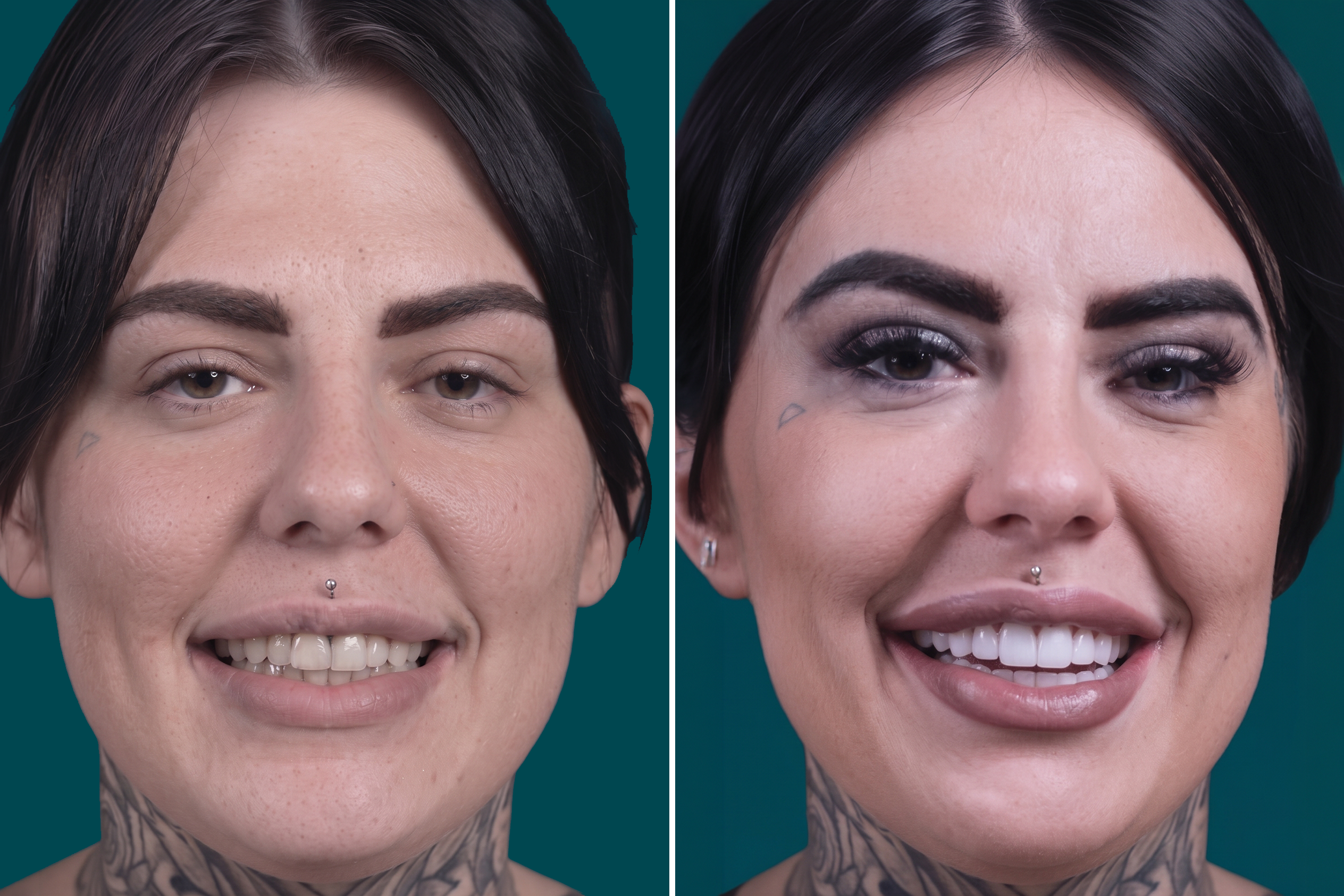
When you look at zirconium veneers before and after photos, find the tooth that was grey. Does it blend in now, or still jump out under a flash? Reviews from people a few years down the line are the useful ones. Look after them, and wear a night guard if you grind, and you can expect well over a decade from them.
Veneer or crown for a root-filled tooth?
Dark teeth have often had a root canal. So would a crown be better than a veneer?
It comes down to how much tooth is left. If the root canal went in through a small hole at the back and the tooth is still mostly intact, a veneer is usually fine. But a tooth that's more filling than tooth, or has a big post in it, or has already lost a corner, is different. Veneer that and you've dressed up the front while the rest is free to crack. It needs covering on every side.
Then a full crown is usually safer. Zirconia is used for those too, and our zirconia crowns page explains when a crown is the better call. Since zirconium veneers already need deeper preparation than other veneers, the difference in drilling can be smaller than you'd think. Another reason to decide tooth by tooth.
What to send before coming to Istanbul
Thinking about zirconium for one or two dark teeth? The most helpful thing to send, along with your photos, is an X-ray of those teeth if you have one. Tell us what you know. Did the tooth take a knock? Roughly when did it start changing colour? Has it had a root canal, and when?
For the photos, use daylight, no filter, and get your normal teeth in the shot next to the dark one. That lets the dentist judge how much colour needs hiding, and whether internal bleaching, a more opaque glass-ceramic or zirconium is the likely answer.