
 English
 Italiano
 Español
 Français
-1.webp?v=munwbinr)
-1.webp?v=munwc8nk)
-1.webp?v=munw2t0u)
-1.webp?v=munw3qia)




.png?v=mtn37ore)
.png?v=mtn382cn)
.png?v=mtn38kn8)
.png?v=mtn3922l)
.png?v=mtn39jxs)
.png?v=mtn39vgz)

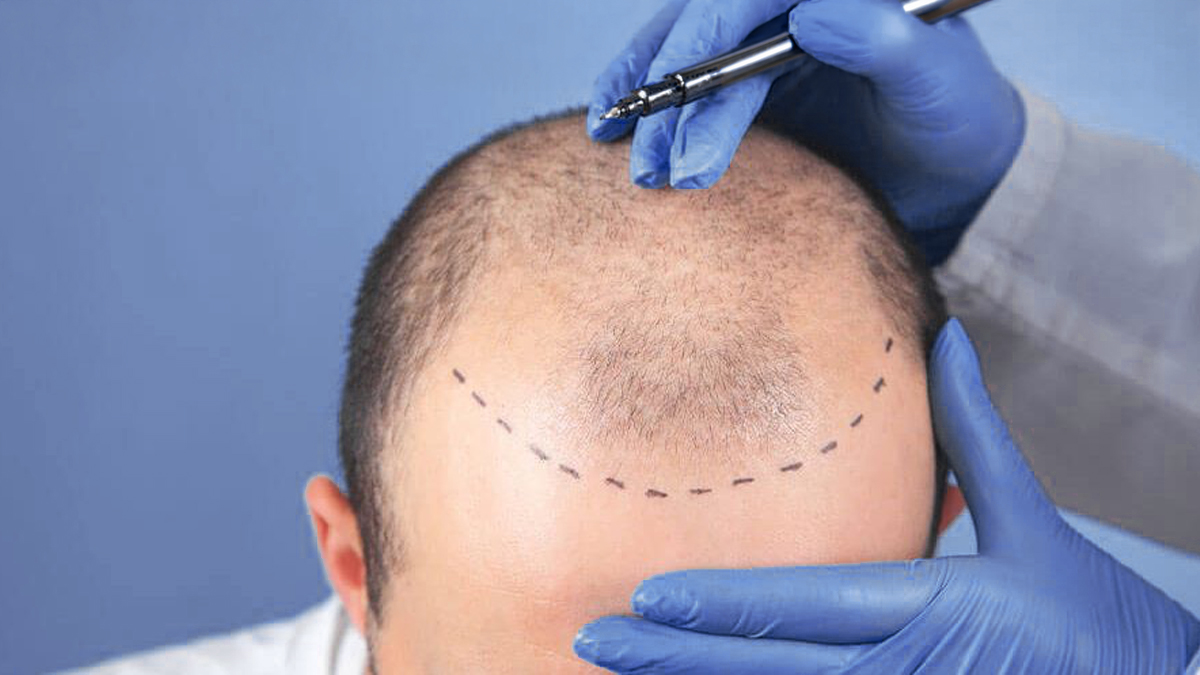
Scroll through FUE hair transplant photos and your eye goes straight to the front. New hairline, fuller top, big before and after. The real work of FUE happens somewhere else. It happens behind you, in the donor area, where a few thousand follicles are lifted out one at a time. How well that part is done decides how your hairline looks in a year, and how the back of your head looks for decades afterwards.
Most people's first worry is the one in the tagline up top: the scar. FUE's answer is tiny dots instead of a line. Below: what those dots actually are, how they're kept out of sight, and the small habits that tell a careful extraction team from a rushed one.
How an FUE hair transplant works, step by step
Hair clipped, scalp numbed front and back, and then the slow part begins. Working across the back and sides, the surgeon or technician uses a hollow micro-punch, thinner than a millimetre. The punch is centred over a follicular unit, turned or pushed gently to free it from the surrounding skin, and the graft is lifted out with fine forceps.
Each graft is checked, sorted by the number of hairs it carries, and kept in a cool storage solution while the rest are harvested. Then, as the pathway above explains, the recipient channels are opened in the thinning area, and the grafts are placed into them one by one at the angle and direction your existing hair grows. Nothing is cut out in a strip and nothing needs stitching.
The safe donor zone
Not every hair back there is equal. There's a horseshoe-shaped band, roughly from above one ear, round the back of the head, to above the other, where follicles are most resistant to pattern loss. That's the safe donor zone, and good FUE stays inside it.
Grafts taken from too high on the crown, or too low on the neck, may come from hair that thins later in life. Taken from the neck, they can also be finer and grow at awkward angles. Keeping extraction within the safe zone is one of the quiet decisions that protects both your result and your donor for the long term.
Punch size, hair type and transection
The page above notes that punches are under a millimetre wide. The exact size isn't fixed. It's chosen to match your hair.
Fine, straight hair can usually be taken with a very small punch. Thicker hair, or hair that curls under the skin, needs a slightly wider or differently shaped punch, because the follicle below the surface doesn't run in a neat straight line. If the punch is too small, or angled wrongly, it can cut through the follicle as it frees it. That's called transection, and a transected follicle may not grow.
Transection rates aren't something many clinics publish, but it's a perfectly reasonable question to ask. A careful team will talk about how they adjust punch size and angle for your hair type, especially if your hair is very curly. Curly and afro hair raise their own challenges, covered on the afro hair transplant page.
Time out of the body
Between being lifted out and being placed in its new home, each graft is outside your body. The page above lists this, alongside punch and handling, as one of the things that decides the result.
Grafts are delicate. They need to be kept cool, moist and handled only gently, by the edges rather than the bulb at the base. A well-organised team keeps that time as short as practical, often by extracting and placing in batches rather than harvesting everything first and planting it all hours later. It's not something you'll see from the chair, but it's worth knowing it's being managed.
Spreading the extraction evenly
This is the detail that separates a donor area nobody notices from one everyone does.
A good surgeon takes grafts spread out across the whole safe zone, leaving plenty of hair between each extraction site. Taking too many from one patch, or too many overall, leaves the back looking thin, patchy or "moth-eaten", especially once the hair is cut short. That's usually called overharvesting, and it can't be undone, because the follicles that were taken don't grow back.
This is also why the number of grafts in an FUE hair transplant in Turkey is set by your donor, not by the package. The page above is clear that "up to 5,000" is a ceiling, not a promise. For some people it's comfortably achievable. For others, taking that many would mean a thin donor area for life.
FUE scars: what the donor looks like afterwards
The hero line above makes the point: FUE leaves tiny dots, not a line. Each extraction site closes within a few days and, once the hair grows back to stubble length, becomes a small pale dot that sits among the surrounding hair.
At most normal lengths, including short back-and-sides cuts, those dots are hidden. The one situation where they may show is a very close shave, such as a skin fade or a zero clipper guard, where there's no hair left to hide them. If you like to keep your hair shaved right down, mention it at the consultation, because it may affect how grafts are spread and how many are taken.
How many grafts can FUE take?
Of all the techniques on this site, FUE is the one that can reach the full package ceiling, because grafts can be spread across the whole safe zone in one session. Whether you get close to that number depends on your donor density, the size of the safe zone and the thickness of your hair. A person with dense, coarse donor hair may be able to give far more than someone with fine, sparse hair at the back.
That's also why FUE is so often the starting point for larger cases. The main hair transplant page explains how the right number of grafts is worked out in the first place.
Using beard or body hair
Running short on scalp donor? Some surgeons will borrow from under the chin, and now and then from the chest. It isn't a like-for-like swap. Beard hair is wiry. Chest hair grows short and gives up early in each cycle. So they tend to go where they bulk things out, behind the hairline or into the crown, and stay well away from the front edge.
It's an option for specific cases, not a routine top-up. If your scalp donor is thin, ask whether it's been considered.
FUE into an old strip scar
FUE also has a repair job. People who had a strip procedure years ago sometimes have a visible line across the back of the head, especially if they now like their hair short. Grafts taken by FUE can be placed into that scar to break it up and make it much less noticeable. Fair warning: scars don't have much of a blood supply, so grafts there are a bit hit and miss, and a second pass isn't unusual.
Who shouldn't have FUE?
Nobody can move hair that isn't there. Thin back and sides? Then the donor can't carry a big job. Patchy loss from alopecia areata, or shedding after chemotherapy, is a different problem altogether, and surgery isn't where you start. Those need a medical diagnosis and, often, time. A good FUE assessment says so plainly.
FUE vs FUT
The FAQ above sums up the headline difference: dots with FUE, a single line with FUT. For most people today, FUE is the default.
FUT still has a role. When very large numbers of grafts are needed, or when a donor area has already been thinned by earlier FUE, a strip can sometimes provide grafts that FUE can't. Some patients even have both, at different times, to get the most from a limited donor. The FUT hair transplant page covers when that trade makes sense.
FUE, sapphire FUE and DHI
It helps to know that sapphire FUE and DHI both use the same extraction described on this page. The difference lies in what happens next. Sapphire FUE changes the blade used to open the channels the grafts go into. DHI skips separate channels and places grafts directly with an implanter pen. So when people compare "FUE vs DHI", they're really comparing two ways of implanting grafts that were taken out in exactly the same way.
Shaving for FUE
Classic FUE means clipping both the donor and the recipient areas short, a point the pathway above makes in passing. For some people that's no problem at all. For others it's the biggest obstacle, especially if work or family life means they'd rather nobody noticed.
The donor area usually looks like an ordinary short haircut within a couple of weeks. The front takes longer to look normal because of the healing grafts. If shaving isn't an option, an unshaven hair transplant or DHI can be discussed, usually with fewer grafts per session.
FUE hair transplant recovery: the donor area
After an FUE hair transplant in Istanbul, the back of the head tends to feel more sore than the front for the first few days, because that's where most of the tiny wounds are. It can feel tight, tender or slightly numb in patches, and sleeping on your back may be uncomfortable for a night or two. Small scabs form over each extraction site and fall away within about a week or so with gentle washing.
Numbness in the donor area usually fades over the following weeks as the nerves recover. Tell the team if you notice anything that seems to be getting worse rather than better. At the front, FUE results follow the usual pattern: shedding around week three, new growth from month four, and the full picture at about a year.
FUE hair transplant before and after: check the back too
Most FUE hair transplant before and after shots show the hairline, and that's only half the story. Ask to see the donor area as well, ideally at a short haircut a year after surgery. You're looking for an even spread of hair with no thin patches, and dots too small to pick out. Patient reviews that mention how the back looks, not just the front, are worth far more than the ones that don't.
FUE hair transplant price and cost in Turkey
The FUE hair transplant price in Turkey is set here as one session: €1,600 for any graft count up to 5,000, €1,800 once accommodation is added, or €2,100 including fibroblast therapy. Many clinics abroad charge per graft instead, which is one reason the UK, German and US ranges shown above are so much wider. With a fixed price, there's no financial reason to push the graft number beyond what your donor can safely spare.
Photos of your donor area
For an FUE plan, the back of your head matters as much as the front. Along with photos of your hairline, top and crown, send clear close-ups of the back and both sides, ideally with the hair cut fairly short or combed so the scalp shows. If you've had a transplant before, include those areas too. Our FUE team in Istanbul can then judge how dense your donor is, how far the safe zone reaches, and how many grafts FUE can realistically take for you.