
 English
 Italiano
 Español
 Français
-1.webp?v=munwk66z)
-1.webp?v=munwl7fd)
.webp?v=munwltco)
.webp?v=munxkqh9)
.webp?v=munxkae8)


.png?v=mtn37ore)
.png?v=mtn382cn)
.png?v=mtn38kn8)
.png?v=mtn3922l)
.png?v=mtn39jxs)
.png?v=mtn39vgz)
"Sapphire" has become one of the most used words in hair transplant advertising, and one of the least explained. Some clinics sell a "sapphire hair transplant" as a premium upgrade. Others print it on every package whether anything has changed or not. The line under the page title puts it more simply: the blade that opens each channel shapes how your grafts sit and heal.
That really is the whole story. Sapphire improves one step of the operation; it doesn't work miracles. So it pays to know exactly where it helps, which of the claims about sapphire FUE in Turkey hold up, and how to check the blade in your quote is the real thing.
Sapphire FUE vs FUE: the one step that changes
Extraction in sapphire FUE, the section above confirms, is identical to classic FUE. Same punch, same donor area, same scattered dots. If you want to understand that part, the FUE hair transplant page covers it in detail.
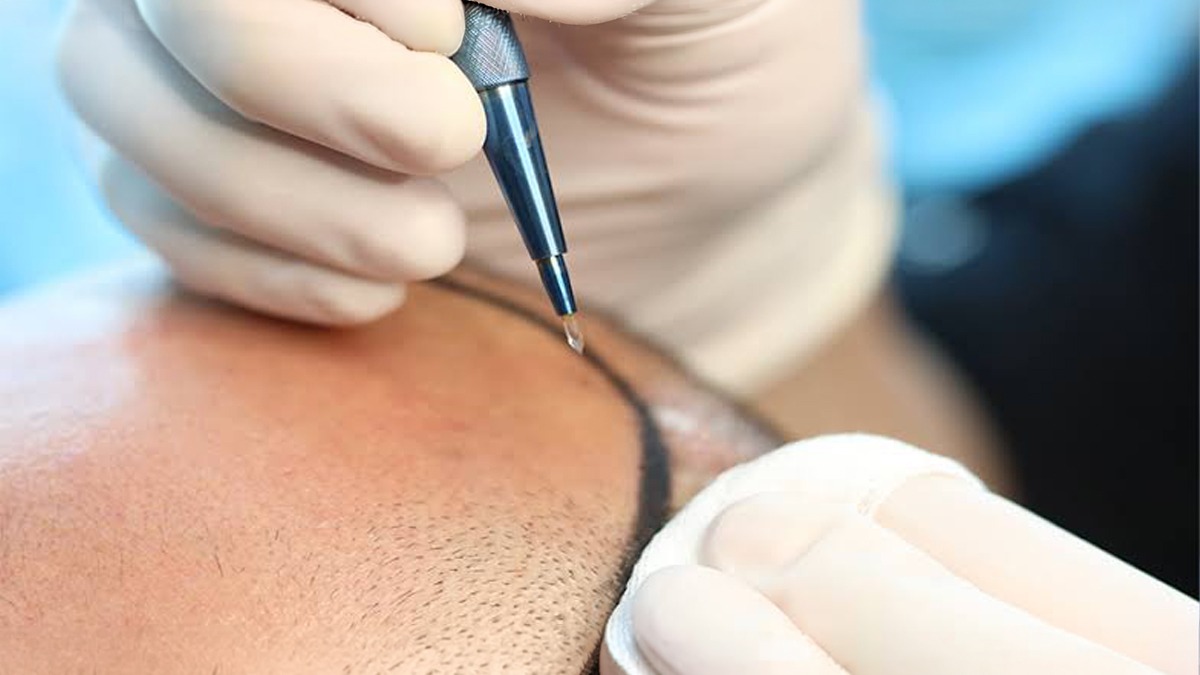
The difference comes afterwards, at the front. Before any graft can be placed, a small opening has to be made in the thinning area to receive it. That's the recipient channel, and a planted graft will grow in whatever direction, at whatever angle and depth, that channel sets. In classic FUE those openings are often made with fine steel blades or needles. In sapphire FUE they're made with blades cut from synthetic sapphire, 0.6 to 0.8 mm wide, as the page above says.
Who is sapphire FUE best for?
The pathway above points to large areas where density is wanted, and that's the classic sapphire FUE hair transplant case. Think of someone around Norwood 4 to 6: a receded hairline, thinning or bare skin across the mid-scalp, and often a crown that has opened up behind it. There's a lot of ground to cover, most of it without much native hair, and the head is going to be shaved anyway.
In that situation, being able to open thousands of clean, closely spaced channels in one day is exactly what's needed. For a small patch of thinning in otherwise full hair, or a hairline adjustment in someone who doesn't want to shave, other techniques often fit better. How that choice gets made is set out in the hair transplant overview.
Sapphire vs steel: an honest comparison
Being a harder material than steel, sapphire keeps a sharp edge through thousands of incisions, as the page above says, so the last channel of the day is cut as cleanly as the first. That consistency is its main practical advantage, along with the narrow, smooth openings it makes.
It's also fair to say that excellent results are achieved with fine steel blades and needles too. Put a great blade in careless hands and you'll still get a poor result. Put a decent steel blade in careful ones and you can get a very good one. Sapphire is a better tool in skilled hands. It isn't a substitute for them.
Why the channel matters so much
It's easy to think of the channel as just a hole. It's closer to a mould.
Tilt first. Along the hairline, hair creeps forward almost flat against the forehead, then stands up more and more as you move back towards the top. Then which way it points: around the temples and crown that shifts every few centimetres, like wind across a field. Then how deep. Too shallow and the graft pokes up out of the skin; too deep and it gets buried. And the width needs to be just enough to hold the graft snugly.
Get those right and transplanted hair falls naturally among the hair around it. Get them wrong and it can grow at odd angles, look tufted or refuse to lie flat, however well the extraction was done. Sapphire doesn't choose those angles for the surgeon. It simply makes it easier to cut them cleanly and consistently, thousands of times in a row.
Myth: sapphire FUE grows more hair
This is the claim patients most often bring with them, usually after scrolling through sapphire FUE results online, and it isn't really true. The number of hairs that grow depends on how many healthy grafts are placed and how well they're handled. A sapphire blade doesn't add follicles.
What sapphire can do is make denser placement easier. Because the channels are narrow and clean, grafts can sit closer together with less damage to the skin between them. In a large area that needs coverage, which is the case the pathway above has in mind, that can help the result look fuller for the same number of grafts. It's a real advantage. It just isn't the same as "more hair".
Lateral and sagittal slits
Few patients know this one, yet it's a question worth asking at any consultation. Channels can be cut in two orientations.
A sagittal slit runs front to back, in line with the direction the hair points. A lateral slit, sometimes called coronal, runs side to side, across the direction of growth. Lateral slits tend to hold a graft so the hairs fan out sideways, the way natural hair does, and they can make it easier to control the angle at which hair lies against the scalp. Many surgeons use lateral slits for most of the recipient area. It isn't a strict rule, and experienced teams may mix the two, but it's a good sign if the team can explain which they use and why.
How close is too close?
Dense packing is one of the selling points of sapphire channels, and the page above mentions a density map with targets for each zone. There's a limit, though.
Every graft needs blood supply to survive in its new place. Pack the channels too tightly and the skin between them can struggle, which may reduce growth rather than increase it. A sensible plan puts the most density where it has the most visual effect, usually the front and the part line, and uses a little less towards the back and crown, where the eye reads coverage differently. That's what "zone-by-zone" should mean in practice.
Matching the blade to the graft
The 0.6 to 0.8 mm range isn't a single size. It's a set of options. Single-hair grafts, which usually go into the very front of the hairline, are small and fit a narrower blade. Grafts carrying two, three or four hairs are larger and need a slightly wider one.
Using the right size for each graft keeps the fit snug. Too wide, and the graft may sit loosely or pop out. Too narrow, and it has to be forced in, which can damage it. A careful team sorts grafts by size as they're extracted and opens channels to match.
Sapphire FUE among existing hair
Sapphire FUE is at its best in areas that are largely bald, where channels can be opened freely without anything in the way. When the thinning area still has a fair amount of native hair, the picture changes.
Opening channels between existing hairs carries a small risk of damaging them, and some of that hair may shed temporarily after surgery. That's one reason DHI hair transplant is often preferred for thinning areas that still have hair, or for patients who can't shave. In many larger cases, the answer is both: sapphire channels for the bald zones, DHI where native hair remains. That combination is covered on the hybrid hair transplant page.
The crown and its spiral
The crown is where channel direction matters most. Hair there grows in a whorl, spiralling out from a central point, and each channel has to follow that swirl. If it doesn't, the crown can look thin even with plenty of grafts, because the hairs cross each other instead of lying together.
Sapphire blades make it easier to cut many small, precise channels in changing directions. The skill is still in reading your natural whorl and following it.
Sapphire FUE recovery and healing at the front
Donor healing is the same as in any FUE. The difference shows in the recipient area. Narrow, clean channels tend to mean less swelling and a little less bleeding on the day, and small crusts that clear within the first one to two weeks, in line with the healing note in the pathway above.
After a sapphire FUE procedure in Istanbul, once the crusts have gone, the recipient area often stays slightly pink for a while, especially on fair skin. That usually fades over the following weeks. Protecting the area from strong sun during that time helps it settle evenly.
Sapphire FUE price: is it worth it?
Here, there's no premium to weigh up. As the price section above explains, sapphire FUE is priced the same as classic FUE, up to 5,000 grafts: €1,600 on its own, €1,800 once three hotel nights are included, or €2,100 with fibroblast therapy on top. So sapphire FUE cost in Turkey, in this case, is simply the cost of the transplant.
Where sapphire is sold as an expensive extra, the question is whether that extra buys anything. The blade helps. The planning, the angles, the handling of each graft and the experience of the person opening the channels help far more.
Sapphire FUE before and after: judging density
Sapphire FUE is chosen for coverage, so judge the before and after images on coverage. Look at the mid-scalp from above, with the hair wet or parted, not just the front in profile. Check that before and after shots share the same lighting and angle, since a brighter light can make thin hair look fuller. And notice the direction the new hair lies: neat, consistent flow is a sign the channels were cut with care. Reviews that talk about how quickly the scalp settled are useful too.
Checking you're actually getting sapphire
The section above makes a pointed remark: for some clinics, "sapphire" is a word on a price list rather than a change in technique. It's a fair thing to check.
Ask what the recipient channels will be opened with, and in what sizes. Ask whether lateral or sagittal slits will be used. Ask who will open the channels, since that's the step that sets angle and direction. A team that genuinely works with sapphire blades will answer all of that easily, and will usually be happy to show you the blades.
Photos for a density plan
For sapphire FUE, the top and crown photos matter as much as the hairline. Take one straight down from above, with your hair parted in the middle, and one of the crown with the hair wet or combed flat so the whorl and the thin areas show clearly. Add the usual front, sides and back. From those, the team in Istanbul can map where density is needed most, whether sapphire channels, DHI or a mix suits your scalp best, and how many grafts your donor can support for a sapphire FUE hair transplant in Turkey.