
 English
 Italiano
 Español
 Français
.webp?v=muml67kk)
.webp?v=muml9rdi)
.webp?v=muml6okx)


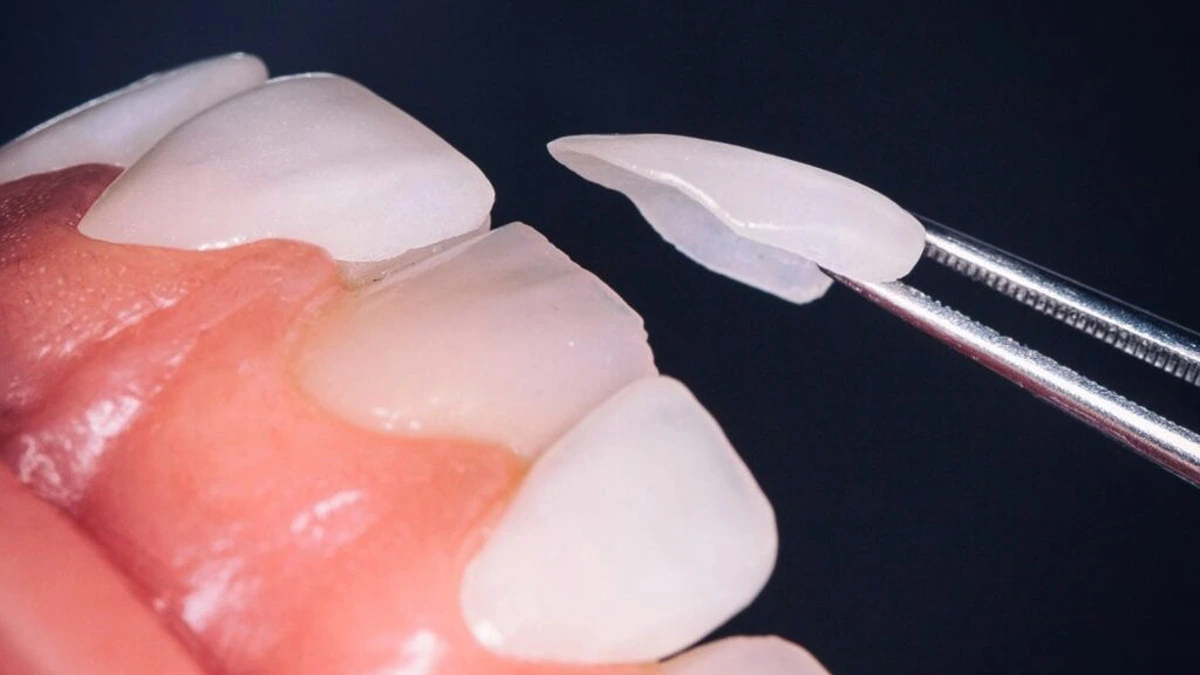
















Few words in cosmetic dentistry cause as much confusion as "laminate". Talk to one dentist and it simply means a porcelain veneer, full stop. Talk to another and it means something far narrower: a shell so thin that the tooth under it has barely been touched, and sometimes not at all.
On this page, laminate means the second thing. That distinction matters, because it changes what you're actually buying. A laminate isn't a special material. It's an approach, and honestly, it fits fewer mouths than the adverts would have you believe.
Same ceramic, different thinking
The shell itself comes from the same ceramic families as other veneers: porcelain built up by hand in layers, or the pressed glass-ceramic most people know as E.max. You can read about those on the porcelain veneers and E.max veneers pages.
What makes it a laminate is the thickness and the thinking behind it. A conventional veneer is planned so that the new shell replaces roughly the enamel that was removed. The tooth ends up about the same size it started. A laminate is planned the other way round. Little or nothing comes off, and the shell goes on over the top. You finish with a tooth that's very slightly bigger than before.
That one idea explains almost everything else on this page: who laminates suit, who they don't, and why the trial smile is so important.
A tooth that gets slightly bigger
On paper, half a millimetre is nothing. On a front tooth, you'd be surprised how visible it is.
For some teeth it's exactly the right amount. Think of front teeth ground short over the years, a side tooth that never quite grew to full width, or one that leans back behind its neighbours. On those, the extra thickness isn't a side effect. It's the whole point.
If your teeth are already a normal size and sit where they should, the same half millimetre works against you. The teeth start to look thick. Your upper lip rests a fraction further forward. In profile, the smile can look slightly puffy, as if something has been added rather than improved. This is by far the most common reason laminate cases disappoint, and the ceramic itself is rarely to blame.
Three people who might be well suited
It's easier to picture with examples.
The first is someone in her thirties whose upper side incisors never grew properly. They're narrow and a little pointed, and they leave small gaps on either side. Her other teeth are healthy and a good colour. Thin shells on those two teeth can widen them and close the gaps with almost no drilling.
The second is a man in his fifties whose front teeth have been ground shorter over the years. They're still sound, but they look flat and old. Laminates can add back the lost length. He'll have to wear a night guard, since the habit that flattened his teeth hasn't gone anywhere. His own enamel, though, stays where it is.
The third is the person with one front tooth set a millimetre or so behind its partner. She's noticed it in every group photo since her teens. Nobody else ever has. A laminate on that tooth brings it forward into the line of the arch without touching its neighbour, and because the tooth was set back to begin with, the added thickness is exactly the correction it needs.
What all three have in common is room. Each of them has space for the tooth to get slightly bigger without looking wrong.
And people who probably aren't
Teeth that already stick out are the clearest example. Adding thickness to a prominent tooth pushes it further forward, which is the opposite of what's needed. Those teeth either need moving with aligners first, or a conventional veneer with some reduction to keep them in line.
Dark teeth are the second. A shell as thin as a contact lens, as the page above describes it, lets most of the colour underneath show through. A tooth that has gone grey after a root canal will still look grey. For teeth like that, the opaque option on the zirconium veneers page is usually the realistic answer.
The third is anyone hoping for a big change in shape. Laminates refine. They can lengthen an edge, round off a corner or close a small gap. They can't turn crowded, overlapping teeth into a straight row.
What "no-prep" really means
"No-prep veneers" is one of the most appealing phrases in cosmetic dentistry, and one of the most stretched. So what does it look like when it's done properly?
Usually the enamel gets a light going-over first, just enough to take the glassy shine off so the bond grips. Now and then a sliver is smoothed at an edge to give the shell somewhere tidy to stop. The page above describes this as 0 to 0.3 mm, and that range is the honest picture: some teeth need nothing, some need a whisper, and occasionally one needs a little more.
What you should be wary of is a promise of "no drilling at all" for ten teeth, made from a few photographs. If a tooth genuinely doesn't have room, one of two things happens: the result looks bulky, or the tooth gets prepared anyway and nobody mentions it. A better question to ask is how much will come off each tooth, one by one. A careful plan can answer that.
The edge at the gum line
This is a detail most people never hear about, and it's one of the main differences between a good laminate and a poor one.
With a conventional veneer, the dentist shapes a small step at the gum line so the veneer can sit flush against it. With a laminate on an unprepared tooth, there's no step. The shell has to thin down to almost nothing at its edge so it blends smoothly into the tooth.
Make that edge even slightly too thick and you've built a tiny shelf right at the gum. You'd never spot it in the mirror. Plaque finds it within days, though, and the gum beside it gradually turns red and puffy. On a good laminate you can run a fingernail across the join and feel nothing at all. Ask how the edges will be finished. It's a fair question, and the answer tells you a lot about the lab.
Can they be removed?
Almost. And the "almost" matters.
With nothing drilled away, your tooth underneath is pretty much as it was. The shell is glued to it, though, not clipped on, and getting it off means grinding it away bit by bit. A little of the outer enamel usually goes with it. That makes a laminate the most tooth-friendly ceramic veneer there is, but it isn't something you can peel off and forget about.
If being able to undo the treatment is your top priority, composite veneers are the more honest answer. They can be added, adjusted and removed with even less impact on the tooth, although they won't last as long or keep their shine as well.
Getting the colour right
The pathway above explains why whitening comes before laminates. Because the shell is so thin, it takes on the colour of whatever sits beneath it. Brighter teeth underneath give the lab a better starting point.
There's a timing point that's easy to miss. Teeth often look a little whiter straight after bleaching than they will a week or two later, as they rehydrate and settle. The shade for your laminates should be taken once that has happened, not on the same day as the whitening.
Thin shells also give the dentist a small amount of control at the bonding stage. The resin used to attach them comes in slightly different tints, and on a laminate, that tint can shift the final colour by a small amount. During the try-in, the shells are often tested with different try-in pastes so you can see the effect before anything is permanent. It's fine-tuning, though, not a way of hiding a genuinely dark tooth.
Why the mock-up tells you almost everything
A trial smile is useful on every veneer case. With laminates it's close to a preview of the finished result.
Because a laminate adds thickness rather than replacing it, a mock-up placed over your unprepared teeth is very close in size to what you'll end up with. If the mock-up looks bulky under your lip, the laminates will too. If it looks natural in profile and you can speak comfortably, that's a strong sign the teeth have room.
So take the mock-up seriously. Look at it from the side. Smile in a photo. Read something aloud. If it feels too full, say so, because that's the moment to change the plan, perhaps to thinner shells on some teeth or a conventional preparation on one or two.
Living with thin shells
Once bonded, laminates are surprisingly tough. The bond to enamel is very strong, and because no dentine has been exposed, most people have little or no sensitivity afterwards.
They're most vulnerable before they're bonded, which is why the lab and the dentist handle them so carefully, and at their thinnest edges afterwards. The care advice on the page above is simple and worth taking literally: front teeth aren't tools. So no tearing open packets, no nail biting, no chewing the end of a biro. And if you grind at night, wear the guard. It looks after the laminates and the teeth they're stuck to.
When the assessment says no
A good laminate assessment sometimes ends with "not for your teeth", and that's a useful result, not a failure. It usually means one of a handful of alternatives will serve you better: whitening alone, a short course of aligners, conventional porcelain or E.max veneers with light preparation, an opaque shell on a dark tooth, or composite as a first step. How those options compare is laid out on the main dental veneers page.
The aim is the result you want with as little tooth removed as possible. Sometimes that's a laminate. Sometimes it's something else, and it's better to find that out from your photos than after you've flown in.