 English
 Italiano
 Español
 Français
Hairline Lowering - New Hairline Design

- Dental Treatments
- Hair Treatments
- Plastic Surgery
- Weight Loss Surgery
Istanbul, Turkey — Two Operations Hiding Behind One Name
Your Scalp Picks the Operation. Not You
One route moves the hairline you already have, in a single afternoon, and leaves a fine line where it stops. The other builds a new one in front of the old over nine to twelve months, and leaves nothing at all. Which is open to you comes down to how far your scalp will slide forward — and a hand measures that in seconds.
Recorded with consent, none of them filmed early. Both routes are represented, and so is the part most clinics leave out — what the hairline looks like a year on, close up.
Natural Clinic brings several specialist fields together under one roof: hair transplantation, dentistry, facial, body and breast aesthetics, bariatric surgery and reconstructive treatments. Cross-disciplinary medical teams, multilingual coordination and internationally recognised safety standards carry each patient from consultation and treatment planning through to recovery and aftercare.
Advanced treatments across multiple medical specialties
Experienced specialists working across disciplines
Consultation, treatment, recovery and aftercare coordinated under one roof
Large-scale medical infrastructure in Istanbul
Search for hairline lowering and you will find two entirely different operations described under one heading, often on the same page. One is forehead reduction: an incision, an advancement and an immediate change. The other is a hair transplant aimed at the frontal line, with a year of waiting and no scar. Almost everything that confuses people about this procedure comes from that.
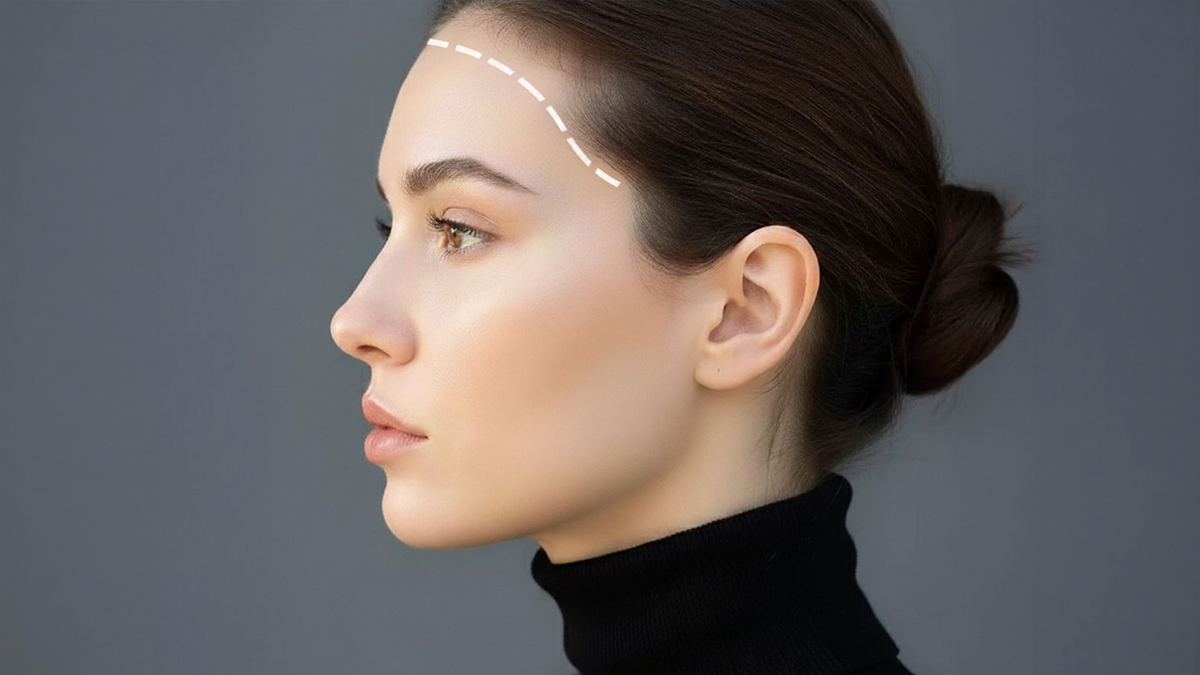
Advancement or grafts · anaesthetic · decided on laxity
In the surgical route, an incision follows your existing hairline, the scalp is released and advanced forward, a strip of forehead skin is removed and the wound closed — usually with a trichophytic technique, so hair grows up through the scar line and softens it. The hairline moves in one operation, typically by a couple of centimetres, and the result is there once the swelling settles. In the graft route, follicular units are placed in front of the existing line instead: no incision, no scar, and a result that arrives over nine to twelve months.
A naturally high forehead with stable hair and a scalp loose enough to advance. Predominantly women. One operation, immediate result.
Anyone whose hairline is high because of pattern loss or traction, and anyone unwilling to accept a scar line. Quoted per case. Neither route sits inside our published hair transplant packages, which are shown below for context only.
Hair Transplant Specialist
Sefa Yaşar graduated from the First and Emergency Aid (Paramedic) Program at Beykent University. He began his healthcare career as an emergency department nurse and has been working in the field of hair transplantation since 2018. He has experience in pre-operative preparation, hair transplant procedures, and patient follow-up.
Education
Istanbul performed 1,020,000 operations in 2023, and the overwhelming majority were transplants rather than scalp advancement. Ask how many surgical lowerings they perform a year , and ask to see the scar line at twelve months rather than only the front view.
.png)
Theatres, recovery and aftercare in the same building, not a subcontracted hospital.
.png)
1,020,000 international operations were performed in Turkey in 2023. Volume is the honest advantage.
.png)
Lower operating costs, not lower standards. The same procedure runs £3,000–£10,000 in the UK.
.png)
We perform both routes, so the recommendation is not decided by what we happen to offer.
.png)
English, Italian, Spanish and French. The plan and the aftercare explained in your own language.
.png)
Ask what happens when the transplanted hair falls out. It will, and it is normal.
Surgical advancement and graft-built hairlines share a name but little else.
A hairline that hasn't moved suits surgery; a receding one usually doesn't.
Scalp mobility, measured in person, caps any surgical advancement.
Hair is encouraged to grow through the incision line to soften it.
Single hairs build an irregular line that matures over nine to twelve months.
Many surgical patients later add grafts along the closure.
Two different operations share one name. These answers help you understand which hairline lowering route fits you.
Hairline lowering describes two different procedures that reduce forehead height. Surgical hairline lowering, also called forehead reduction, moves your existing hairline forward in one operation. Graft-based hairline lowering builds a new hairline in front of the old one using hair transplantation, with results developing over nine to twelve months.
Surgery makes an incision along the hairline, advances the scalp and removes a strip of forehead skin, giving an immediate change and a fine scar. The graft route places single hairs ahead of the existing line, leaves no incision scar and uses donor hair, but takes up to a year to show.
Surgical hairline lowering suits people with a naturally high hairline that has been stable for years and a scalp loose enough to slide forward. It is mostly chosen by women. Scalp laxity is measured by hand at the assessment, and it decides how far the hairline can safely move.
If the graft route is the one your case suits, the technique used to place those hairs is the next decision. Those pages are below.
Personalised Care, Just for You
Send photographs of your hairline from the front and both sides, hair pulled back, and tell us whether it has moved in the last five years. A surgeon replies with which route your case suits, how far the line could realistically come down, what it costs with hotel and transfers included, and how long it takes. Including when the honest answer is grafts rather than surgery, or waiting a year first. No obligation, no cost.
Find Out Which Route
© 2026 Natural Clinic. All rights reserved.